Access All Areas: Exploring the Tay Country by Wheelchair
Leading accessibility travel writer Carrie-Ann Lightley talks to us about a recent trip to Scotland's Tay County, where she encountered woodland accommodation, Highland coos and a wonderful exhibition of art and design by disabled people

Six months back we spoke to Carrie-Ann Lightley, one of the UK’s leading disabled travel writers and accessibility consultants, about her trip to Dundee to attend the second Scotland's Tay County Tourism Conference. At the event, she spoke about her lived experience as a wheelchair user and presented ways in which tourist destinations could improve inclusivity for disabled travellers.
As well as taking part in the conference, Lightley also took some time to squeeze in a visit to Dundee’s most popular visitor attraction: the V&A Dundee. She had a fine time at the Kengo Kuma-designed museum. Her one regret, however, is that her trip was too early to take in V&A Dundee’s major new Design and Disability exhibition, which wasn’t opening till June. “I timed my trip slightly wrong,” she said back in March, “but I’m already wondering if I can arrange a return visit.”
It turns out she got her wish. Lightley recently had the opportunity to return for a longer visit to Scotland’s Tay Country to experience some attractions across the wider region, and she made sure to include a return to V&A Dundee. First though, Lightley made her way up from her home in the Lake District to her main base for the trip: Forbes of Kingennie, a country resort in Angus, seven miles from Dundee.
Lightley had never visited Forbes of Kingennie before, but she says she immediately got “Center Parcs vibes”. She was staying in one of the site’s Escape Pods, individual cabins situated within woodland. “It’s shaped like a caravan with grassed turf on the roof, and it’s wooden all around,"
says Lightley.
The particular Escape Pod she stayed in is named Sòlas Retreat. It’s Forbes of Kingennie’s only cabin dedicated to accessibility. “My first impression on entering the unit was that they’d clearly done a lot to try and make it inclusive to different needs,” says Lightley. “The thing that stood out the most is that they had a ceiling track hoist.” The hoist’s purpose is to help people who aren’t able to transfer out of their wheelchair into a chair, bed or shower, and what made this hoist unique is that the track runs through the entire unit. “It goes from the bed- room through the hallway into the living and kitchen area and into the bathroom. So it’s very easy to move around and use independently.”
This isn’t a facility that Lightley requires herself, but she knows how important it is for people who do need it, and how rare it is to find it in holiday accommodation. There isn’t a single hotel in Scotland with one, she tells me, and to find one like this in a self-catering accommodation is also incredibly uncommon.
A lot of thought has clearly been put into Sòlas Retreat’s setup. Lightley used her manual wheelchair on this trip and managed to manoeuvre around the snug pod, but she reckons there might not be enough space for some powered wheelchair users because of the lack of turning circle space.
The first stop on Lightley’s trip was Dundee Science Centre. “It’s definitely more aimed at children,” she says of the venue, but she was impressed by their access provisions. “Considering they’re a small charity, they’re working really hard to make it inclusive.” Lightley was particularly impressed that they had a Changing Places toilet facility. “It’s basically a more high-spec accessible toilet. It’s a very large space, it has a ceiling track hoist and it has an adult-size changing bench. So again, for somebody who can’t independently transfer out their chair and needs support with toileting, it’s so important.”
Despite being so essential, this is another amenity she doesn’t see in enough public spaces. “Many towns and cities don’t have them at all. Like where I live, in Kendall, there’s one, but it’s on the outskirts. So if you’re in the centre of town and you need that facility to go to the toilet, you’re kind of stuck.” The Science Centre, by contrast, is close to the centre of Dundee, and crucially, entry is free. “You don’t have to have a ticket to go into the Science Centre. So anybody who needs that kind of facility in Dundee, whether they’re visiting from somewhere else or whether they’re local, they can go and use it.”
Lightley’s trip also took her further afield into Scotland's Tay County, up towards Newton Farm, near Forfar. The farm is very much a visitor destination – they offer guided visits and have a four-star bed-and-breakfast on site – but tourism isn’t the guiding principle behind the project. Everything is led by what is happening on the farm, what the animals need, and the animals’ natural environment. “I was so impressed when Lou [Nicoll], the owner and operator of the farm, said to me, ‘I will never tether an animal so that somebody can come along and pet it. We are not a petting zoo.’” Despite being a fully authentic farm experience, there was still plenty of animal interaction involved. “We got to groom Highland cows. We got to feed alpaca and goats and sheep and say hello to all of these animals. And we had one of the farm dogs, a Labrador called Oban, who literally followed us around all day, which was also wonderful.”
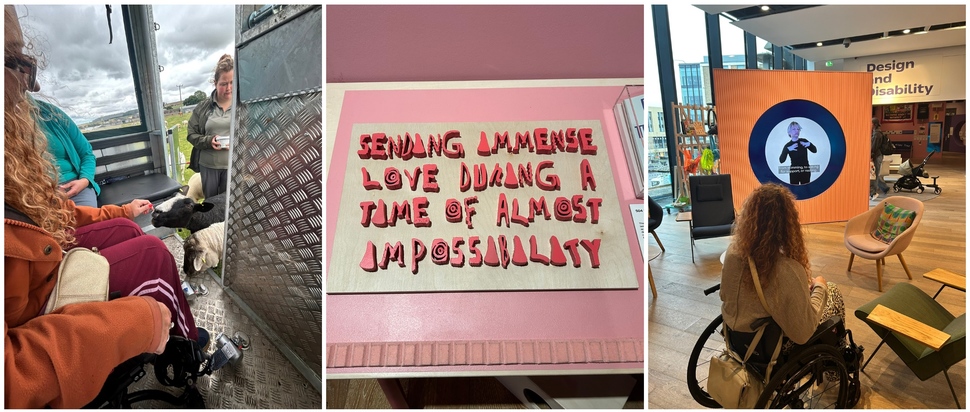
Working farms, by their very nature, aren’t particularly accessible, though, what with their gates, machinery, uneven fields, and, especially when it has been raining for a few days, as it had been on Lightley’s trip, lots of mud. It’s not exactly the kind of environment that’s easy to manoeuvre for wheelchair users, but Nicoll and her team have a novel solution: they’ve adapted a trailer.
“I’ve never experienced anything like that before,” explains Lightley. “Basically, the trailer hooks onto the back of a Land Rover. It has a ramp that folds down that I was able to go up onto, and then there are tie-down restraints for a wheelchair.”
Lightley explains that the trailer came to be because of a visitor request. “The farm had someone contact them who was a wheelchair user who really wanted to come and experience the farm, but they didn’t have any kind of powered mobility device or any way that they could physically get around on the tours that would be compatible with the terrain. So Lou and her family decided to look into it and see what they could do, and this is the result. And it’s opened up these wonderful experiences to so many people.”
Newton Farm was clearly one of Lightley’s trip highlights, as was the chance to finally see V&A Dundee’s Design and Disability exhibition.
The first thing she was confronted with when she entered the exhibition was a piece of design she recognised: The Disability Pride Flag. “Instantly that made me feel, OK, this is where our community is,” she recalls. Right next to the flag were some T-shirts with various slogans from the disability movement over the years. “One of them was a 90s disability rights activist slogan that ultimately led to the development of the Disability Discrimination Act in 1995, and us all getting our rights.” That slogan was the punchy ‘Piss on pity.’ “I think says everything about this exhibition,” says Lightley.
“Seeing those two pieces of design together, the Pride Flag and that slogan in this mainstream, prestigious space. There’s a real power to that.”
Another piece that moved Lightley deeply was Yasmeen Fathima Thantrey’s u taken ur tablets? It’s a conceptual piece that takes the form of a long banner that loops and hangs across the gallery ceiling, on which Thantrey has printed her year’s worth of medications prescribed from the NHS app. “It’s reams and reams and reams and reams,” says Lightley. “The idea is to show people who are outside of this world of chronic illness that this is the reality. This is a part of disability that doesn’t often get seen or spoken about. I’ve had some really challenging health times over the last 12 months, so I just really identified with that piece.”
The exhibition lets people with disabilities feel seen and engage with artists with similar lived experiences. But it’s also a show that should be essential viewing for non-disabled people too. “I repeated this to my friend several times,” says Lightley. “I said, ‘I love that non-disabled people are coming in here and spending time in this space and learning about the richness and the broadness and the celebrations and the challenges of disability. That this show is on in this mainstream space where adults and children, everybody of all varieties, are coming and learning more. I absolutely love that.”
Dundee Science Centre, 14 Greenmarket, Dundee DD1 4QB
Newton Farm Holidays & Tours, Newton of Fothringham Farm, Inverarity, Forfar DD8 2JU
Forbes of Kingennie Country Resort, Forbes of Kingennie Dr, Dundee DD5 3RD
V&A Dundee, 1 Riverside Esplanade, Dundee DD1 4EZ
Find out more about accessible holidays in Scotland at visitscotland.com/accessible and at AccessAble accessable.co.uk/scotland-s-tay-country
Read Carrie-Ann Lightley's travel writing at carrieannlightley.com