Travel blogger Carrie-Ann Lightley discusses inclusive travel
Travel writer and content creator Carrie-Ann Lightley is one of the UK's leading voices in accessible travel. She details a recent trip to Dundee as a wheelchair user, and tells us about her visit to the city's V&A museum

Being able to travel, to escape your daily routine for a few hours, days or weeks and explore somewhere new, is one of the greatest gifts we have as human beings. But it’s not always as simple as packing your toothbrush and heading for the door. Every trip takes planning, and if you have a disability, the logistics of getting to your destination become significantly more complicated.
One person who’s been striving to make travel less daunting for disabled people is Carrie-Ann Lightley. She’s a wheelchair user who loves to expand her horizons through travel, and for well over a decade, she’s been sharing her travel experiences on her blog and across social media with the aim of inspiring other disabled people to get out and do similar.
“Influencing somebody to travel and discover the possibilities that are out there, it’s one of the best feelings,” Lightley tells me over video call from her home in Kendal in the Lake District. “To help disabled people imagine themselves in a place where they might have thought previously wasn't inclusive for them, that’s really remained a driving force of what I do.”
Lightley recently shared her experience of inclusive tourism as one of the speakers at Scotland’s Tay Country Tourism Conference (Tay Country includes Perthshire, Fife, Angus and Dundee), which took place in Dundee, Scotland's sunniest city on the banks of the river Tay, on 3 March. This inaugural event was a huge success. “It was great to see such a strong turnout and genuine interest in the conversation around inclusive tourism,” says Lightley. “It means a lot to hear that my session made people think about how they present their businesses and facilities. If it helps build a bit more confidence around accessibility, then that is exactly the outcome I hoped for.”
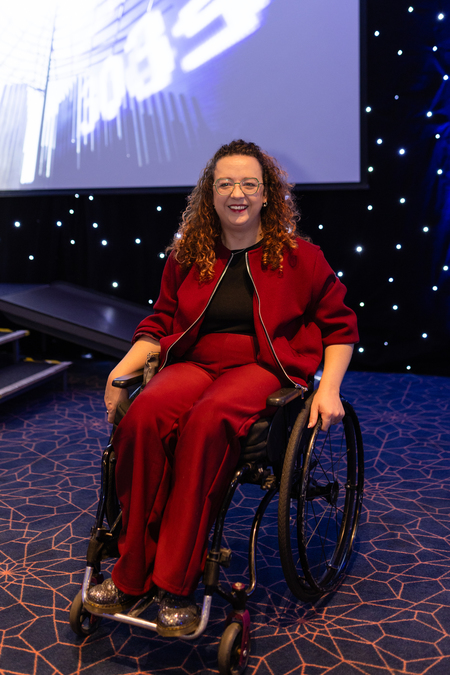
Carrie-Ann Lightley at the first Tay Country Tourism Conference in Dundee | photo: Lydia Smith
With that talk fresh in her mind, it was an opportune time to ask her about that trip and find out how accessible she found it. She starts by explaining that her transport, which involved two train journeys – one from Oxenholme to Haymarket in Edinburgh, and then one from Haymarket to Dundee – was actually a bit boring. For her, that was a good thing. “I always say that for a disabled traveller, the best kind of journeys are mundane ones where everything just flows as it should do.”
This didn’t stop her from having a bit of trepidation. “I have travelled solo by train a lot, and it’s always something I've really enjoyed because it gives me that sense of independence and achievement, but I hadn’t done it for a while.” The views she experienced certainly helped calm her nerves, though. “Oh, goodness, crossing over the Forth Rail Bridge! Out of nowhere, there was this great big blue sky reflecting on the water. I really made me pause and just take it all in.”
To make sure she could get on and off the train, bring a decent-sized bag with her, and to help navigate between platforms at train changes, Lightley used the Passenger Assistance app, which meant there was an assistant waiting for her at each junction of the journey. All of Lightley’s assistance turned up on time, and the booking process was relatively straightforward. Despite taking two different journeys with different operators, her assistants could all be booked in one go.
She stayed in Dundee overnight at the Apex City Quay Hotel & Spa, and again, things went smoothly. “The room itself had lots of circulation and turning space, a really comfy and huge bed, and just lots of little nice touches.” The Apex’s trump card, though, was the bathroom. “I really love that I had a choice of either a wet room shower or a bathtub that has been designed to be shallower and easier to get out of. Now, for a lot of disabled travellers, a wheel-in shower is the gold standard; that's what they need. For me, personally, the bathtub was great for my muscles; I have Cerebral Palsy, and it helped with pain from travelling.”
She wishes that more travel spaces realised that disabilities are individual; it's not one size fits all. “We all have very different needs. Even two people having the same condition would have very different requirements, ultimately. So the fact that the Apex offered a choice, I thought, was really powerful.”
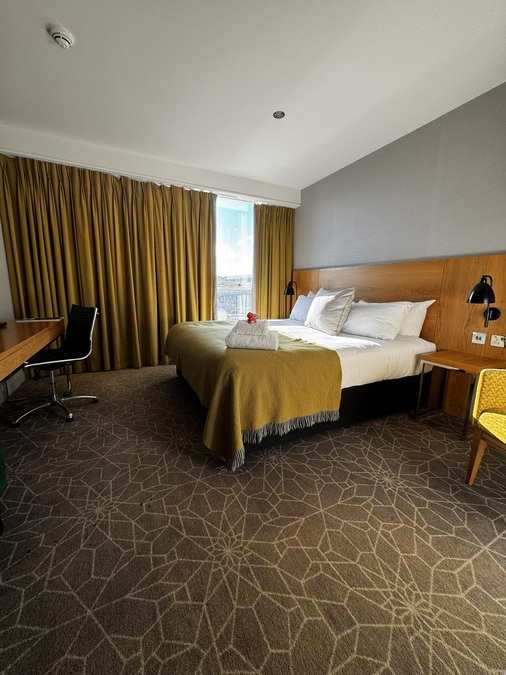
Carrie-Ann Lightley's room at the Apex City Quay Hotel & Spa in Dundee, courtesy of Carrie-Ann Lightley
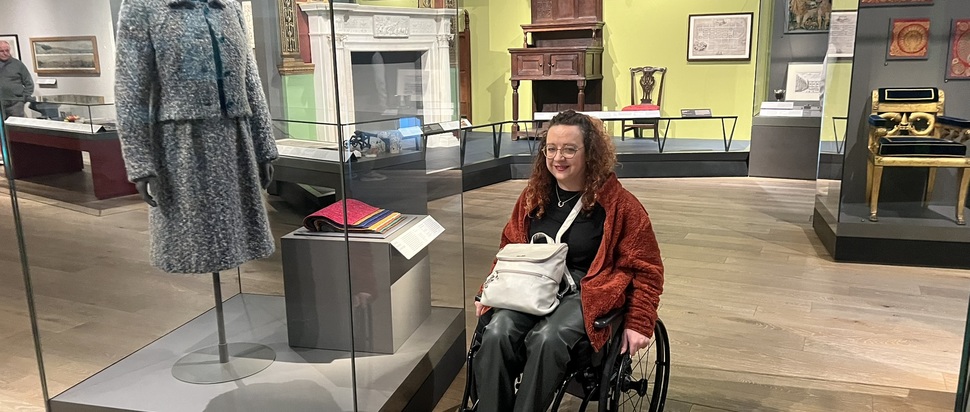
While in Dundee, the ‘City of Discovery’ and the UK’s first UNESCO City of Design, Lightley also squeezed in a trip to the V&A Dundee. As one might expect from a public building built in the last decade, the Kengo Kuma-designed masterpiece has a wide range of accessibility features. What did surprise her, though, was that the space's feeling of inclusivity was not just from a disability perspective. “Often with galleries, they can feel a little bit stuffy,” she explains. “Sometimes they can feel a little bit like they're aiming at a particular clientele, but what I loved about V&A Dundee is that throughout my visit, there was a sense of fun. There were families all over the place, and there were little stations for children to draw. I also noticed several other disabled visitors. It really gave me the vibe that the art here is for everyone to enjoy.”
Her only regret is that she was too early for V&A Dundee’s Design and Disability exhibition, which begins on 4 June. “I timed my trip slightly wrong, I guess, but I'm already wondering if I can arrange a return visit.” That a major design and disability exhibition is going to be on at all speaks to the museum's forward-thinking attitude, she reckons. “I think that the fact that they're showing that exhibition and that it's completely free entry for everyone, gives a commitment to inclusivity and to telling disabled people's stories too.”
Find out more about accessible holidays in Scotland at visitscotland.com
Read Lightley's travel writing at carrieannlightley.com