Breaking the Silence: Money and the Edinburgh Fringe
We talk to Kie Carson, Tamsyn Kelly, Selina Mosinski, Ahir Shah and Jack Skipper about their journey to this year's Fringe and the unspoken taboo beneath it all – money

Money may well be one of the last taboos. The reasons are tangled: as perhaps the most significant measure of success, it's judged as bad taste or somehow indelicate to talk about. The silence means there's plenty of space for shame to flourish, while the convention that it's gauche or even vulgar to talk about money ultimately serves only the privileged few. The current code for money issues is ‘the cost of living crisis,’ a phrase which shares in the tendency to euphemise
Ahir Shah's new show Golden, the follow-up to his huge hit Ends, tackles money as a central theme, exploring the effects of growing up under the shadow of debt. He argues we should reclaim vulgarity, saying, "I would love it if it were vulgar to talk about money – I mean that in the strict sense of vulgar as the commonplace thing that everyone's doing – the issue is actually that it's not that: money is rarefied in the most horrid way and I think that we'd all be a lot emotionally and socially better off if we were talking about it."
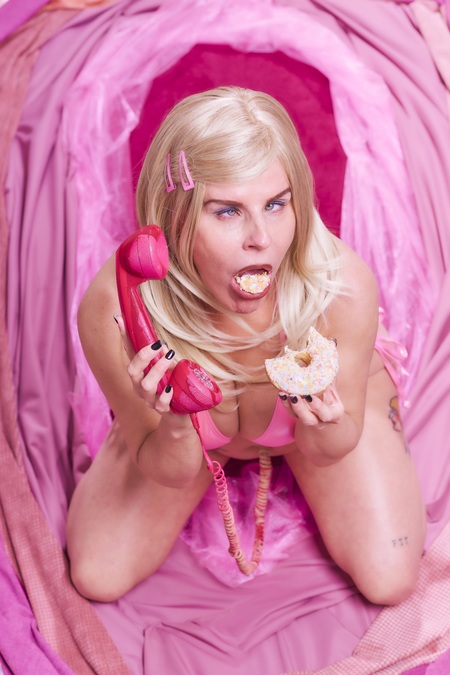
Tamsyn Kelly's new show, Rat's Ass, also foregrounds money and the compromises she's had to make to stay afloat. She has a characteristically forthright take on the ideological function of that 'rarified' quality: "People with money are embarrassed because it's embarrassing to have so much when other people don't have enough, and their discomfort is why working-class people aren't allowed to talk about money."
In the face of this unspoken prohibition, Kelly argues the burden falls largely on the working class to do the thorny work of articulating financial realities, and she urges middle-class and upper-class comics to do more, as that "would help enable conversations or help enable work from working class comics... It's kind of on them to make the conversation less taboo because we're easily dismissed" (with the kneejerk calls to go and get a job and so on). She mentions 2024's Olga Koch Comes From Money as one notable attempt.

Tamsyn Kelly. Credit: Rebecca Need-Menear
In the show, Kelly grapples with her use of the OnlyFans platform as a means of supplementing her income from comedy, something she feels conflicted about: "'Empowering' was the word that came up a lot in people's responses," she says, "but of course it's not empowering – I'm being valued for something that I believe to have little value over something that I put a lot of effort into." By most measures her career is flourishing, and she's one of the success stories of the working-class showcase, Best in Class, but she's still not making enough to make ends meet.
Selina Mosinski, who's at the Fringe with her debut, Puss in Boots – A Working Class Fairy Tale, echoes this sense of a mismatch between external measures of success and the reality of life without a safety net. As viral icon Charity Shop Sue, and with appearances in hit show Alma's Not Normal, she describes people's surprise when she tells them "I've only been earning full time creatively for the last three or four years; I don't own a house, I haven't got a car, I've not had kids." But she's clear that "finding a group of people that really get you and that can see your creativity is worth its weight in gold – it is worth more than money."
While she's palpably excited about Edinburgh as the catalyst to push herself creatively and the chance to see new work, she's troubled by the fact that she's tacitly supporting an exclusionary project, because the Fringe is "inaccessible for certain demographics." And homogenous audiences will affect her directly: "I know this audience is predominantly middle-class and a lot of my work caters more to either a queer audience or a working-class audience."
There's also the inevitable, gnawing anxiety about the cost of it all, something Kie Carson, a new comedian testifies to. He says, "This year I’ve got £5000 worth of credit card debt: accommodation, Fringe registration fees, flyers, posters, props. That is a lot of up-front cost. And the shows I’m taking are on the Free Fringe. I’m flyering the shows myself. I designed the posters myself. My partner took my headshots using a mate’s green screen. I've paid for no PR. There is a constant pit in my stomach about money. I’m constantly working and I’m constantly skint." That being said, Carson says, "my starving artist era is actually quite fun in comparison to my simply starving era." He continues, "To be able to laugh about it with 20 people in a karaoke booth on Cowgate is a bit of privilege I can take back."
Selina Mosinksi. Credit: Tom Platinum Morley
Jack Skipper, carpet fitter-turned-TikTok-star, is returning to Edinburgh with his Comedy Award-nominated debut show, Skint, and he's pretty dispassionate about the Fringe experience: "I'm just keeping it as simple as I can," he says, "this year I'll double down and be more myself – I'm not going to tailor myself to any idea of an Edinburgh audience." He reckons "ignorance is bliss" when it comes to industry machinations; determined not to pay any heed to the whispering about "who's who."
Skipper sees authenticity as key to his work, and he is clearly perturbed by the distorting effects of fame and power. While class is a significant aspect of the experience of financial struggle for many, it doesn't really resonate for him. "I've only been made aware of the whole class thing since doing comedy," he says, "reviewers start calling you working-class and then you slowly adapt – I started mentioning it in my own bios and I don't know why I'm doing it to be honest." He dislikes the pressure to be "representative" and says, "I'm from a very humble background but I think working class is a blurred concept: what does it actually mean to be working class? Is it socioeconomics, is it your accent, is it your heritage?" Whatever the case, Skipper laughs, he's "a thoroughbred."
Class also doesn't figure in Shah's experience of money troubles, and he suggests that "the immigrant community often sits slightly outside of the traditional class structures." He wonders, too, if he may have arrived at a different place from the generalised anxiety about crassness in talking about money: "My grandparents wanted subsequent generations to do well. Now that I am doing well, I don't feel any shame or reticence – that's part of what their sacrifices were for – to deny my success is to deny those sacrifices." Although he does feel some reticence – and describes dancing around the subject of income with comedian friend, Pierre Novellie, who grew up in South Africa, only able to spit it out once Novellie had identified their shared 'colonial mindset' of shame and silence, thus releasing the inhibition. Shah quotes Tom Wambsgans from Succession: "All my life I've been thinking a little bit about money" – a speech where the character's honesty about his preoccupation with money is symbolic of real vulnerability. It helps us to see that the idea that you're ‘tight’ or ‘grasping’ in thinking about money is arguably a pathology largely driven by class or 'colonial' mandates.
Like Tamsyn Kelly, for whom "there is no bigger conversation," Shah is passionate about "breaking the silence" about money. He's resolved to fully use his platform and the paradoxical freedom of talking to a room full of strangers – a freedom which extends to the audience, whose habitual defences might be lowered. As Shah notes; "Whatever your colour or culture, whatever you sound like, wherever you live, this might be happening to a dozen families on your road and they might look different from you, they might sound different from you, they might be giving an outward show of things going well and you just don't know if no one talks about it. Instead, everyone just feels imperially alone." Hopefully he's right, and stand-ups talking about money will allow us all to feel a little less alone.
Kie Carson: Silly & Surviving, The Three Sisters (Wee Room), 6-30 Aug; 2 Boys 1 Bucket, The Raging Bull, 6-30 Aug; The Comedy Chaos Gameshow, West Nic Records, 6-30 Aug
Tamsyn Kelly: Rat's Ass, Monkey Barrel Comedy (Cabaret Voltaire), 7-30 Aug
Selina Mosinski: Puss in Boots – A Working Class Fairy Tale, Pleasance Dome, 7-30 Aug
Jack Skipper: Skint, Pleasance Courtyard, 5-16 Aug
Ahir Shah: Golden, Pleasance Courtyard, 6-30 Aug