Game On Glasgow: The Commonwealth Games return to a changing city
It’s been a long 12 years. We take a look at the legacy of the 2014 Commonwealth Games and consider what the 2026 Games may offer Glasgow and its communities, amid trying times
The 2014 Commonwealth Games logo is well-stamped into collective Glaswegian memory: blue, yellow and red lines circled around an optimistically crisp green G. An anthropomorphic thistle appeared in its proud stance often – a hand on each hip and a wide smile. Cash wasn’t essentially obsolete and so the commemorative 50p – a cyclist and runner on one side, Queen Elizabeth II on the other – was a nice bit of marketing. For 2026, many of us expected at least a little déjà vu, most likely in the form of a friendly thistle or two. But, as we edge closer to the forthcoming Commonwealth Games, it’s clear that Glasgow is a different city than it was in 2014.
In 2024, it was announced that Glasgow would again host the Commonwealth Games, after the Australian state of Victoria suddenly withdrew as hosts in 2023. The city, however, was very clear: with financial limitations, 2026 would be a scaled-back iteration of the Games. While the 2014 Games featured 17 sports, the 2026 Games features only ten. A lot has happened in those 12 years: the Scottish Independence Referendum, Brexit, an ill-fated austerity programme headed by the Tories, a pandemic, and the rise of the far-right, all amid the UK’s complicity in genocide and international conflict. Such events shape and re-shape a city (and a nation).
The 2014 Games are largely considered a success. More tourism, more sports, more housing (see Athletes’ Village in Dalmarnock). Significantly, the 2014 Games cemented Glasgow as an international events host. Events such as COP 26 in 2021 and the UCI Cycling World Championships in 2023 continue to fill the city’s calendar, regardless of the countless travel disruptions and jaw clenching they may bring.
It was most certainly difficult to ignore the 2014 Games, with spectacle-like opening and closing ceremonies, and countless events around the city. Much to the misery of then-school pupils (myself included), the Games had an all too firm footing in the school curriculum of that summer term, with Commonwealth-inspired PE tournaments and sport-themed French lessons. Unlike the Independence Referendum, the Commonwealth Games had a political neutrality which was likely somewhat easier to work into lesson plans. It was undeniably easier to stomach than the mass propaganda of the 2012 London Olympics.
This year, the Glasgow 2026 Festival Fund has given £1.25 million in funding to community groups across the city, to mark the Commonwealth Games. Recipients include Rumpus Room, Sunny Cycles, and Garnethill Multicultural Centre, amongst many others. Radical Glasgow Tours – also a recipient of the Festival Fund – are offering a number of tours which explore Glasgow’s relationship with the Commonwealth and the role of sport in shaping the city over the years. “At its inception the British Empire Games, as the name suggests, was an explicit imperial project, started in the waning days of the Empire,” say Radical Glasgow Tours. “We think it's important to highlight how the violence of British Imperialism shaped and continues to shape the world and to speak honestly about the ways in which the Commonwealth Games have their history rooted in that Empire but also present an opportunity to learn from internationalist and anti-imperialists of the past.” From Black British Communist Boxer Len Johnson fighting at Ibrox in the 1920s, to the planned anti-fascist Olympiad in Barcelona in 1936, to the present day sporting boycott of Israel, Radical Glasgow Tours hope to offer both Glaswegian locals and tourists the opportunity to learn about how sport can play a part in wider socio-political movements.
“Glasgow has always been a hotbed of community organising and the last ten years has seen lots of brilliant new organisations contributing to the movement in our city, from Mothers Against Genocide, to the Housing Struggle Archive, Living Rent to Rumpus Room,” say Radical Glasgow Tours. In Glasgow, ‘radical’ culture is far from relegated to the margins – we’re a city built on it (as well as mass colonial wealth). In the mainstream, Glasgow’s radical past and present received international attention with Kenmure Street: first, with the protest in 2021; then, again, with Felipe Bustos Sierra’s Everybody to Kenmure Street in 2026. The city’s radical tendencies are rightfully under the global spotlight.
But Glasgow’s Games are no stranger to such efforts. SNP Councillor Graham Campbell is a political campaigner and community activist, who led Flag Up Scotland Jamaica, a twinning exchange project formed during the 2014 Commonwealth Games; such projects sought to acknowledge and reckon with Scotland’s colonial history. “The 2014 Commonwealth Games, the run up to it – especially the two years before – was all about whether Glasgow would have a cultural celebration which would actually reflect the Commonwealth, the world that was coming to us,” he says. As the Second City of the Empire, Glasgow’s relationship with the Commonwealth is particularly pertinent, directly profiting from colonial endeavours. With Scottish exceptionalism – the notion that Scotland is less racist than the rest of the UK – in the mix, the Games demanded a truthful confrontation with our history. Throughout the 2014 Games, gatherings in the Briggait, the Glasgow Chambers of Commerce, and the African & Caribbean Centre sought to create space for critical engagement with the city’s past.
“We’ve become a much more diverse and multicultural society, more than we were back in 2014, because more people from more countries have come to live here that never had a connection with Scotland,” says Councillor Campbell. Our approach to the 2026 Games – and beyond – ought to honour such diversity. Looking ahead to this summer, Councillor Campbell recognises that we must continue to take responsibility for both our past and present. “I'd like to see Glasgow and Scotland play its role in the Commonwealth, speaking up for human rights, speaking up for democracy... speaking up for loss and damage, as we've done before at COP.”
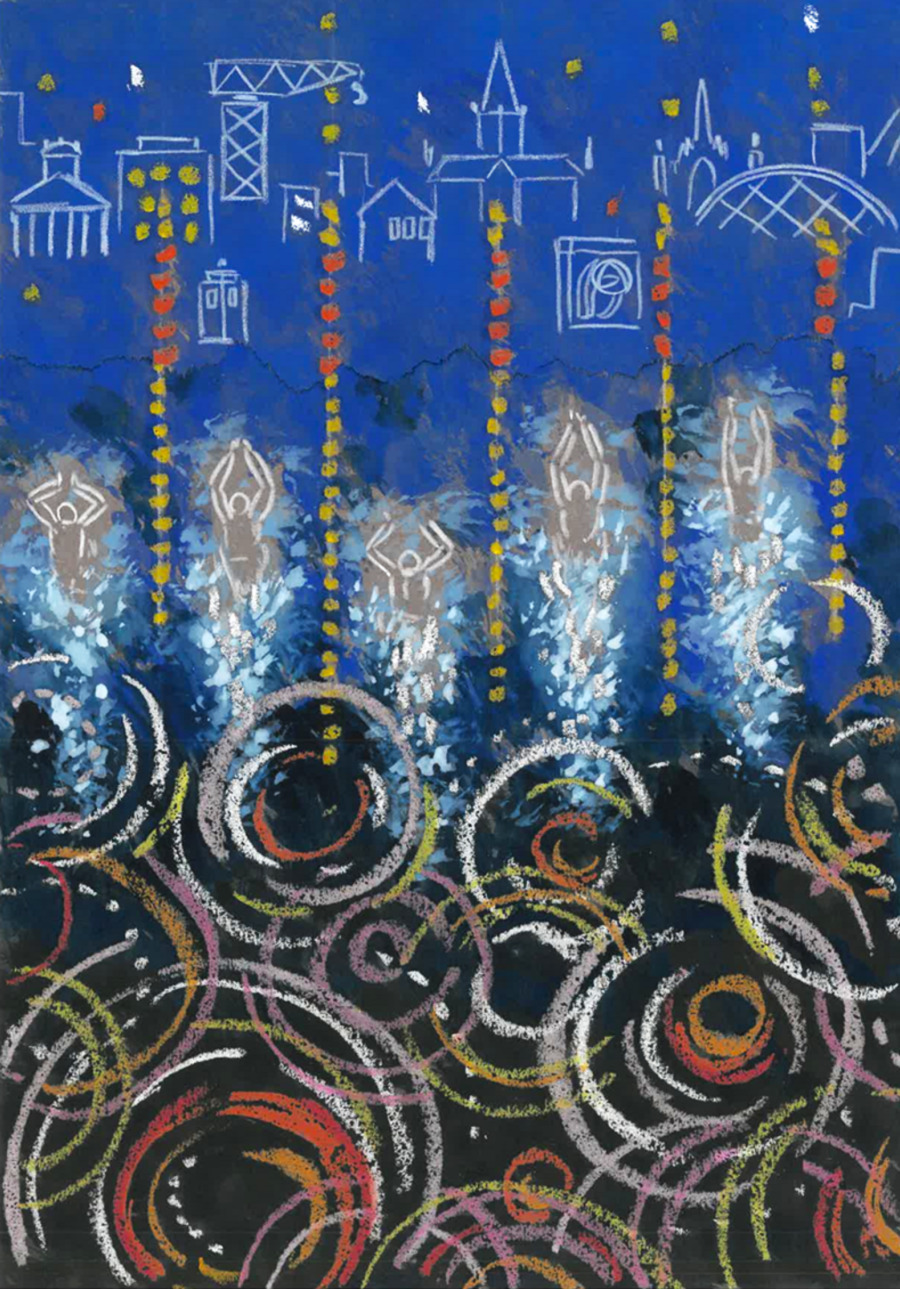
Illustration by Martin Stubbington
Only months after the 2014 Games, the nation voted against Scottish Independence. In memory, the events sit somewhat disparately, as if years apart; a combination of puberty and political disillusionment likely has that effect. That summer was bright and busy; that autumn was grey, disappointing. As Stuart Whigham argues in Scottish Affairs, back in 2014, it was assumed that the success of the Games could bolster the Yes vote; in hindsight, it was largely agreed that the Games had little impact on the outcome of the Referendum.
The Yes campaign prided itself on a Scotland which welcomed the world; separate from the UK, Scotland could adopt a more open immigration policy. At the time, it was difficult to conceive just how much immigration would become an utter obsession for British politics; at the time, it was difficult to conceive that racist riots would become an almost-annual event each summer. While Councillor Campbell notes his pride at the thousands who attended June’s anti-racist rally in Glasgow, the riots continue to loom large, particularly for communities of colour.
A quadrennial multi-sport event won’t save us from the rise of the far right, nor will it bring about a socialist revolution. “A capitalist packaging of sport as the celebration of the individual rather than an expression of the collective has stripped us of the ability to use sport to foster collaborative work and to build community through it,” say Radical Glasgow Tours. “But these games and the infrastructure for them, as well as the festival around them can be an opportunity to bring sport into our collective lives.” Whether it’s exchanging a panting ‘hello’ to another half-hearted jogger or catching up with teammates at a weekly five-a-side game, incorporating sport into our daily lives can offer small – but meaningful – moments of connection.
Community, however, relies on public spaces which do not merely permit but nurture these everyday connections. Glasgow, for all its brilliance, is currently lacking in that department. In the Southside, the Queen’s Park Glasshouse is under threat. In the East End, the People’s Palace remains closed, with no clarity on its reopening or long-term funding. In the city centre, the CCA’s doors remain padlocked. Increasingly, Glasgow is looking a little less tourist-friendly, with both Glasgow Central and the Mackintosh Building badly damaged by fires. No city is immune from budget cuts, particularly after a pandemic and a decade of austerity-led policies. But Glasgow seems to continue to sell itself – both at home and away – on the basis of the culture and community it is putting up for sale. It is an undeniably grim state of affairs for those of us who live here.
It is easy, then, to question why Glasgow is hosting this year’s Commonwealth Games in the first place. Admittedly, appearances can be deceiving. “There's been no public money spent by Glasgow taxpayers towards the cost of these Commonwealth Games,” says Councillor Campbell. With funding from the Commonwealth Games Federation, as well as government support, this year’s Games are allegedly operating on a highly cost-effective model. “And because we've already got the venues, we've already got the routes, we've already got everything in place, it will not cost us any money. It will bring, of course, some economic benefit.” Here’s hoping that the communities who make Glasgow so great see some of that good return.
For better or for worse, we’re not in 2014 anymore. 2026, HWFG. At the very least, Glasgow deserves a good time – maybe, just maybe, the Commonwealth Games can offer us that.
The 2026 Commonwealth Games take place at venues across Glasgow, 23 Jul-2 Aug