Walking Away: Johnnie Walker and Kilmarnock
Whisky is tied to place – but what happens when it leaves its roots behind? Kerry McGahan tells the intimately connected stories of one of the world's most famous whiskies, and her home town, Kilmarnock

Recently, while visiting a friend in Valencia, I stumbled upon something surprising. In the neighbourhood of Russafa, there appeared a looming mural of the famed striding man, Johnnie Walker whisky’s iconic symbol, across the side of a brick building. Johnnie Walker’s humble roots are firmly planted a thousand miles away in my hometown of Kilmarnock, East Ayrshire, but it was glaringly apparent that his influence reaches well beyond that of a local hero.
I could not help thinking of the statue residing beside Johnnie Walker’s gravesite back home, which features him standing up straight, differing significantly from that renowned bottling walk pose. So, who exactly is the man striding across this Valencian building?
Early Strides
Johnnie Walker’s global success highlights the power of commercialisation. There is a clear distinction between Johnnie Walker, the brand, and John Walker, the man who began it all from a humble grocer's on King Street. The empire started in 1820 when John’s father died, bestowing him the aforementioned store. Grocers traditionally sold a range of single malts, but John, unsatisfied with this, used his experience as a tea blender to combine them, creating an original whisky blend of his own. In 1852, tragedy struck in the form of a flood, devastating Kilmarnock and destroying the majority of John’s stock. Nevertheless, he persevered.
When John Walker passed away in 1857, his son, Alexander, led the company to soaring new heights. The blend, originally named Walker’s Kilmarnock Whisky, went through several alterations. From Old Highland Whisky to Johnnie Walker Black Label, the company learned to adapt in the name of consumerism. In 1908, Alexander’s sons commissioned painter and illustrator Tom Browne to create the striding man, and from these calculated business efforts, John Walker, the grocer, was nixed. Johnnie Walker, the titan of industry, emerged.
End of an Era
By 1937, the company had outgrown the various cramped Kilmarnock town centre establishments from which it had been operating. They relocated to a plot of land on Hill Street where, following the end of the Second World War, Johnnie Walker was able to begin blending whisky on a significantly larger scale. At this point, Johnnie Walker remained a hometown hero. It was a success story that Kilmarnock could proudly revel in, and wholly emblematic of Ayrshire’s thriving industrial sector.
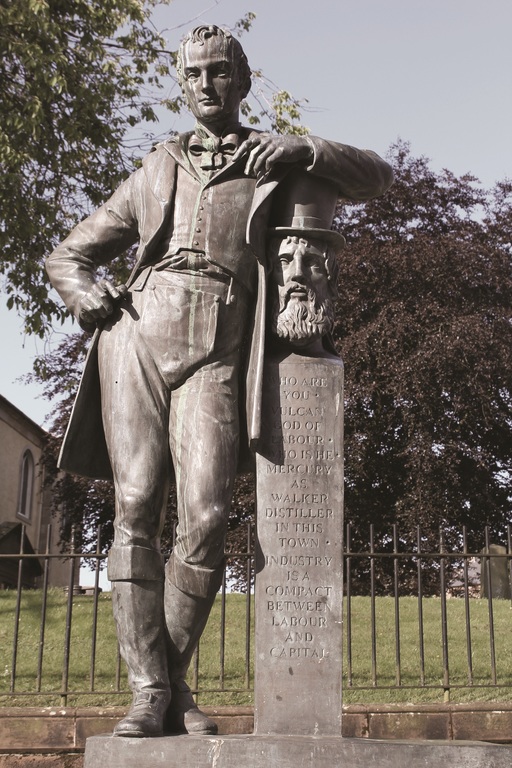
Image: Leslie Barrie.
To the dismay of over 700 workers, the Hill Street plant announced its closure in 2009; the process was finalised by 2012. The news came as a horrible surprise to staff who had dedicated their working lives to the company. All but the senior managers at the plant’s owners, Diageo, had been left in the dark. Rage and injustice rippled through the community. Alex Salmond, the then-First Minister of Scotland, joined a march of 20,000 people through the streets of Kilmarnock, vowing to not let Diageo go quietly.
But Diageo stood firm. Despite a noble fight from trade unions, staff and townspeople alike, the majority of the town's 700 jobs were lost. Of those, 194 continued to work for the company, whilst 434 accepted ‘voluntary’ redundancy packages. In truth, there was no real alternative. The most common option provided was a transfer to Diageo’s Shieldhall Plant in Glasgow. Unfortunately, the early starts and late finishes required at a whisky plant worked poorly in tandem with a commute of over an hour from Kilmarnock to Shieldhall, particularly when the necessary public transport links did not exist.
Closing Doors
In the years since the Hill Street Plant closed its doors, tens of millions of pounds have been poured into the Johnnie Walker visiting experience on Princes Street, Edinburgh. A variety of tour packages exist, ranging from a 90-minute sensory experience of light shows and live performances to sophisticated cask draw tastings and rooftop lunches, and a £450 full-day experience including a trip to Glenkinchie Distillery, the "Lowland Home of Johnnie Walker". Kilmarnock is notably absent from the trail. The smack of betrayal stings.
Nevertheless, there is a marked sentiment of resignation among those residents who dedicated their careers to Johnnie Walker. A Facebook group titled 'Johnnie Walker – Kilmarnock' has over 1,200 members, and reads as a roll-call of nostalgic reminisces and funeral announcements. It is evident that when Johnnie Walker departed, it took an immeasurable amount with it – socially, culturally, and economically. Pensions were lost, and lifelong friendships were tethered as economic pressures took sudden precedence.
Alex Rae, a Kilmarnock resident who formerly worked in spirits supply and blending, spoke to the BBC in 2019, ten years on from the announcement of the closure. In his opinion, it was important to let ‘bygones be bygones’. In other words, get yourself to the job centre and find something new to do. Halfway down John Finnie Street, white lettered graffiti reads ‘Pay Your Leccy’. I ask, haven’t we given enough?
In 1985, Glengarnock Steelworks shut its doors. In 2023, the Aquafil carpet factory closed in Kilbirnie. In the years between, Kilmarnock alone has also seen the closure of Saxone Shoes, Massey Ferguson (makers of combine harvesters), and Glenfield & Kennedy (water valves and fittings specialists). Ayrshire’s industrial hub has been in a state of uncertainty for decades. By expanding the company outside of Kilmarnock, did Johnnie Walker teach us a lesson about persistence and adaptation in the face of adversity? Was it a blessing in disguise?
Should we, as Rae suggests, let it go – be grateful that Scotch whisky expanded outward, rather than inward? That it didn’t fall into disrepair along with the rest of Kilmarnock, eaten alive by poverty, deprivation and governmental failure? After all, with alcohol-related deaths at 22.5 per 100,000 and drug-related hospital deaths at 305 per 100,000, both higher than the national average, I cannot help but understand why Kilmarnock has not been included in the Johnnie Walker heritage trail.
After the Flood
When water gathered in the Fenwick Moors in 1852, swelling the burns that came together to form the Kilmarnock rivers, it would have been easy for John Walker to allow nature to take its course. Instead, he showed remarkable persistence.
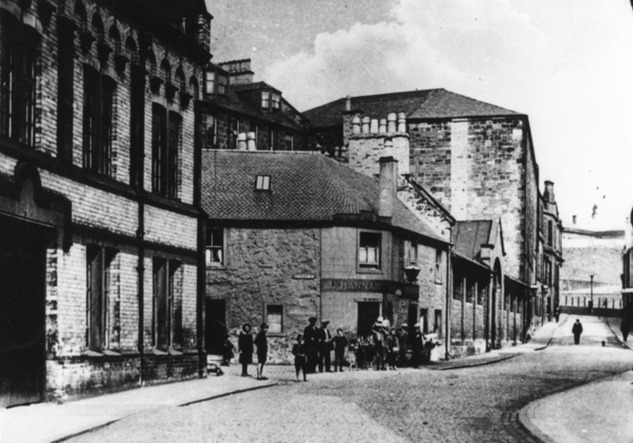
The Strand in Kilmarnock which was the site of the buildings which constituted Johnnie Walker's Whisky bonds. c. 1900. Image: East Ayrshire Council.
Since its days as an industrial powerhouse, Kilmarnock’s reputation has notoriously suffered. Coinciding with the closure of the Hill Street plant was the 2010 television show The Scheme. Following the lives of six families living in the housing estates of Onthank and Knockinlaw, the programme was simultaneously a national success and the nail in Kilmarnock’s proverbial coffin. Albeit exploitative, there is obvious, aforementioned legitimacy to the drug and alcohol-related problems which The Scheme presents. In 2022, over a quarter of the town’s population still lived in some of the country’s most deprived areas.
Based on the current state of affairs, it does feel that a fatalistic viewpoint on the future of Kilmarnock would be the easiest to take. But while looking up at the legendary striding man immortalised by that Valencian graffiti, I felt a swell of pride for my hometown. Ayrshire needs practical change: access to viable employment, quality education, job security, and reliable pensions. The sort of action that requires patience, attention, and investment from local councils and the Scottish government alike.
However, it is easy to forget that people are the most important factor in any town’s success. After all, John Walker began as merely a grocer. A flourishing community and cultural enrichment are vital to economic prosperity. Opportunity, change; we can find them right where we are. Alright, Johnnie Walker marched away. Now, what can be rescued from the flood?
Kerry McGahan is a Glasgow-based writer who was born-and-bred in Kilmarnock, Ayrshire. Her work touches on culture, lifestyle and social inequality from a uniquely Gen Z perspective