Water of Life: Whisky, Alchemy and the Islamic Golden Age
Whisky carries history – perhaps more history than you've really considered. Masa Nazaal looks at the unsung influence of the scientists, scholars and alchemists of the Islamic Golden Age on modern whisky production
Sitting on a stool at Captain's Bar on South College Street in Edinburgh, a row of whiskies lines my eyeline: The Macallan, Glenfiddich, Laphroaig. Each distilled and bottled in Scotland.
A man in the corner of the pub stands, and the room’s constant clatter falls quiet. He begins to sing, lifting a glass of whisky above his head: “Campbeltown Loch, Och Aye! / Campbeltown Loch, I wish ye were whisky! / Ah wid drink ye dry.” The song, popularised by Andy Stewart in the 1960s, is just one of many that fix the spirit in Scotland’s cultural imagination, echoing through pubs as both celebration and ritual. Robert Burns cemented his devotion to the drink in 1786: 'O thou, my muse! guid auld Scotch drink! / Whether thro' wimplin worms thou jink, / Or, richly brown, ream owre the brink, / In glorious faem, / Inspire me'.
This 'richly brown' drink is woven into Scottish culture as a vessel for togetherness as much as for sorrow. However, its story does not begin in Scotland, but further east, in the Islamic world, where the science of distillation was refined long before it travelled, centuries later, into the making of the nation’s signature spirit.
Looking closely at the drink itself, traces of these origins remain. The word 'alcohol' derives from the Arabic kohl, a fine black powder traditionally made by heating minerals until they vaporise and condense again in purified form. Over time, the term came to describe substances produced through similar processes of refinement, like distillation.
What begins as a word opens into something much larger: a history of experimentation, movement, and exchange. To trace it properly, we have to return to the world in which this process first took shape.
The Islamic Golden Age
The Islamic Golden Age unfolded during the medieval period, at a time when Southwestern Asia and North Africa were experiencing an extraordinary expansion of knowledge, culture, invention, philosophy, and art. Experimentation was at the heart of this world, as scholars sought new ways to understand and engage with the natural world. Central to this pursuit was a desire to comprehend the unity of creation, and to connect with God. From this impulse arose numerous fields of knowledge, including alchemy.
Alchemy, in the Islamic context, was both a practical science and a philosophy. Its aim was to transform metallic substances, like iron and copper, into silver or gold. At its core, it was about synthesis, transformation, and the creation of something new. Alchemists sought the elusive (and mythical) 'philosopher’s stone' that would help turn metal into gold and create an elixir of life, yet their work extended beyond metallurgy: it encompassed health, mystical inquiry, and the natural processes of the earth. By experimenting with materials like stones, water, and other natural substances, they attempted to reproduce the processes of creation on an accelerated scale. They did so because they wanted to experience and participate in the divine act of creation, seeking understanding, mastery, and closeness to God.
It was through this culture of experimentation that the process of distillation was refined. The goal was not to produce alcohol, which was prohibited under Islamic law, but to explore transformation and transmutation in matter. From these experiments came scientific methods that endure today. Distillation, as we know it, was formalized by the scholar Jabir ibn Hayyan in the 8th and 9th century, laying the foundation for techniques that would travel across continents and centuries.
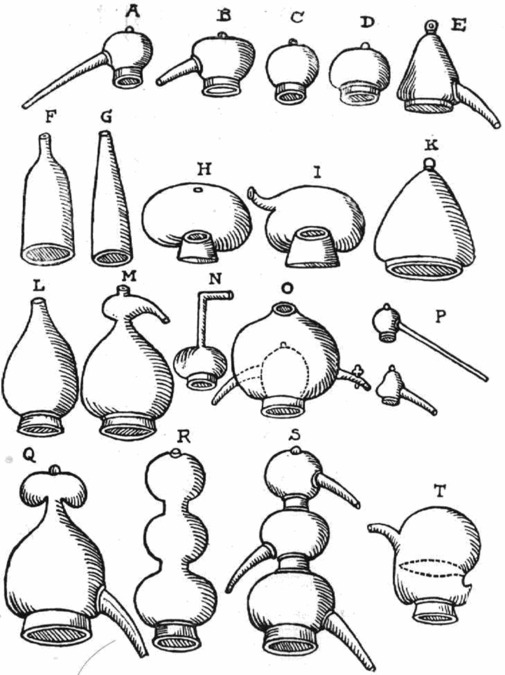
Alembics. Source: Andreas Libavius Alchymia (Public Domain).
The Still, The Scholar, and Distillation
Jabir Ibn Hayyan, a ninth-century scholar of Persian background from Kufa, Iraq, is often called the father of chemistry. It's a title reflecting the immense influence of his work at a time when alchemy and chemistry were closely intertwined. His fascination with transforming metals and materials led him to develop some of the earliest and most important forms of chemical technology. Among his most influential inventions was the alembic still, a tool that remains central to distillation.
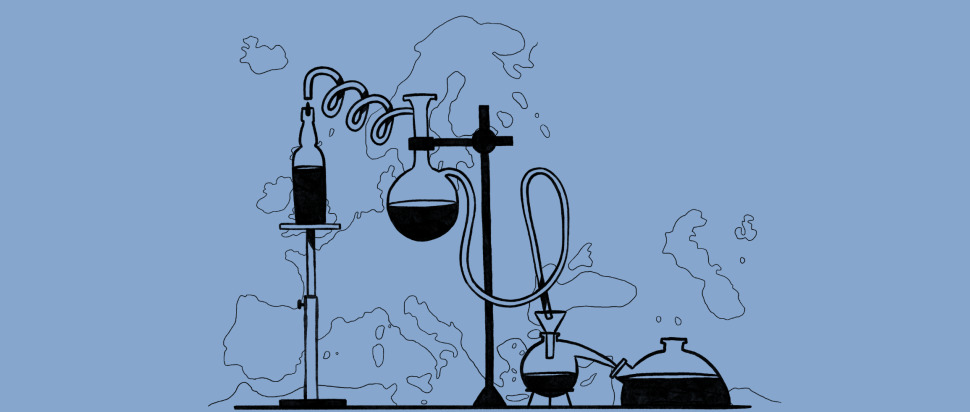
The alembic itself is a striking vessel: a bulbous base swelling like a globe, narrowing into a tall, tapering neck that curves into a slender tube leading to another container. As the liquid heats, vapors rise through the neck and tube, cool down, and drip into the receiving vessel. This condensed essence, capturing the heart of the original liquid, became known as the 'spirit'. Because alcohol boils at a lower temperature than water, heating wine in the alembic allows the alcohol to evaporate first, separating it from the water and leaving a purer, concentrated substance.
This newly concentrated alcohol was not initially used for drinking, but for practical purposes like antiseptics and lamp fuel. Over time, however, its use as a beverage grew as knowledge of distillation spread throughout the Islamic world and into Europe. Ibn Hayyan’s methods first appeared in the medical school in Salerno, Italy, in the 12th century. Around the same time, it began to be consumed more widely, earning the nickname 'water of life' as it moved across Europe.
Traveling monks, bringing with them Ibn Hayyan’s alembic still, are believed to have played a key role in the spread of distillation, especially to the British Isles. It’s thought that some of these monks arrived in Scotland, where they established Lindores Abbey in Fife and began developing what would become the Scottish distillation tradition.
Once in Scotland, however, they faced a problem for distillation: a lack of the vineyards they had been used to. Instead, they turned to fermenting grain mash, and this adaptation eventually became the foundation for what we now know as whisky.
A Story of Migration
It wasn’t the whisky that travelled across the world, it was the process. The distillation of a substance, transforming it into something new. The experimentation of alchemy, and the knowledge behind it, moved across borders and across time. A process first developed in a laboratory in Iraq in the 9th century now finds itself in a bottle on a shelf in a pub in Scotland.
This process doesn’t belong to a single place; it’s shared. It moves, crosses borders, and settles wherever it’s practiced. Scottish whisky is Scottish because of an Islamic alchemist who developed a method that could travel, and be adapted, reshaped, and made specific to the contexts that took it in. It found a home here.
In a time so marked by Islamophobia and xenophobia, where borders feel rigid and heavily policed, it’s worth remembering the history behind something that has come to define Scotland’s cultural landscape. In a drink, there is a story of migration, a cross-continental exchange that was once allowed to flow.
To acknowledge the story of whisky is to acknowledge that Scotland does not exist in isolation. Neither do the things it creates. They are shaped by movement, by exchange, and by a shared process carried across the world.
Masa Nazzal is an artist and researcher who focuses on community education and border abolition. She uses sound, embroidery and writings to imagine borderless futures
This article is taken from issue three of GNAW, the food and drink magazine from the team behind The Skinny. Pick up your free copy at venues across Scotland and beyond, and follow GNAW on Instagram at @gnawmag