A Poet’s Pour: Whisky in a Dry City
Whisky is a portable, shareable piece of its environment – and it can go to somewhat unexpected places. Janette Ayachi reflects on one such experience, bringing Scotland's national drink and poet to the UAE
Ushered onto the decking of a five-star hotel in Dubai on a warm January evening, I sat at a candlelit table before a screen that read ‘An Ode Tae Rabbie Burns’. An audience was perched. They smiled, sipped, and waited as patiently as casks stored to age. Time cannot be rushed. Nor can whisky. In the hush, it felt ceremonial.
This was no casual gathering. I had been granted access to do something the country forbids. The UAE has tightly controlled alcohol laws, yet here we were: Scottish poets bringing a taste of home to the Emirates Airline Festival of Literature, with permission to pour. The strange legality, the scent of peat rising in desert air, Burns' words and our poetry about to be spoken, instilled a quiet thrill, like whisky warming my throat.
Above us, a planetarium of stars. Below was the shimmer of the Creek Harbour. Fairy lights palpitated against glass. Each dram held its own segment of moonlight; we all tilted, swirled and inhaled it. I loved Scotland already; now I was falling for Dubai too.
Time Made Tangible
Everyone was offered three single malts, each paired with a poet. Flavour moved with language, amplifying each other. Place cards showed a panorama of Scottish landscape: wheat in the breeze, sunlit hills, faint crags. Small dishes were offered, tiny and delicate as if made by bees.
The aroma of peat mingled with the sweetness of palm trees. Poetry and whisky felt sacred together. The flavours shifted alongside stories, and tasting became communal. Not wine with food, but whisky with verse. Both cross borders and carry a sense of place. Whisky is intensely local – water, barley, climate – yet it travels globally. A dram becomes a vessel for language.
Peat is time made tangible. It forms in bogs and fens, where water halts decay, pressing centuries into softness. Then it's cut from wind-blasted moors, waiting for flame. When barley is coaxed into life, then stilled, it’s dried in peat-fed kilns, and the process becomes something alchemical. Smoke seeps deep, carrying bog, weather, years, until it rises again in the whisky.
Ritual and Reverence
I was shown how to drop whisky into my palm, rub my hands, and lift the scent before tasting. Ritual. Reverence. The ‘water of life’ is sacred, akin to divine seeing. In the glass, I tasted sea breeze, spice and nutmeg. I saw the tempestuous Hebrides turning in amber light. Whisky’s lineage is ancient, yet always renewing; tradition carried by new voices.
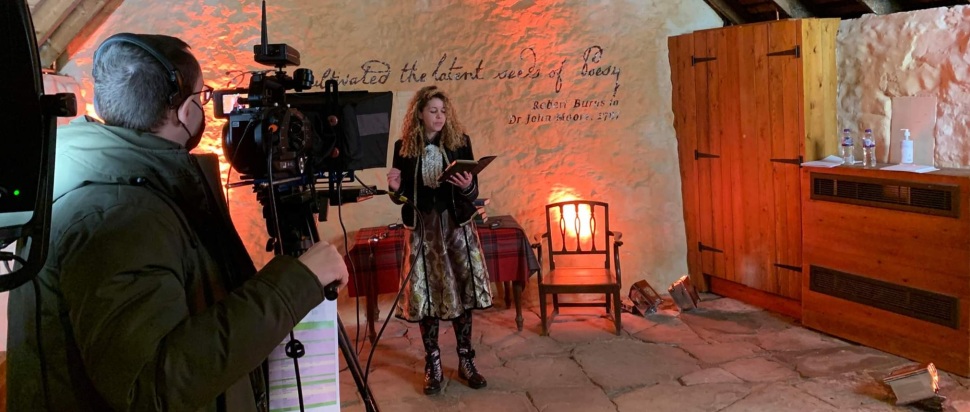
Being a contemporary Scottish poet, I’ve had my share of Burns experiences, from live podcasts with Jackie Bird in her home studio to reading my poetry in Burns Cottage with Edith Bowman, televised for the National Trust for Scotland. Last year, commissioned by Cask 88 to handwrite 25 labels for A Poet’s Pour, a series of single cask whiskies honouring Burns, I wrote about dunes, lochs, heather and heritage. Whisky embodies Scotland. I wanted the poem to do the same.
Conviviality and Contemplation
But what is whisky’s natural state: shared or solitary? Tavern laughter, suppers, raised glasses, the heat of a crowd? Or the lone poet stepping out into bracken and weather, seeking reflection and other realms? Burns held both: conviviality and contemplation. Whisky remains a symbol of freedom, pride and gathering; fuelling ritual and rebellion in the same glass.
After the event, the staff kept serving, so I carried glasses through the hotel into the green room, sharing them like contraband with my new festival friends who were happy to be in on the heist. Risk hovered, but so did pleasure. Later, I poured one last whisky into a paper cup to take upstairs. A luxurious bath took precedence, singing and splashing under skyscraper windows. By morning, the cup had wilted, softened, and drunk its fill.
Burns’ words travel. Whisky travels. Scotland appears unexpectedly, a portable homeland in a globe of ambrosia. But not everything survives the journey. Some moments are meant to be held briefly, then absorbed, leaving only warmth, memory and the trace of smoke – all the more beautiful for its transient fleet.
Janette Ayachi is a Scottish-Algerian poet and author of Hand Over Mouth Music, winner of the Saltire Poetry Book of the Year 2019, and QuickFire, Slow Burning, shortlisted for Scotland’s National Book Awards and The Laurel Prize 2024. She appears regularly on BBC arts programmes and performs her work internationally
This article is taken from issue three of GNAW, the food and drink magazine from the team behind The Skinny. Pick up your free copy at venues across Scotland and beyond, and follow GNAW on Instagram at @gnawmag