Rose of Nevada
Time is as slippery as freshly caught mackerel in Mark Jenkin's third feature, in which two young men (George Mackay and Callum Turner) find themselves transported back in time by a mysterious fishing boat
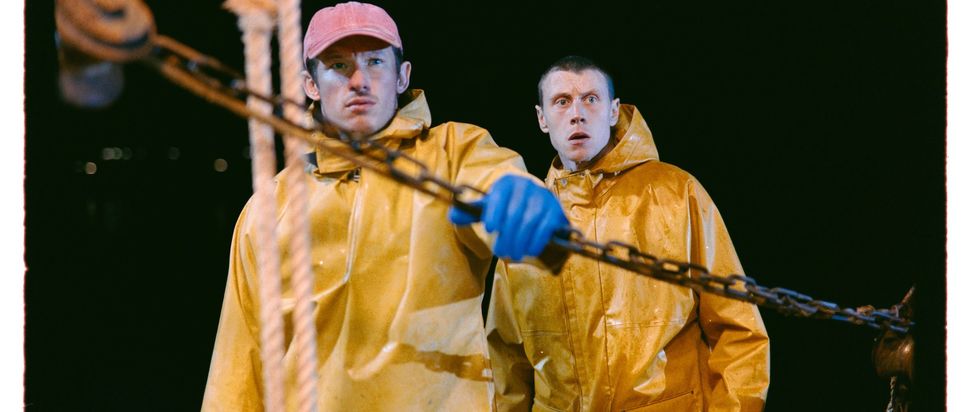
Time and tide lap unnervingly at the shore in Mark Jenkin’s wonderful and ghostly new film, Rose of Nevada. When a long-lost fishing boat reappears in the docks of the Cornish fishing village it set out from decades earlier, two young men (George MacKay and Callum Turner) volunteer to crew it, only to find themselves drawn into an inexplicable time shift. This is a hauntological odyssey – in which the eponymous craft’s absence becomes a catalyst for the decline of the village – and a temporal horror in which two young men wrestle with whether to fight or give in to the inexorable currents.
Nick (MacKay) is aware of the anguish that pervades the village at the start of the film. Thirty years ago, the Rose of Nevada put to sea and never returned, its two local deckhands lost with it – one leaving eerily grieving parents and the other a wife and child with an undeniable void. Though gone, their shadow is long. When Nick and drifter Liam (Turner) agree to man the oddly returned boat on a new run, piloted by the sea-salt-and-pepper Murgey (Francis Magee), they think the worst they face is days of back-breaking graft. However, when they return to shore via an ominous fog, they find themselves years in the past and mistaken for the lost men of yore.
There is a mystery that sits at the film’s centre, but it's a slippery one that feels more akin to weird fiction than the calculus of time-travel. We see the relationship of cause and effect as a hole in the roof in the present is shown to be the product of a midnight adventure in the past. A cap changes hands in the present only to do so again in the past, and complete a recurring cycle. A portentous warning long since carved into a beam inside the boat must be re-carved by the person who read it. These feel less like clues in a puzzle than they might. There comes to be an inevitability, an undertow that seems too powerful and dispassionate to be resisted or reasoned with.
That sense is amplified by the boat, a fishing vessel which, when at sea, is a cramped setting that is defined by the roar of industry. Nick and Liam are just cogs in a grinding mechanism as fish pour into the hold, winches get jammed, crates must be packed and unloaded, and the sea wind whips up the salt air. They feel at the mercy of the machine both literally and metaphysically, and their individual responses to that – one accepting the past, the other yearning for their family in the future – create an ongoing tension.
All of this is delivered in a style that remains bracingly singular and experimental despite Jenkin's increased budget and the presence of hot, buzzy actors in the cast. The post-dubbed audio, creating a slightly unreal quality, blends with the heady celluloid visuals whose intensity of colour creates an almost painterly effect. Jenkin's almost-anachronistic aesthetic only serves to heighten the potency of these young men adrift in time, being pulled slowly towards an unknown fate.
Released 24 Apr by BFI; certificate 12A