Out of Time: Mark Jenkin on Rose of Nevada
Mark Jenkin returns with his stunning new film, Rose of Nevada. While visiting Glasgow Film Festival, the Cornish auteur discusses the beauty of the human face and his passion for capturing modern life with his ancient Bolex camera
For an audio version of this interview, listen to the latest episode of The Cineskinny podcast in the player below, or wherever you get your podcasts...
No British filmmaker working today has a style that's as instantly recognisable as Mark Jenkin’s. The Cornish writer-director has three features under his belt now, and each appears to have been unearthed from an earlier, simpler time in film history. He shoots on 16mm using a hand-cranked Bolex camera. He then develops the celluloid by hand, creating distinct scratches on the prints that enhance the feeling they’ve been dug up from the distant past. His approach to the soundtrack is similarly old-school: dialogue and sound are overdubbed later rather than recorded with the image.
Despite Jenkin’s antiquated filmmaking language, his first two films, the gentrification drama Bait and the woozy folk horror Enys Men, were hugely popular with arthouse audiences. His latest, Rose of Nevada, which had two sold-out shows at Glasgow Film Festival last month, should prove similarly popular, not least because it’s the first Jenkin film with a high-concept plot. If I were to jot it down on the back of a cig packet, it would go something along the lines of 'in the present day, two hot fishermen join the crew of a mysterious vessel that vanished three decades ago, only to find themselves trapped in a time-loop back to the early 90s.'
When I meet Jenkin after one of those sold-out GFF screenings, he tells me he’d been thinking about this plot for years, but hadn’t got very far. “All I had was the opening scene, which was of a boat being found in the harbour early one morning that had been lost at sea 30 years before, with all hands going down on it.” He turned to the actor Mary Woodvine, his partner and long-time collaborator, for some inspiration. “I pitched the scene to Mary, and she pitched back what might happen next. And then I pitched back what might happen after that. In one night, we managed to carve out what the story would be – not what it was about, not what the message of it was, or any themes running through it, just the nuts and bolts of a time travel story.”
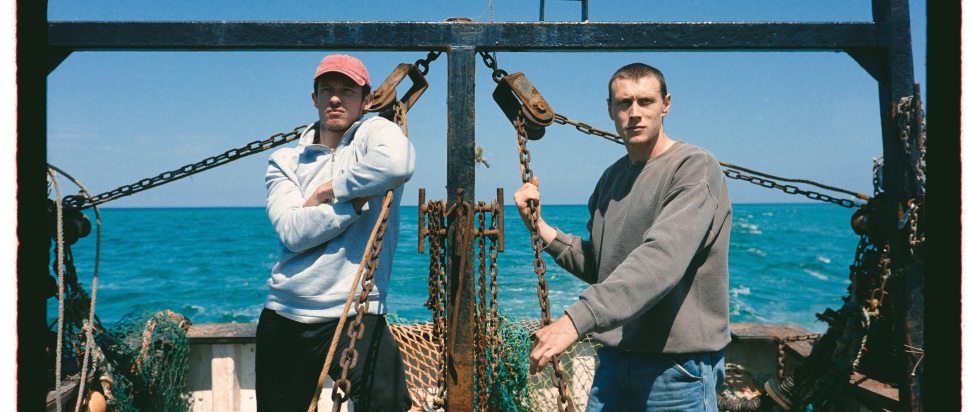
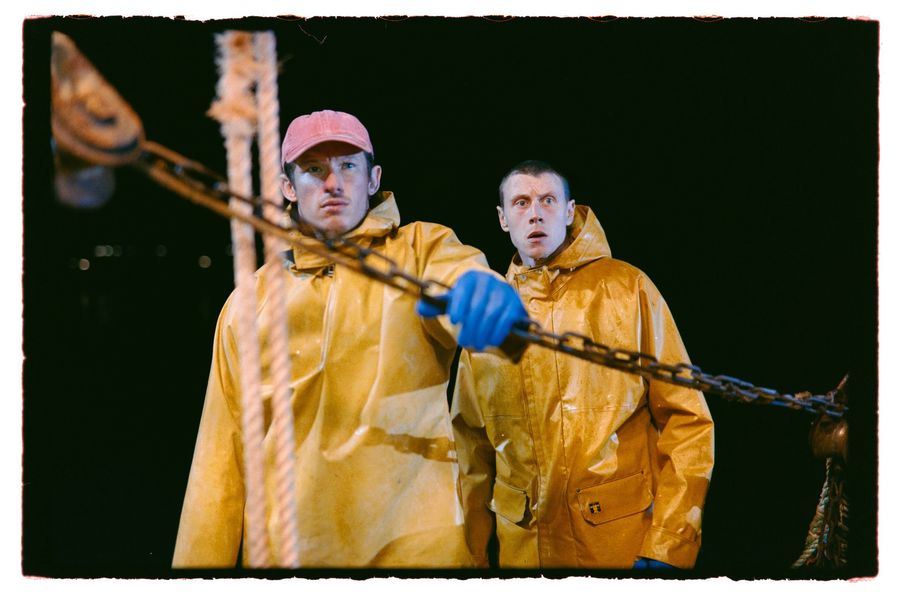
Another reason why Rose of Nevada might have bigger commercial prospects than Jenkin's previous work is that for the first time, he’s working with Hollywood actors. Those hot fishermen I mentioned are George MacKay and Callum Turner. Jenkin’s filmmaking relies heavily on close-ups – of hands, objects, and particularly faces – which he then painstakingly edits together, telling his story through these visual puzzle pieces. It must help, then, to have great face cards to focus on.
Jenkin certainly has an appreciation for the human face. “People sometimes talk about classic Hollywood, those matinee idols, as if we're not beautiful anymore, but we're as beautiful as we always were," he says. "It’s the films that are not as beautiful – that's the problem. Somebody like Greta Garbo, they’d shoot the hell out of her face in the Studio system, because that's what sold the movie. And they did it very carefully; they lit those stars properly. I think we've lost that to a certain extent, because now we shoot these muddy mid shots that are lit for post-production a long way down the line. But I like to shoot big close-ups, and I like to light them with direct light.”
Rose of Nevada contains many of the tropes audiences find deeply satisfying in time travel flick – low-level butterfly effects, potential grandfather paradoxes – but it's far from a simple genre exercise. Despite its sci-fi premise, it has as much to say about the social-economic issues in Jenkin's native Cornwall as the earlier, more politically righteous Bait.
“I think with all my films, I want to create an authentic context," he explains. “So in Cornwall, we've got food banks, and the public toilets are closed, and the banks are gone, but it's very difficult to highlight that without being didactic with it, saying, ‘Look, this is a food bank.’ Or have a character say, ‘Isn't it a disgrace that there's a food bank.'" Throw in time-travel, though, and these politcal points start to announce themselves organically. "If you jump back simply one generation, 30 years, to the mid-90s, which certainly, for somebody my age, doesn't seem that long ago, and you see that that food bank was previously a pristine post office in the heart of a community, then the audience, on an unconscious level, recognises in the background there’s a different story going on. They think, look at what we lost, which we never talk about until it's kind of too late.”
This sense of degradation of our high streets isn’t limited to Cornwall, of course, as Jenkin observed this morning as he was killing time in Glasgow city centre before his screening. “I like to look through a camera and look around and see the state of the world, you know?" he says. "I just walked down to the Clyde a minute ago, and it's all there. I was taking images where you’ve got the old industrial past, which is preserved and celebrated. Then stuff from the 70s and 80s is demolished and ground down into nothing. And then there are shiny glass blocks being built. I haven't got a comment on that, because it's complicated, and that's economics, but I've taken some photos that, when I get them developed, hopefully capture the past, present and future all in one photograph, you know?”
That’s what we call time travel. And if those images ever inspire Jenkin to make a film outside Cornwall for the first time, we look forward to seeing the results.
Rose of Nevada is released 24 Apr by BFI; Mark Jenkin presents a preview screening and Q&A at the Cameo Cinema, Edinburgh on 21 Apr, as part of a UK tour