Kent Jones on Late Fame
In Late Fame, Willem Dafoe plays a failed poet who gets rediscovered in his dotage by a group of young New York scenesters. The film's director, Kent Jones, discusses Dafoe, New York and smartphones
Past is past, and if one
remembers what one meant
to do and never did, is
not to have thought to do
enough?
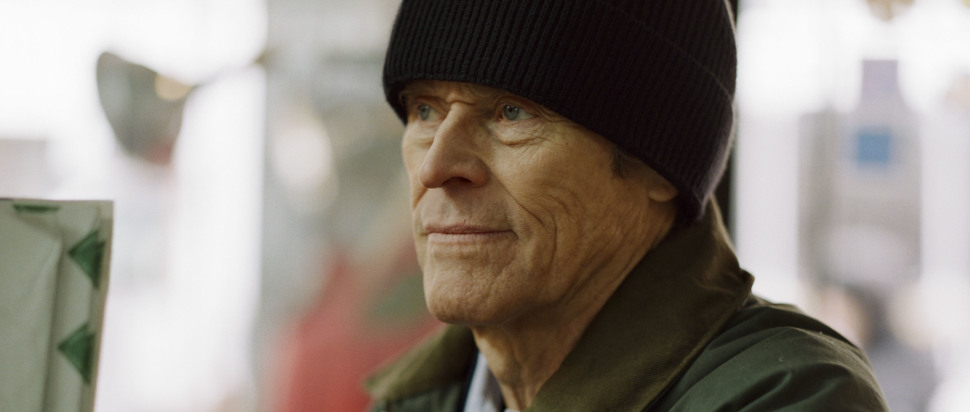
So goes James Schuyler’s Salute, and the poem’s sentiment preoccupies Late Fame, Kent Jones’ second feature. In the film, Willem Dafoe plays Ed Saxberger, a postman in his 70s who published, decades earlier in the New York of Gregory Corso and Lou Reed and the Factory, a book of poetry titled Way Past Go.
That collection didn't make much of a splash on its release, but it's now been rediscovered by a coterie of young, pretentious aspiring writers in the vein of Whit Stillman’s urban haute bourgeoisie (or U.H.B.). Like the U.H.B., they are loquacious, self-assured, and most of all, monied. They dub themselves the 'Enthusiasm Society', but they're less Skull and Bones than the Lost Boys of the Lower East Side.
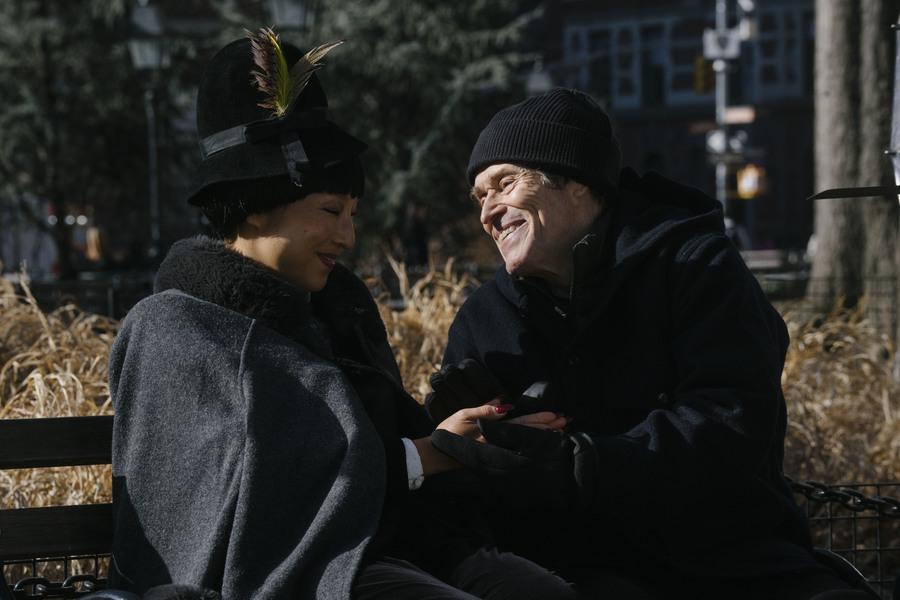
“There is an element of satire," Jones says of the group. “But I didn't have any desire to skewer them. I just wanted to strike a balance there, which I hope I did, so that they're not just figures of fun.” Fun is one word to describe the mysterious and flamboyant theatre actress Gloria, played with chutzpah by Greta Lee. The Wendy to their Lost Boys, she’s older and more clued up, and through her, the exhausting emotional labour of the bohemian artist façade is peeled back.
Gloria – who wants to convey the impression that she “eats caviar every day and goes to Paris every year for the finest silks” – is more vulnerable than she appears; but with Saxberger she can allow herself to be seen. “There’s a desperation to [Gloria] because the clock is running out of time,” notes Jones. “It's always easier for men to age on screen than it is for women, and it's somewhat the same in theatre.”
Jones reckons “it's debatable whether any of [the Enthusiasm Society] will ever write poetry,” which surprises me. “They just have dreams of writing poetry or having written poetry,” he continues. “The only one who probably will be a writer is the boy that Luca Padovan plays [Winn, in the film], who confronts Saxburger at the end and gets a very harsh but extremely important lesson: you can't plug yourself into someone else's energy and get validation.” No matter how privileged or well off you may be, I want to add.
One thing the Enthusiasm Society are vehemently against is smartphones, something Jones also stands behind. It’s a pure intention in today’s world, wanting things that are embodied, tangible, real. Like them, Jones doesn’t have a social media account. “I didn't want to get messages from people that I knew 40 years ago saying, ‘Hey, how have you been?’” he laughs. “But also more than that, I could see that the truism that conflict drives traffic has always been there.”
Talking about social media, he sounds like one of his characters. “There's far too many assertions, categorisations, rankings… If I have to hear one more thing about boomers versus Gen Z!” he laughs. “It's demeaning ultimately… It’s all connected to business. It's connected to marketing, putting people in categories.”
Having lived in New York for the past 40 years, and having previously served as artistic director of the New York Film Festival, Jones comes to filmmaking with a wealth of references. Late Fame has a cosy, analogue quality that calls to mind Hal Ashby and John Cassavetes. He even showed Cassavetes’ Love Streams to his director of photography, Wyatt Garfield, for the “way the faces light up the screen.
“Films are a part of me,” he says, “so I don't have to go back and look at them, and I don't need to pay homage to them. They pay homage to themselves.”
Late Fame is reminiscent of other quiet character studies in films like Paterson and Wendy and Lucy. At its centre is Saxberger, whom Dafoe plays with a tenderness and subtlety that feels almost devotional, like prayer. “Willem is a remarkable artist,” says Jones of his lead actor, “and he can do different registers, and his face is, as you say, extremely expressive, which is why he's so effective in horror films and Robert Eggers and Yorgis Lanthimos movies.”
There was a retrospective of Dafoe’s work at Anthology Film Archives in the middle of shooting. Jones recalls attending one of the screenings: “Willem did a talk with Marty Scorsese after The Last Temptation of Christ. He said, ‘When I'm giving a performance, I'm trying not to be an actor.’ Meaning he’s bringing everything to bear and then letting it happen so that it's just about being on camera, with the sense of the character absorbed.”
Ultimately, Saxberger’s not the tragic lost cause who missed out on being another Allen Ginsberg. He doesn’t need to be lionised. “I never really wanted that, and that’s OK,” he says to the Society at one point – something that seems appalling to them, but feels real. And really, when he says it, it does seem like he’s OK.
Late Fame is released 4 Sep by Vertigo