Adrian Chiarella on queer coming-of-age horror Leviticus
The gay teens in Leviticus are told by their elders to fix their desires or die. The film's writer-director, Adrian Chiarella, tells us how he mined childhood fears of homophobia and a fascination with the Bible to shape this allegorical horror
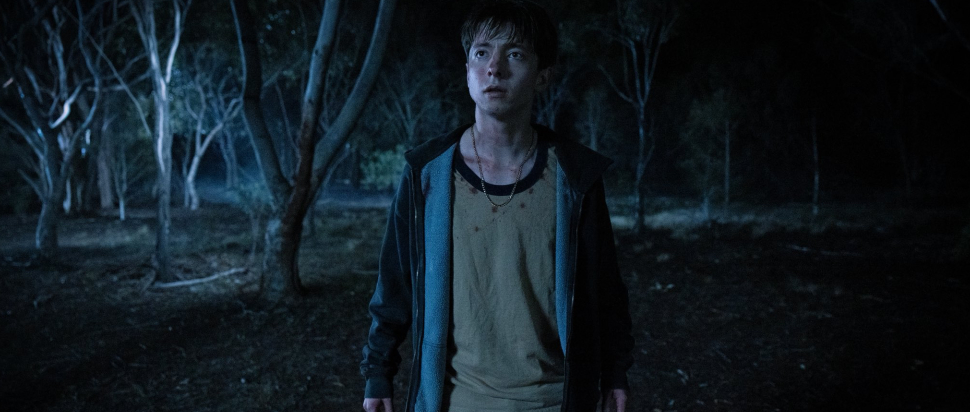
What if the person you most desired became your ultimate fear? That’s the predicament facing the gay teens living in a god-fearing backwater in Australian filmmaker Adrian Chiarella's assured debut, Leviticus. Terror caused by your own sexuality is nothing new for queer kids: the fear of people finding out, the fear of being rejected, the fear for your own safety from the bigots all around. For these reasons, Naim (Joe Bird) and Ryan (Stacy Clausen), the boys at the heart of Chiarella's film, keep their burgeoning feelings for each other on the DL. But when word gets out around town that adolescents in the community are having ‘unnatural’ urges, a mysterious shaman is brought in to put these kids right. His solution to the problem is to unleash a dangerous and particularly cruel hex. It’s a demon only the cursed person can see, that comes for you when you’re alone, and takes the form of the person you’re most attracted to. As horror premises go, it's a nifty one.
When Chiarella was thinking up ideas for what would become his debut feature, he kept getting conflicting advice. “Everyone tells you ‘do something personal’, but also, ‘try and reach an audience.’” Since he was a child, growing up in the suburbs of Sydney, he always found fear to be a great leveller. “I’m from quite a multicultural family,” he says over Zoom. His dad's side is Italian, and his mum's is Chinese. “When I was young, I realised quite quickly that jokes wouldn't land with everyone in the family, but scary stories would. Like, if I saw something really creepy on the street and told any family member, no matter where they were from in the world, I'd have them in the palm of my hand.”
So horror would fulfil the ‘reach an audience’ part of that advice, but how to make it personal? Chiarella’s approach was to simply think of what scared him most as a kid. “I was thinking about the things that terrified me through my teenage years and into my early adulthood, and it was this idea of homophobia. Not just the sort of garden-variety homophobic violence. Sure, that’s terrifying. But also what burrows inside of us as a result of that.”
Leviticus opens with a classic horror cold open. A young woman lifeguard is alone at night in a pool locking up when she succumbs to the amorous advances of an invisible entity, which we later discover is the doppelgänger of her girlfriend. During the tryst, however, the sex turns to brutal, bloody violence. If you walk into the cinema late and miss this scene, you’d be forgiven for thinking you were watching a low-key queer coming-of-age romance, so tender and intimate is the early section of the film as we’re introduced to Naim and Ryan.
“In earlier drafts of the film, I didn't have that cold open,” reveals Chiarella, “because I was just so fixated on telling this story about these two young men and the bond that they form.” People he would share the script with, however, were concerned he was burying the lede. “They would say, ‘This is great, but something’s not quite working?’” Chiarella was initially reluctant to lead with blood and fury, but he began to see that a grisly opening would not only sate the gorehounds, it would also buy him a bit of time. “I realised the film needed something to point to the type of horror movie we were in, and I knew if I got that opening right, we would then be able to have 25 minutes or so of just watching Joe and Stacy's characters connecting.”
As well as exploring modern-day homophobia, Chiarella says he also “wanted [the film] to feel like a biblical parable.” He didn’t grow up religious, though; far from it. In fact, his mother got worried that he might have drunk the Christian Kool-Aid at school. “I remember mum was very concerned one day when I won a bunch of prizes in divinity class,” recalls Chiarella. “She was like, ‘You don't believe this stuff, do you?’ And I was like, ‘No, I'm fascinated by the stories.’” Even the most hardened atheist must admit The Good Book has some good yarns. “I think the young filmmaker in me became obsessed with these epic tales, and so many of those stories in the Bible are quite violent, actually. So for Leviticus I drew on all that biblical imagery: the snakes, the frogs, the goats and the stoning.”
The title, of course, refers to the book of the Old Testament that right-wing commentators love to quote during debates on morality. Funnily enough, it’s not the verse urging us to 'love thy neighbour' they’re so attached to; they prefer the one that goes 'You shall not lie with a male as with a woman; it is an abomination.' Chiarella admits that his choice of title was a bit of a provocation towards the religious right, but it has had an unexpectedly delightful consequence. “I didn't realise this until recently, but the film has had some success in the US. It's built this very loyal young fan base, and what’s happened is that [its US distributor] Neon's been selling T-shirts that say Leviticus on them, and [the film's fans are] all buying up the merch and walking around with that word in the world. So this word that’s been used to denigrate us for centuries, it's now been reclaimed somehow by young LGBTQ+ film fans. I love that.”
Leviticus is released 4 Sep by Picturehouse Entertainment