[seagull] @ Studio Theatre
[seagull] is a superbly directed production bringing together Deaf and hearing actors, with silence as its boldest gesture
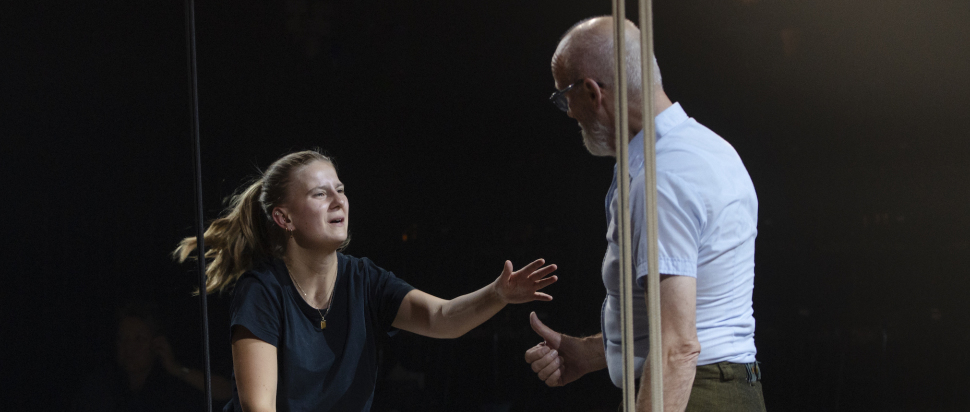
Depressive Masja (Lobke Leirens) and her suitor Medvedenko (Tom Dewispelaere) open the play with a splash: a literal splash, with buckets of water, amid a tangle of real cables running across the theatre-within-a-theatre. The sound of water fills the otherwise silent, ecstatically despairing scene. But the image is an ominous warning of where this contemporary take on Chekhov’s The Seagull, by Belgian theatre companies Toneelhuis and Olympique Dramatique, is heading.
“There isn’t a single living being in the play,” Nina (Yousra Boukantar) complains before stepping on stage in the experimental play written by her aspiring-writer boyfriend, Konstantin, played by Yana Wuytjens in a gender-swapped role. Konstantin assures her she needn’t worry about his famous actor mother, Arkadina (Sofie Decleir), who is visiting the family’s country estate. Nina admits that it's Trigorin (Serge Vlerick), Arkadina’s lover and celebrated writer, who makes her nervous. A love triangle is announced.
In her professional debut, Wuytjens is a painfully tender Konstantin, whose tantrums barely conceal a desperate need for his mother’s approval. Director Stijn Van Opstal has a superb eye for the comedy in tragedy, and tragedy in comedy. One of the funniest moments comes in the captions, when the word [silence] appears in brackets. The joke also hints that the brackets around the production’s title could be a sound cue, much like a caption.
[seagull] brings together Deaf and hearing actors, communicating through Flemish Sign Language, movement, captioning and translation. Nothing is hidden: ropes, lights and the machinery of the theatre are all exposed. The actors frequently acknowledge the audience on both sides of the stage, designed by Damiaan De Schrijver and Van Opstal.
At first, the onscreen captions render the play in polished literary language. But progressively, the subtitles become less grammatical, hinting at a more literal translation from sign language. By the very end, Wuytjens, dressed in black, narrates what is about to happen and then steps into the scene. There are no captions for this sequence, only piano notes furiously accumulating on screen. The biggest gesture of all is silence. The ending is left entirely to our imagination. What's astonishing – we can even imagine the final deafening sound.
[seagull], Studio Theatre, run ended