Queer Histories and Colonial Control: Richard Maguire on his Collective exhibition
At Edinburgh's Collective Gallery, artist Richard Maguire investigates the surveillance of sexualities under colonialism through drawings and sculpture
I meet Richard Maguire as he is prepping for his solo show, There Is No Beginning, As There Is No End. This show features new work made and presented as part of Time + Space, Collective Gallery’s open programme for early-career artists. Maguire has been using Collective Gallery's Hillside Gallery as a studio space; I sit with him at a table spread with a little gallery of sculptures – dormant until he gently picks them up to tell me more about the work. We have a wee giggle about the Mariah Carey reference in the show’s title, and our shared experience of growing up in the North East of Scotland. Soft-spoken and thoughtful, Maguire is generous with his time and explanations.
Maguire’s drawings and sculptures negotiate different historical aspects of sexuality and surveillance. He looks at how homosexuality has been weaponised by British colonial powers in South Asia, how this is bound to labour and production, and in the same breath, how we cannot divorce this past from our present. Within this, moments of tenderness emerge in his work. Clasped hands and vulnerable bodies are recurring motifs, sometimes foregrounded, sometimes only flashing peripherally as your eyes move across the space.
The location of the Hillside Gallery – its closeness to neoclassical monuments to David Hume and Dugald Stewart, along with the old site of Calton Jail – is not lost on Maguire. He says “I like the idea of having work that sat either in or underneath this site of the Scottish Enlightenment.” This is an apt spot for an exhibition that foregrounds colonial histories that the mythology of the Enlightenment simultaneously obscures and depends on. Working with Collective Gallery to deliberately enhance how cold and stark the concrete gallery feels, Maguire creates a jail-like setting to explore colonial penalism and the surveillance of sexualities and bodies.
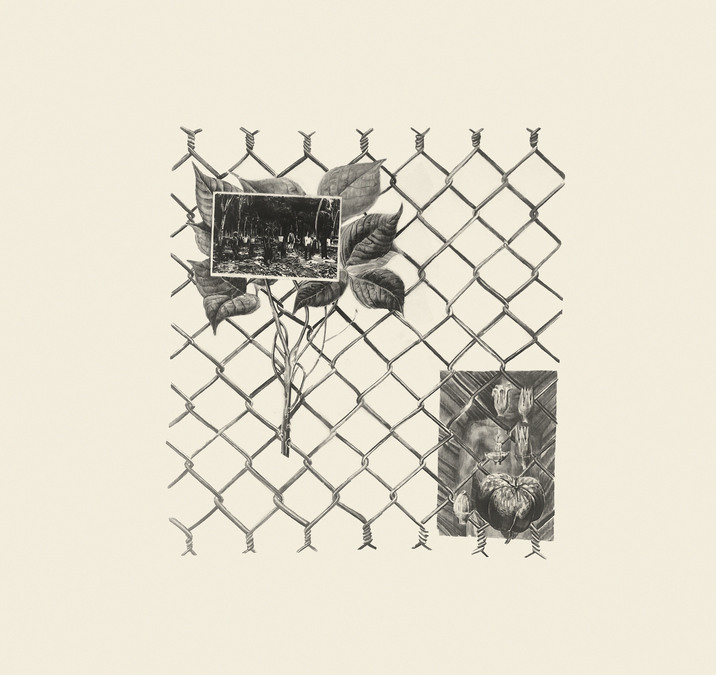
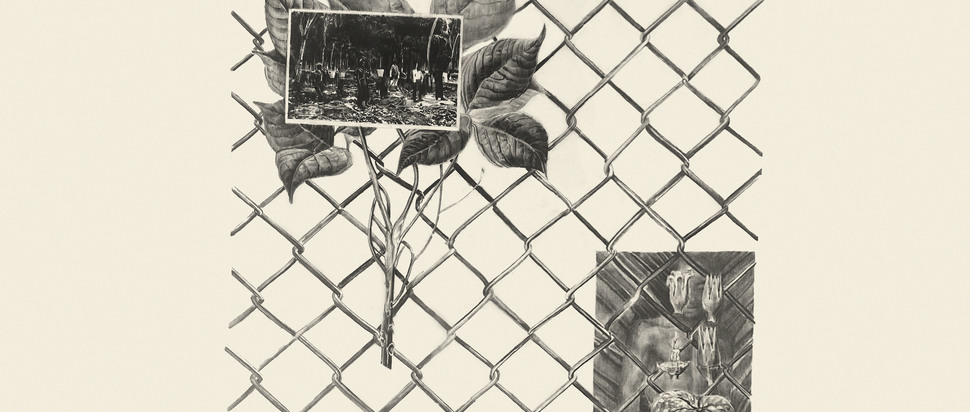
Multiple drawings – The Premises of Stricture (2025) [pictured above] and Pleasure Garden (2026) – feature chain-link fences. He tells me that “part of the idea of referencing them was to talk about juridical changes of forms of slavery, how indigenous systems or Islamicate systems were abolished to make people vagrant under the law and moved people either to plantations or then off to the East Indies or the Caribbean. And that was under the doctrine of [Enlightenment] humanity in some sense.” These exploitative systems were never erased. They were only transformed, transferred to different geographies, and still recur in the present.
Across his drawings and sculptures, we can see Maguire’s mimetic approach, as he replicates archival images and aspects of material culture. Maguire says that when he is finding references “I’m always looking for people, for figures, and how they exist in relation to the context of the image.” There Is No Beginning, As There Is No End draws on the work of Sri Lankan photographer Lionel Wendt, Hindu statuary, and Islamic miniatures.
Pleasure Garden (2026) explicitly links the production of European sexual pleasure and identity to the colonial exploitation of labour through imposing a latex condom onto a rubber plantation, the condom partially obscuring the palm trees. Stone carvings of unnamed tea and latex plantation workers solidify Wendt’s ephemeral, erotically-charged photographs. Pewter-cast clasped hands draw out Islamicate conceptions of same-sex desire through oblique reference to Mir Baqi and the Babri Masjid, destroyed in 1992. Maguire’s work has a shifting, speculative edge. This was something he previously explored in his work for Edinburgh Art Festival’s Platform 2023, recreating destroyed jewellery and textiles to explore how enslavement impacts familial bonds.
Maguire’s initial background was in printmaking, a practice focused on replication and multiples. He then began exploring this replication through drawing. He says of his drawings: “often in person they’re quite hard to decipher – whether they’re printed, whether they’re photographs, or whether it’s a drawing itself but not by me.” His exploration of replication has now expanded into 3D space through sculpture across different media at different scales – stone carving, cast pewter, and silver leaf.
We discuss how being a working artist often comes with material constraints – you’re producing work you know will sell commercially at the cost of being more experimental, often restricted by the space you’re working out of. Time + Space has given Maguire the opportunity to revisit making works at scale, and the scope to be experimental with his materials. He tells me that “being able to move through different media has been nice” – we talk about being able to play with materials like latex and silver leaf. The latex isn’t making the final show (apart from in the aforementioned condom), though silver leafing is looking like it will. Maguire chose silver leaf because “I wanted something that tied different materials together but also that warped in space, and things like graphite... have that kind of reflective quality. I like the idea of this thing that shifts between being lighter and darker than the wall as you move in space.”
Light does shift as you move around There Is No Beginning, As There Is No End. Graphite, pewter and silver leaf catch the corner of your eye before flattening again. There’s a queerness to his works which, while captured, evade capture.
Richard Maguire: There Is No Beginning, As There Is No End, Collective Gallery, Edinburgh, until 14 Sep