Crown Jewel: Inside the revamped King's Theatre, Edinburgh
Three and a half years ago, The King’s Theatre closed for the most significant works in its 119-year history. With its doors reopening this August, one writer takes us behind the scenes of its renovation
I remember the first and only time I ever saw a show at the King’s Theatre. It was mid-February, and my insistence on dragging my visiting family through The Meadows was rewarded with horizontal rain and an icy breeze. Cutting through a dim and narrow lane, we came to a looming profile of red brick and venous drain pipes, introducing us to ‘The Grand Old Lady of Leven Street’ from perhaps her only unflattering angle. We hurried around the corner feeling wet and unglamorous, and made for the entrance with little thought for the edifice itself. But that quickly changed, as its carved teakwood doors swallowed us up, out of the drizzle and into a glow of white and gold.
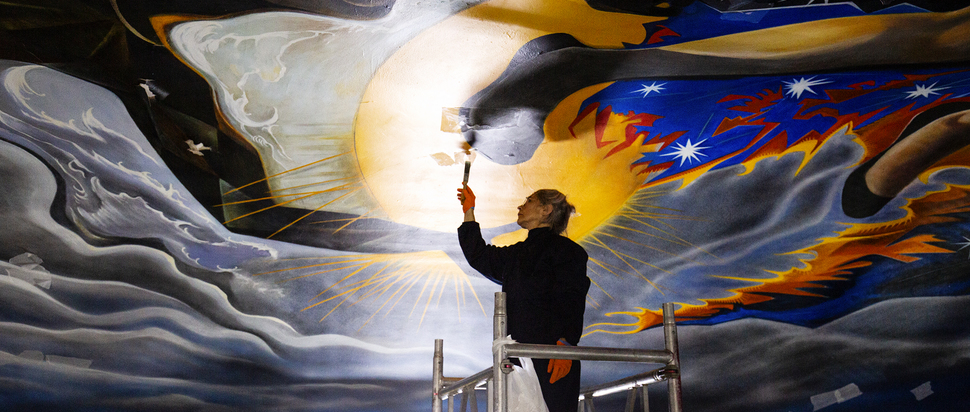
In the foyer, marble pillars grew from the floor, supporting an ornate ceiling plastered with gilded vines, flowers and musical instruments. The auditorium was a sea of crimson, deep and vast, and as I nestled into my seat I found my attention everywhere but the stage. Box seats suspended high in the air resembled little theatres of their own, with velvet curtains suggesting performances might pop out of them at any moment. I peered up at John Byrne’s All the World’s a Stage, a mural commanding the central dome with such allure that for a moment I froze, basking in the wonder of feeling so small.
Remembering that reverie, it feels bizarre to think how long would pass before I found myself in the King’s again. Or that, as I sat there, the biggest changes in its history were being planned – changes which would be revealed to me years later, in the pallid light of a construction site, just weeks before their long awaited unveiling to the public.
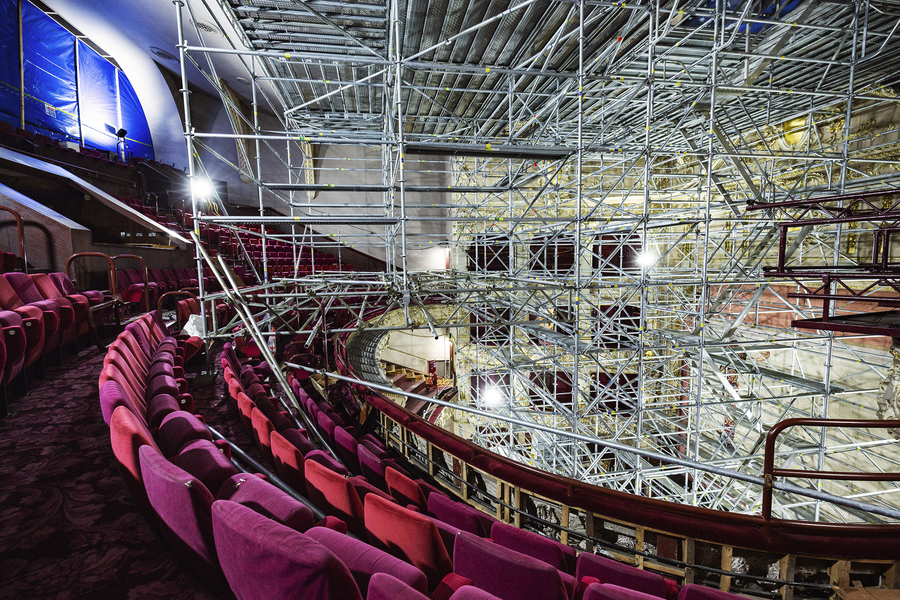
The King's Theatre, Edinburgh during its renovation. Photo: Anneleen Lindsay
When the show ended, we exited to a sky of cracked clouds pierced by rays of tangerine light. They illuminated Tollcross with charm, particularly to a foreign first year student who had scarcely ventured beyond campus and Cowgate. I moved to Tollcross six months later, and it seemed that the King’s was the centrepiece of a small, yet vibrant orbit. It sits resolutely at the base of the steep, winding Leven Street, on which spacious pubs and little cafés mingle with the likes of Scotland’s oldest charity shop and first ever supermarket. For over 100 years, the King’s has attracted locals, tourists, big names and amateur actors alike, and with glee I pictured those faces after a performance, laughter on their lips as they spilled out of the doors and into the night.
My new flat was two right turns and a five minute walk from the theatre. But soon after moving in, ‘The Grand Old Lady’ had been cut from the scene. Not silently, but beneath a clamour of tools and commotion, blurring her out of the foreground of local consciousness. For three years, I hoped to leave my flat and find the scaffolding gone, construction hoarding torn down, and an usher standing at the threshold ready to welcome me in. It never happened. But today, I find myself outside of the King's greeted by someone unexpected.
Neil McLeod, marketing and communications officer for Capital Theatres (the King’s parent organisation), greets me with an enthusiastic smile and shows me through a side door for a behind the scenes tour. It leads us down into the newly built basement, and as people in high-viz jackets and hard hats stream past, I’m struck by the level of excitement and camaraderie in the air. McLeod introduces me to John Robb, Capital Theatre’s technical director and the client-side project lead for the King's redevelopment. Robb frowns when he learns how little time we have, but moments later he’s consumed by a contagious zeal.
First, I’m shown the new power supply room, and though clearly an instrumental feat, I can offer little appreciation beyond hopefully timed nods. But as we continue through the basement, I quickly realise how vital the last few years have been. We turn a corner and arrive at the new accessible changing room. Across from it, an elevator leading up to the stage door has been installed, enabling actors with access needs to perform in a capacity previously impossible. Indeed, Robb explains, the input of people with a range of disabilities was fundamental to the redevelopment plans, helping transform The King’s into one of the most accessible heritage buildings in the UK. The theatre now features accessible toilets on every floor, increased wheelchair-friendly seating, a publicly available Changing Places toilet, as well as new audience elevators and an audio captioning room. These additions are joined by a street-level café, heritage space, bar, gender neutral toilets and a Creative Engagement Studio built for community workshops, school activities and events year-round.
We climb an old staircase bringing us up into the orchestra pit. Not far from where we stand, 1,600 wheelbarrows of rubble had been removed by hand, and admiring the auditorium from this submerged perspective, the magnitude of the project begins to feel overwhelming. I’m gripped by a vicarious vertigo as McLeod points to the colossal figures painted inside the dome, explaining that not long before, Celie Byrne had been part of a team working on a 100-foot platform to restore her late father’s mural.
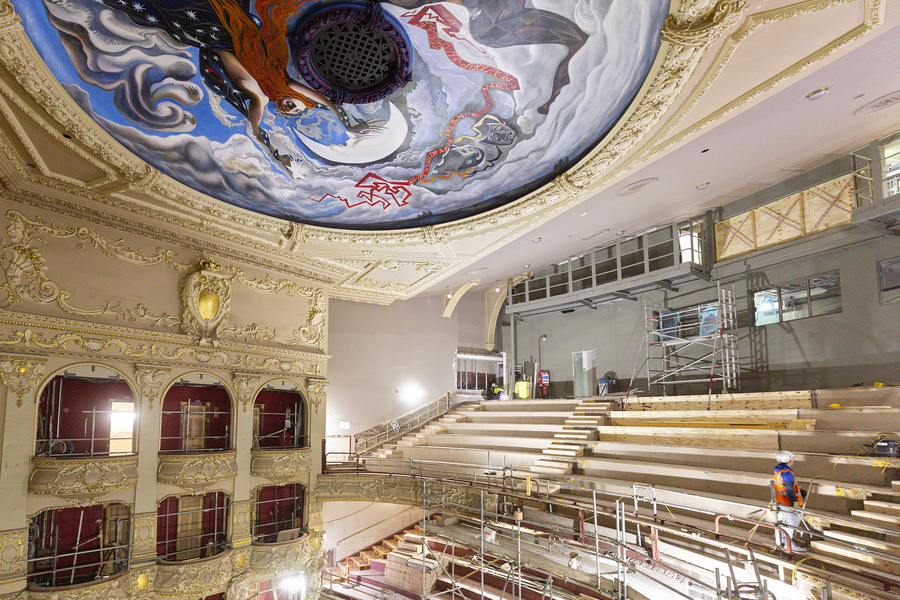
Restoration work at the King's Theatre, Edinburgh. Photo: Annaleen Lindsay
As we walk up onto the stage, Robb tells me that the floor we stand on is also brand new, a flat surface having replaced the old raked one.
"D’you know what that means we can have?" he asks.
"Dancers!" exclaims McLeod.
"Aye, dancers!" Robb replies.
I scribble notes furiously, trying to keep up with the current of knowledge pouring out of him. But as we return to the basement, Robb laments: “I don’t feel I’ve shown you anything.”
I can’t help but laugh, and try to explain that I’ve seen as much as I’m likely to wrap my head around. My visit feels neither like that of a place defined by history, nor one offering a window into an otherworldly future. Instead, the King’s has been adorned by time itself, bearing the badges of both preservation and progress. Perhaps the most enchanting example of this was discovered in late 2024, almost a year into the redevelopment: beneath the plasterwork crown at the centre of the proscenium arch, a message in a bottle had been hidden for 119 years.
Dated October, 1906 – two months before the King’s first opened – the time capsule remembers the building’s original architects, plasterers and apprentices. It poses a reminder that just as land has memory, spaces can keep secrets – and just because the walls can’t talk, it doesn’t mean they’re not listening. Over the last century and more, the King’s has heard the cries of stars being born and the nervous backstage whispers of first-time performers. It’s listened to staff in the box office befriend colleagues in front of house, listening still as friendship blossomed into love.
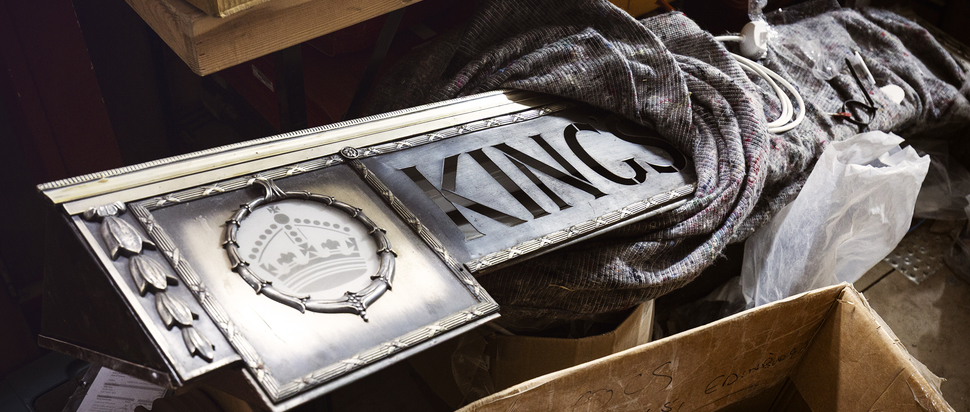 Signage at the King's Theatre. Photo: Annaleen Lindsay
Walking back through Tollcross on an uncharacteristically sunny day, it occurs to me that despite my or anyone else’s excitement, there are sure to be some indifferent to the reopening. I can see how the building’s grandeur may reinforce the notion of theatre as an exclusive, inaccessible art form. And perhaps there’s still a truth there to be reckoned with. But reflecting on this space and the reimagining it’s been through, it seems that no programme or production will ever speak louder than its people. When the pandemic threatened to insurmountably inflate the cost of the redevelopment, it wasn’t saved by public investment and corporate sponsors alone. Take, for instance, the staff and performers who ran the Edinburgh Marathon to support the fundraising effort. Or the other individuals, community groups and local businesses who donated to the project from their own pockets.
Known to many as ‘The People’s Theatre’, the building is proof that when a space is shaped by individuals, our imprints tell a story grander than the sum of their parts. So, when it opens its doors this August, have a look, ask around, and get creative about what you might find.
The King's Theatre, Edinburgh reopens with a special Opening Weekend programme on 1 and 2 Aug
Angels in America, 15-20 Aug, times vary; EXXY, 23 Aug, 7.30pm; Clown Show, 27-30 Aug, times vary (all part of the 2026 Edinburgh International Festival)