Game On: Joe McCann on his new play The Corinthian
As Scotland prepares for the World Cup, Joe McCann's new play restores Andrew Watson – the world’s first Black international footballer – to Scottish history

Football tends to admire itself through the analogy of theatre; in the ensorcelled eyes of supporters, stadiums become amphitheatres – their fans an ever-expressive Greek chorus – while viewers at home learn lines of colourful commentary. But 'the beautiful game' did not begin this way. And with their attention transfixed by craftful direction, fans have not only overlooked the game’s current climate, but failed to tell perhaps the most important story of its past.
Joe McCann’s new play, The Corinthian – directed by Martin McCormick for A Play, a Pie and a Pint at Òran Mór, 1-6 June, and Assembly Roxy, 10-14 June – is set to correct that, by breathing life into the forgotten figure of Andrew Watson: the world’s first Black international footballer.
Watson's achievements surpassed breaking into an all-white XI in the 1880s, or even bearing the captain's armband; he pioneered the Scottish style of football, unique for its emphasis on threading the ball between players, rather than through them. This fluid, more elegant way of playing not only gave football its 'beautiful' quality, but also quickly eclipsed English tactics. Playing the passing game under Watson's leadership, Scotland dealt England two of their worst losses in history. This set the cogs in motion for the establishment of The Corinthians, an English team built with the Scotch Professors' plans, which went on to spread football to the world.
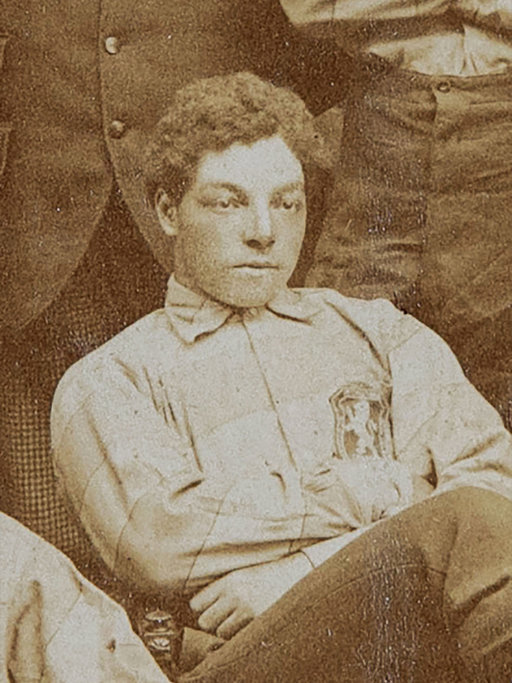
Archive photo of Andrew Watson
But after his death, Watson wasn’t revered as an inspiration. Instead, he was consigned to a set of dust-gathering records, a victim of the artificial amnesia invoked by history’s discomfort with Black pride. Watson was effaced, and with him, Scotland’s contribution to its favourite game.
A poetic rhythm courses through McCann's The Corinthian, transporting viewers from Watson's early childhood in Demerara, to his life and career in Glasgow. But rather than a historical reconstruction, McCann's first ever one-person play is a tapestry of record, memory and imagination. Watson (Dayton Mungai) appears as an omniscient manifestation of these elements, excited but also embittered at the prospect of telling his story here – on a stage, over 100 years after his death, bound by the dimensions of depiction. “Alright,” he says. “I’ll come to you, then. I’ll come to you.”
He does so with an air of consciousness, aware that what we’re seeing isn’t really him, and that this story isn’t entirely his anymore – that the crime of erasure means it can’t be. “One of the toughest things was that I’m telling Watson's story, but I’m not telling a true story," McCann explains. He fills in the gaps with fragments of his own life, injecting personality, drama and the lived experience of a Black Scotsman. In some ways, the play becomes a vicarious two-way stream: Watson emitted by McCann, McCann emitted by Watson – the aggregate of which is neither fact nor fiction, but speaks to truths across time and context all the same.
McCann has made a powerful mark in contemporary Scottish theatre, predominantly telling stories which shine a light on the Black working class experience. His previous A Play, a Pie and a Pint production (Alföld, directed by Dominic Hill) was nominated for a CATS award in 2022, and in 2025 he was named as one of just ten writers for BBC Scottish Voices. Bravery propels McCann's work, converting vulnerabilities into hope, and his successes into shared exclamations of existence. You can hear this determination in the voice of Watson's mother, who tells the young man as he packs his bags, wishing to abandon a Scotland that won’t accept him: “Take up room, Andrew.”
The Corinthian opens ten days prior to the start of the FIFA Men’s World Cup, which will feature a Scottish team for the first time in 28 years. And while times like these can stage lasting scenes of unity, there’s also a risk that impassioned narratives will veil the oppressive elites cashing in on them: “Having the FIFA Peace Prize joke of a President as host for 2026 feels pretty fitting," McCann says. "I'd want folks to enjoy the tournament, but perhaps sit with the messier truth of who gets to belong on the field, and remember the likes of Andrew Watson who made that belonging all the easier for those who came after him.”
Beyond analogies and metaphorical embellishments, football and theatre share a profound faculty: both offer an escape from the world – a peace and solitude born out of the thrill of their craftsmanship. In Watson's words, via McCann: “The quiet of a thing that's mine and will stay mine."
Silences such as these belong to those who fill them, meaning that for Watson, McCann, and anyone else outcast because of who they are, both the sport and the art become vessels of acceptance: “[Football] is something that can’t be taken away from [Watson]," McCann says. "For me, it’s similar to writing.” As political vulgarity and dizzying commodification continue to blemish the beautiful game, our best hope of salvaging it lies in looking back to the start. Enter Andrew Watson: captain, trailblazer, and now, storyteller, poised to reclaim his chapter in history.
The Corinthian, Òran Mór, Glasgow, 1-6 Jun and Assembly Roxy, Edinburgh, 10-14 Jun, part of A Play, A Pie and A Pint