Joanna Bowman on climate crisis play The Trials
In Dawn King's The Trials, teens hold adults accountable to a catastrophic climate in the near-future. Our writer speaks to director Joanna Bowman about exploring praxis through theatre in times of crisis

Joanna Bowman wants audience members to “ask big questions together” – to recognise their sameness in curiosity, despite their strangeness to one another.
No production seems more fitting for such a collective task than her upcoming iteration of The Trials by Dawn King, showing at Tron Theatre from 6-14 March, where the narrative is practically led by a cast of twelve actors aged between 12 and 17 from across Glasgow. “The play belongs to the teenagers," Bowman affirms, as they play jury members who must determine the guilt of three adults accused of total climate destruction.
Bowman is not afraid to inspire ambiguity within the audience. Instead of providing answers, she wishes that viewers leave with questions. “I think there is nothing like watching people negotiate a question or a problem or a situation that yes, you might have had in your life, or you might never have imagined in your own life,” she says. “And to see the kind of variety – joys and sorrows and tragedies and comedies of human experience – like, it's really the best.”
Played by Brian Ferguson, Maryam Hamidi and Pauline Goldsmith, the adults represent older generations’ failures to interrogate these problems themselves, and to act on their responsibility to survive. The young generation inherits this failure, and their sole duty is now of a jury kind.
Bowman asserts that she is “uninterested in telling people what [to] feel about anything." Her method is more patient and spacious. For her, “the co-spirit [of theatre] is sort of a live negotiation that lies in the present, breathing audience." And there is no better place to stage the production than Glasgow’s Tron Theatre, whose “live energy” she finds essential to the play. Its vividness is in its simultaneous irremovability from reality, and promise to carve time and space for a paradoxically patient approach to an impending catastrophe.
“You know, it certainly doesn't start in a position that this is not a problem, or this is not a moving crisis that we all have to deal with,” Bowman says. “But, I think it does meaningfully create space for a number of different responses of how we might actually deal with it, in practice rather than in theory.”
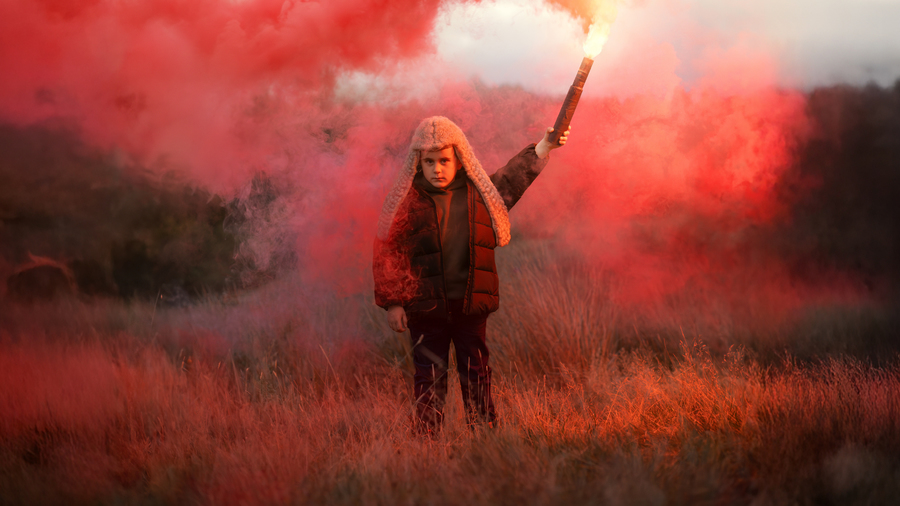
Credit: Mihaela Bodlovic
It is this emphasis on praxis that captures the play’s drive: twelve teens are forced to navigate a crisis that is generations and empires older than them, and finally hold the power of jurisprudence, as those who have long exploited the law plead before them. For teens especially, there is a fine line between the stage and the world. Bowman affirms: “I think being a teenager is like being in a Greek tragedy, hopefully with [no] tragic ending, right?” King’s choice of a young ensemble is especially effective, or in Bowman’s words, “sophisticated," as the adolescent capacity for drama and emotion meets an equal scale of corruption – their antithetical match.
King has quite literally created a play that is ahead of its time, and Bowman’s direction aims to show audiences – “surprise” them – with the prospects of an unpredictable future, as certain as everyone is about its doom. For Bowman, this is definitely not the end of the story. In fact, putting adolescents on the stage, where “theatre [puts] life," necessitates a renewal whereby the young cast and audience alike are “discovering life” for the first time – and it’s complicated.
“The play occupies many different registers,” Bowman adds. “It's not just a message on the fact that the polar bears are dying. It's complicated – it's death – and it’s layered. That's why I think it's effective.”
The twelve teenagers – “some rightfully angry, some quite bored, some [who] think it shouldn’t be their responsibility, some [morally stanced], and some [who] get it over and done with” – inspire Bowman’s “multitudinous way of looking at the planet." To her, it is these varying registers that theatre has the capacity to address, enabling a coexistence between seriousness and humour.
“I think theatre is about rhythm,” she says. “There's a reason that we use the phrase comic timing, and it's about comic timings. It's about building rhythms precisely with the company. Particularly when making political work or work that might be issue-based, like a climate emergency, I would suggest that entertainment and humour is a really good way of disguising or complicating more serious points.”
In an age of overwhelming political crimes and underwhelming levels of accountability, theatre is about catharsis – not solving issues that world leaders should undertake. Bowman likes that theatre is “ephemeral," existing for one night and then disappearing. Nevertheless, the material politics of the production are hand-in-hand with its subject matter: “We're making the production in a really sustainable way. Our set is all recycled, costumes all secondhand,” she says, adding that a material impact on our world is deeply intertwined with the relational. “Theatre reminds us that being alive is a thing worth doing, and for me, that's a thing worth funding,” she says.
As Bowman thinks it crucial for us to observe this production in a space as “distinct” and provocative as The Tron, it is equally necessary that audiences witness this story through the emotional register of a group whose years are fleeting and forgotten, but ever-formative.
The Trials, Tron Theatre, Glasgow, 6-14 Mar