Dominic Hill on Citizens Theatre's new take on 1984
Dominic Hill is set to direct a new adaptation of Orwell’s 1984 that claims the story for Scotland
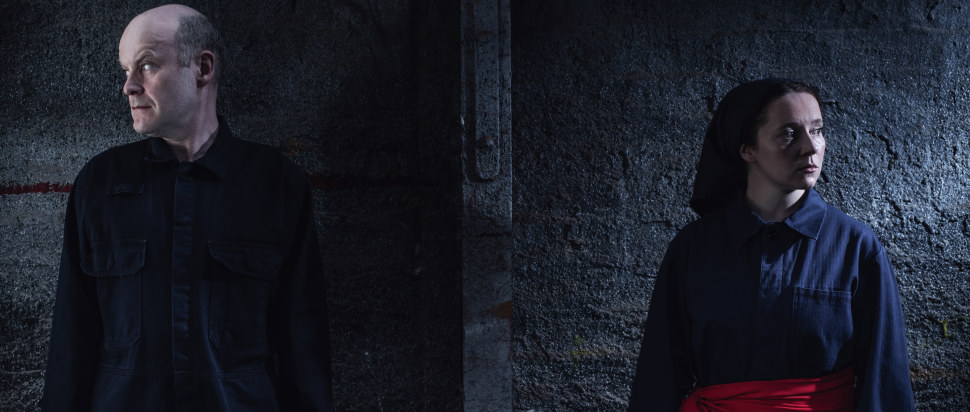
We are all familiar with the topoi of George Orwell’s 1984; state surveillance, doublespeak, political brutality. His last completed work before his death in 1940 has felt frighteningly close to reality in recent years, making Chris Hannan's new stage adaptation, directed by Dominic Hill, a powerful addition to the autumn programme. Hill found a quiet corner to speak to us in between rehearsals.
Like many of us, Citizens Theatre’s artistic director Dominic Hill first remembers reading 1984 as a teenager. “But revisiting it two or three years ago, it definitely felt more prescient and impactful,” he says. “I remember a Guardian article in particular after Donald Trump’s first election about how the book had become a bestseller again. The creeping totalitarianism came more and more to mind.”
Orwell has time and time again proven his unfortunate clairvoyance. Big Brother’s mantras – war is peace, freedom is slavery, ignorance is strength – could easily evoke the normalisation of violence and hate in our political landscape; the Party’s 'Two Minutes Hate' could be likened to a short Reform conference. Meanwhile, 'Newspeak' has been invoked by the Right to characterise progressive restrictions on extremist views as political censorship. The use of Orwellian references from across the political spectrum reflects our political isolation from each other, something both Hannan and Hill hope to confront in this staging.
It would, then, be easy to build a production that directly references our current political climate. But Hill is conscious of sensationalising modern-day parallels; he wants us to draw our own comparisons. “It is a story that makes people politically engaged, but we wanted to keep hold of that Heath Robinson view of the future – we haven’t made it contemporary. We didn’t want to overplay resonances,” he says. His prop department have been hard at work to realise his vision of nostalgic science fiction. “We’ve had some extraordinary machinery and workspaces made, like something out of a Terry Gilliam film.”
It was admittedly the book’s ever-growing resonance, though, as well as the timely lifting of 1984’s copyright a few years ago, Hill wryly adds, that prompted the commission of a new adaptation of the story for the stage. That playwright Chris Hannan was chosen to undertake the task is no surprise. In between adapting literary classics for Scottish stages, he has penned a number of original politically charged scripts, notably Elizabeth Gordon Quinn, a powerful tragicomedy set during the 1915 Glasgow Rent Strike.
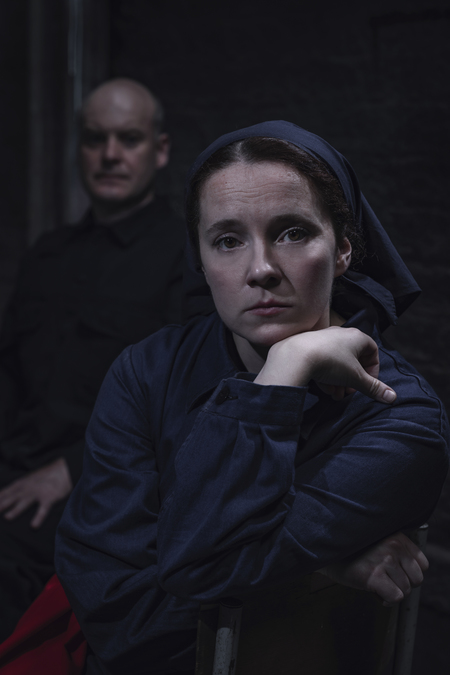
Hannan has been able to root 1984 in the lowlands too, through an ingenious framing device that weaves the original story around Orwell’s time spent in a sanatorium just outside Glasgow, where he was treated for tuberculosis. “It kind of claims the story for Scotland,” he quips. It was during Orwell’s gruelling seven months recovery at Hairmyres Hospital that he completed 1984, despite his doctor’s attempts to get him to rest. His own condition perhaps influenced Winston Smith's gaunt depiction. Hill makes clear that the original's brutality and horror will be an unflinching part of the production, but he hopes to "warm it up" through a love affair between Jack Tarlton's Winston and Jessica Hardwick's Julia that feels earnest and impassioned.
Orwell likely first contracted tuberculosis in a Spanish hospital, where he was treated for a bullet wound in the neck that he sustained while fighting as a volunteer against the fascists during the Spanish Civil War. His memoirs document how Soviet-backed forces ostensibly fighting against the fascists brutally pursued dissenters and published false accounts of glory in battles to bolster their reputation, fuelling a misplaced rivalry amongst the tangle of leftist parties. While Franco's forces were undoubtedly authoritarian, Orwell saw a totalitarianism within the leftist ranks that undermined the true workers' struggle.
“This was a time when propaganda, from both sides, overtook objective reporting and news telling," Hill explains. It is easy to see where Orwell drew inspiration for Big Brother's methods from. When he was finally admitted to Hairmyres in 1947, having suffered years of debilitating chest problems, his ordeals were far from over; Hill tells us that Orwell's doctor there had fought opposite him in Spain. Hannan's adaptation will hone in on this little-known relationship, bringing Orwell's indictment of the horror and brutality of totalitarianism into more personal focus, while also exhibiting some of the political dialogue that Hill hopes to encourage.
Set to tour Dundee and Edinburgh after completing its run in Glasgow, this production of 1984 promises to be a provocative and thrilling watch that unearths the lesser-known context of Orwell’s enduring classic.
1984, Citizens Theatre, Glasgow, 29 Aug-26 Sep, 7.30 pm; touring to Dundee Rep, 30 Sep-10 Oct; The Lyceum, Edinburgh, 27 Oct-7 Nov