'Insurgent Theatricality' at Arika's Episode 12
Founding member of Arika, Barry Esson, and leading Afro-Brazilian theorist Leda Maria Martins speak to us about time, performance and solidarity beyond a fixed theatre
When Barry Esson visited Teatro Oficina in São Paulo earlier this year, he was taken around the theatre in silence. The structure – largely made of scaffolding, built around a tree that has grown inside of it for 50 years – has been repeatedly destroyed and rebuilt.
“Destroyed by fascist militia, burnt down multiple times, remade,” Esson, co-director of political arts organisation Arika, tells us. “I had to stop and have a wee weep to myself.” For him, the dedication to rebuild is part of an “ever-evolving radical performance practice.”
The visit came after years of friendship with Brazilian artists, thinkers and organisers, shaping collaborations between Arika, radical performance organisation Take Me Somewhere, and anti-colonial artists. In November, as part of Arika’s Episode 12: From the Rivers to the Seas, the two organisations bring distinct yet connected approaches to theatre: the work of Leda Maria Martins, poet, playwright and leading figure in contemporary Afro-Brazilian thought, and the radical collective practice of Teatro Oficina, represented by actress and co-director Fernanda Taddei.
Time, memory and the body
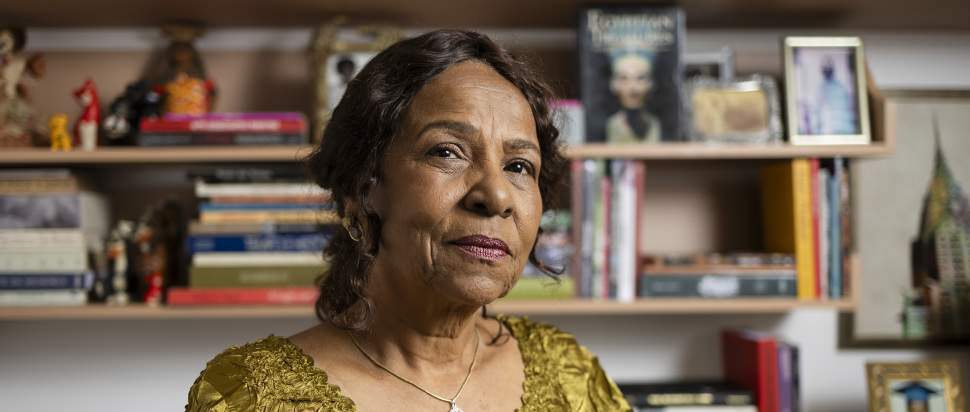
“She literally is a queen in the Afro-Brazilian religion of Umbanda, and it felt like that,” Esson says of meeting Martins in São Paulo. “Leda basically extemporised her whole philosophical, cosmological system over two or three hours – it was like a rain shower of theory, mixed with song, music, movement, jokes.”
Since the 1970s, Martins has observed, analysed and crafted theories of Black performance in Brazil; for Arika, she brings to Scotland a body of anti-colonial frameworks developed over decades of research. One of these is “spiral time” – time as inscribed through African and African diasporic gesture, performance and ritual.
“In the West, there is only one perception of time… a time that goes only forward, in the direction of an end,” Martins explains. “This is a concept of time that fits well in the actions of modernity, beginning with slavery: to extract as much as you can from land, territory, people. Time becomes a very powerful instrument of oppression.”
Instead, Martins says, spiral time sees past, present and future curve into and transform each other again and again through Black corporealities.
“That’s what moved me many decades ago, when I was observing in secular and religious ritual dances how the movements of the body were inscribing something, graphing something,” she says. “I came to this notion of spiral time. People all over the world are loving it because it opens new avenues in everything – in our daily lives. It brings another notion to the sacralities of existence: a way to embrace the fact that nature is not separate from us. We are nature and nature is sacred.”
Against the colonial stage
Much as Martins offers a written and deeply felt logic around Black theatre in Brazil – and its implications beyond – Teatro Oficina challenges colonial conventions through its collective theatrical practice and long history of resistance. The company’s performances dissolve the boundaries between the individual and the chorus, the actors and audience. Drawing on group improvisation and the Brazilian tradition of anthropophagia – the 'devouring' of colonial influences to create something culturally distinct – Oficina creates something both emergent and responsive to 500 years of colonial legacy in Brazil.
“Fernanda, who is coming to the Episode, talked us through the history of the company, its resistance to the military dictatorship, the violence towards and torture of the company and its members, how they went into exile at one point and joined the Mozambique independence struggle,” Esson explains.
The profound contributions that both Martins and Teatro Oficina have made to anti-colonial theatre globally will be on full display at Arika’s Episode in November, where Scottish audiences can engage with ideas rarely translated in English. Esson is interested in what becomes possible when they meet and challenge the ways we engage in solidarity here.
For Esson, art’s political force lies in “a move away from ‘art’ per se, or specific artforms, towards… the ways in which communities look and want to be seen, listen and want to be heard, move and want to be moved.” This sense of connection across places and struggles shapes Episode 12 as a whole. Centring Palestinian struggle and resistance, the programme looks at anti-coloniality on a planetary scale, from Palestine outwards, asking where we might find solidarities without flattening specificity.
Along with Martins’ events, Routes of Black Theatre in Brazil and The Curved Time of Memory, and Fernanda Taddei’s discussion on Teatro Oficina, Power of Presence in the Presence of Power, the Episode looks at liberation and justice in an array of contexts – not excluding Scotland.
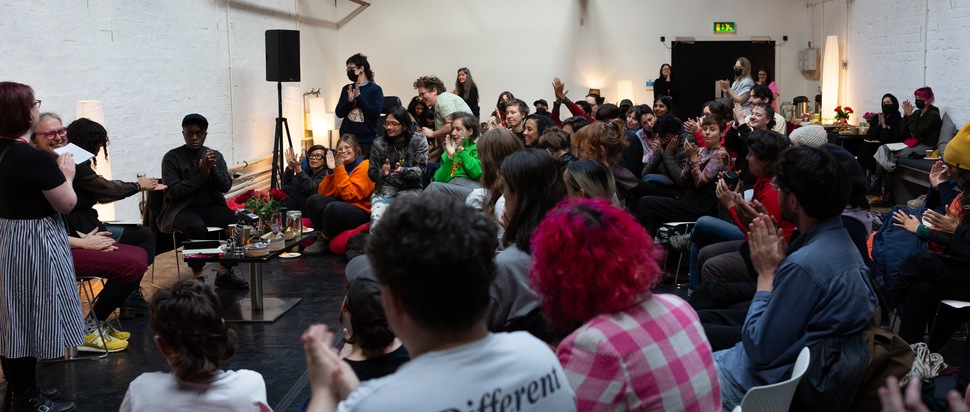
Trans Breakfast at the End of the World for Arika Episode 11, 2024. Credit: Alex Woodward
In Pedagogy and Liberation in Times of Proscription, people involved in prison abolition, anti-apartheid organising, student encampments and campaigns for Palestinian liberation in Scotland consider how the global politics of the state manifest locally. It Wasn’t History But Memory, brought together by Harry Josephine Giles, explores Gaelic worldviews, cultural revitalisation, forced depopulation and the connections between cultural erasure and ecological destruction.
In a rare moment, at Arika, theatre is given room to exist beyond the usual confines of the art world. In a landscape where conversations about theatre so often return to funding, access and what is “good”, the Episode offers a chance to explore what performance can become when it is placed in conversation with other forms of knowledge, resistance and collective life.
"It's unlike anything we’ve worked with before," Esson says. "[These events] respond to, in locally complex and specific ways, oppressions and constrictions that happen globally... They connect to, while embodying totally different strands from, an internationalist insurgent theatricality."
Arika Episode 12: From the Rivers to the Seas, Tramway, Glasgow, 11-15 Nov, events either free, by reservation, or sliding scale evening pass