Reimagining Glasgow: The Blue Nile's A Walk Across the Rooftops
Forty-two years on from its release, we explore why Glasgow needs The Blue Nile's A Walk Across the Rooftops more than ever for reimagination and reinterpretation
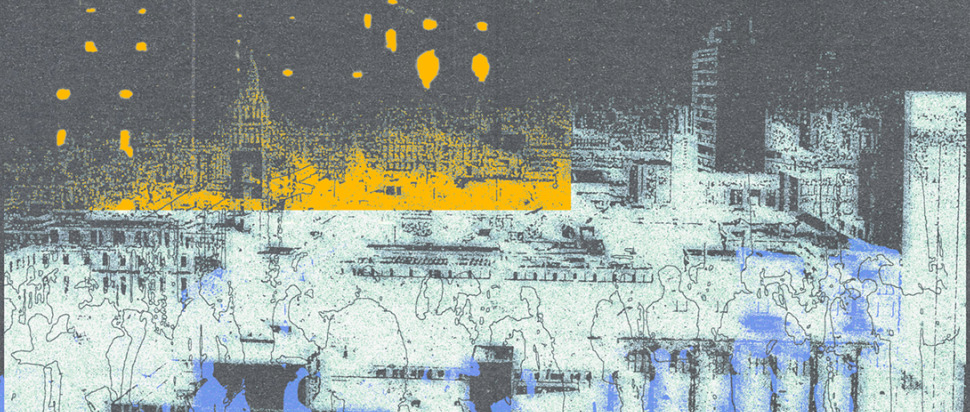
On a quiet Sunday brunch shift a few months ago, the name ‘James Kelman’ came up on the bookings. The Glaswegian writer is a hero of mine, and it seemed I was going to be serving him in a matter of minutes. I sprinted out for a cigarette to compose myself and imagine what I'd say to him. But nothing focused or concise was forthcoming. Instead, I thought about Glasgow and how it feels to live in a city that's big, but not really a metropolis. Not a place where it feels history is allowed to happen anymore, because no decisions are made here, yet a place so burdened by its former prominence that its inability to produce the future paralyses its imagination.
We’ve been here before. Think of the Glasgow Kelman was writing about in the mid-eighties. Empty shipyards, shuttered shops, and crowded but silent pubs. Glasgow’s painful transition to post-industrialism was approaching its climax. Post-industrial and post-imperial, the city’s sense of self was disintegrating, its old glamour dead and vacant.
Margaret Thatcher’s repeat victory in the 1983 election seemed to have doomed the municipal and industrial socialism that had been pioneered on the Red Clydeside. The Clyde was possibly the quietest it had been since the Industrial Revolution. Amidst such brutal upheaval, a band going by the name of another great river were reimagining the city’s foundering as a state of grace.
Midway through 1984, A Walk Across the Rooftops, the first album from The Blue Nile, arrived. It’s different from everything else. It doesn’t really exist in time as we’d know it; instead the past is simply a part of a collage that transforms the present.
The Nile imagine a noirist city, shadow and light shifting endlessly across its contours. Ruination is recast as glamour, the rain trickling down the face of an empty tenement appearing as the tears of some great dame. Grand narratives, stories and plots co-exist within an electrified everyday. The new architecture of decay and absence is a canvas to be projected upon and played within, a gateway to possibilities generated by the interaction between the social dreamings and the daily lives of its inhabitants.
Tinseltown in the Rain, the first half’s centrepiece, sweeps between the immediacy of its Cadillac-engined bass, racing close to the ground, before the strings fly us out above town. We’re seeing and hearing both from within and from above, 'Caught up in this big rhythm' of the great machine of the city, as it endlessly huffs and whirs.
The same thing happens on the title track, with its melodrama unfolding along the city’s untraversed exteriors; its rooftops, the bridge between the ground and the stars. It evokes the loneliness and isolation forced upon the residents of any city simply through proximity to so many people that can sometimes feel desperately untraversable. The song’s character is transported from the everyday of the street to the grand vision of the sky, seen from the rooftops. Stair-case strings, twinkling keys and mournful horns turn this desperation into something grandiose, a desire to embrace a world more dramatic: 'The lights are always changing / The black and white horizon / I leave the redstone building / And walk across the rooftops'.
This record perfectly evokes how it feels to live in a city. It captures the joy of the mingling smells of asphalt and greenery after a downpour on a grey summer evening; the loneliness of a winter’s night, high up in a tenement with only the wind for company. Without ever mentioning the city, The Blue Nile manage to burn an image of Glasgow into the mind’s eye. The space, the silent melancholy held in the interstices between sounds and words, becomes more than a canvas – it transforms into a character in itself. This is where we hear the city, in what’s left unsaid, unplayed.
Their investigation of space leads the band to find cracks in the city’s material façade, exploring them so as to find dreams of different worlds, like a film you haven’t seen yet. Doing so reconstructs the emotional mass of the city, glimpsed on damp, near-empty streets, through the scraps of light emanating from its windows and street lamps, drawing a white blur on the horizon. What if the rain on Renfrew Street really is the backdrop to a noir thriller, or some grand, doomed romance?
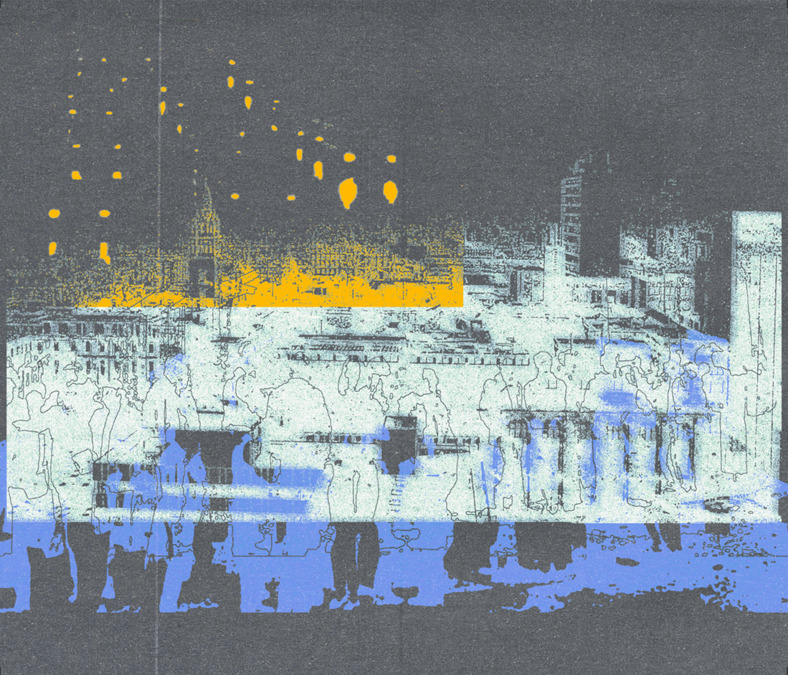
Illustration by Joe Munsey.
The Nile’s Glasgow becomes a place small enough to have a distinct feeling and sense of self, and yet huge, large enough to contain a near infinity of miniature vignettes and dramas: Stay’s dreams of love rekindled by summer’s freedom; Easter Parade’s capturing of a singular moment perfectly in perpetuity: 'In the bureau typewriter's quiet / Confetti falls from every window / Throwing hats up in the air / A city perfect in every detail'. The city shelters its populace from the rain and in turn, the people cover its decrepit buildings in flowers and paintings.
Glasgow is a city of ruins, filled with sites of absence. The M8 is a knife through the heart of the old Victorian town; the city smothered in would-be monuments to faded imperial glory. The now-empty plots and decaying, uninhabited structures seem to exist adrift from the present, crumbling evidence of what-once-was.
The city’s current reality is bleak. Amidst an interminable housing emergency and the near-cyclical destruction of beloved institutions, it seems to be getting bleaker. The tattered banner plastered on the Met Tower claiming 'People Make Glasgow' takes on an ironic truth. Draped in the decay of a better past, it’s left entirely to Glasgow’s populace to maintain a sense of cultural self that persists outside its ruins. The city faces a similar moment as it did in the mid-80s; untethered from its former identity, yet still covered in its detritus.
Glasgow is not a metropolis, and this feeling of being lesser, this apartness, comes from the sense of marginalisation that attends being 'regional'. The metropolis is content to obsess over itself, and so each regional centre mirrors this, vaunting a cultural autarky of its own to create a bulwark against Londonism. “This is Manchester,” so I’m told. “We do things differently here.”
Like Manchester, Glasgow is one of several 'Second Cities of Empire', and it seems terrified of letting go of its former role as a protagonist of history. It appears stuck in a miasmic pastiche of its own past, whereby the humour of the 2000s is endlessly recycled alongside the canonisation of the 80s and 90s music and art scenes; a whole city flattened into Billy Connolly and Still Game, Simple Minds and Franz Ferdinand. These airy references to the ethos of earlier times are endlessly repeated, but never with much reverence, because to revere the past would admit that it is something better than now, something with distance enough from us to become an object of reverence.
There’s a famous exchange in Alasdair Gray’s Lanark where the novel’s half-protagonist, Duncan Thaw, is asked why Glasgow’s magnificence goes unnoticed. Thaw responds abruptly: “Because nobody ever imagines living here.” For Thaw, Glasgow is never an artist’s muse and “if a city hasn’t been used by an artist, not even the inhabitants live there imaginatively.”
But Glasgow is just as much the world as the places where we imagine history to happen, and the world does not have to validate us for us to have worth, feel meaning. We don’t need to quote Diego Maradona or Anthony Bourdain talking about how much they love Glaswegians for us to fruitfully utilise our own cultural space, to give the city its breath back. Because even as the material world crumbles, the cultural one can flourish. The cracks in materiality give root to new ideas, allow connections to be made where once there were just walls with their backs to one another. Glasgow can converse with its ghosts because the spectre of our industrial past is still visible and present, is right here with us. But too often we’re mistaking these ghosts for living things, desperately willing their fading imprint back to life. At its root, this is a fear that the future has left this place.
“What is Glasgow to most of us?” asks Thaw. “A house, the place we work, a football park or a golf course, some pubs and connecting streets.” For PJ Moore, the Nile’s keyboardist, “the Glasgow you see now, it isn’t the Glasgow that was there when we were writing the songs. It never existed. It was part Chicago, part New York, part Brigadoon.” Every city ultimately imagines itself into being; The Blue Nile tried to imagine Glasgow in decay as the most glamorous place they could think of: something like an American metropolis during Hollywood’s Golden Age. A Walk Across the Rooftops remains vital in demonstrating that, even in a desperate moment, then as now, the city can become the canvas for another dreaming, a new interpretation.
Anyway, 'James Kelman' arrived, but he wasn't the Glaswegian writer. He was just a guy with the same name, in for brunch with his family. The shift finished and, energised by this non-encounter, I put A Walk Across the Rooftops on and walked up to Garnethill. Towards the album's close, as the M8 fell away beneath my feet, Heatwave came on. Vocalist Paul Buchanan croons like Sinatra over a synthscape that seemingly reassembles the Fordist production process. The chorus rises and envelops the ears, like having a sunset-crested vista greet your eyes upon escaping the clustered, loud grey of the production line’s innards. 'Are we rich or are we poor?' he sings, 'Does it matter anymore?'