Scottish Ensemble & Brìghde Chaimbeul @ The Queen's Hall, Edinburgh, 23 Aug
While the collaboration between Scottish Ensemble and Brìghde Chaimbeul offers nothing like a clear answer to any grand question on artmaking, the work itself captivates and hypnotises
Before Scottish Ensemble and Brìghde Chaimbeul’s collaboration starts, a video work by Jonny Ashworth plays: a moon slowly sinking then rising behind clouds, above a cove. The video then tells an elliptic fable of a tailor intent to stitch garments as a fearsome ghoul rises from the ruins of a church. It’s a compelling allegory for an artist like Chaimbeul – amongst all the horrors of the contemporary world, what does it mean to sit, patient and insistent on complex and elaborate work, difficult to execute?
With a runtime of 80 minutes (and no interval) we could expect the demand of this concert to be around longform patience, but what unfolds is far more informed than a mere soundbath. A multifaceted suite, it begins in contemporary drone, up there with the intense majesty of Kali Malone – the ensemble something close to a living synthesiser made of string instruments, Shepard tones galore – followed by sections which are warmer, yet similarly vortical and uncompromising.
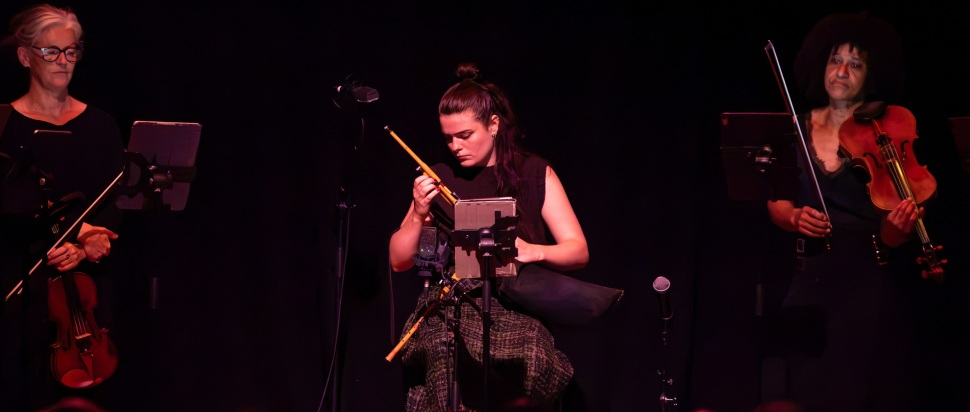
Chaimbeul’s duet with Jane Atkins on viola is an affecting highlight; it also showcases the interesting inversions at play. Whereas strings can theoretically play any scale, pipes cannot. Typically, strings have to step into the pipes' world, or work alongside that range. In this duet, though, the viola does ‘pipeisms’, with similar constancy to the folk instrument. With this in mind, also noteworthy is a later section that begins fiddle-led, resembling traditional folk, before disintegrating quickly into something atonal – raised to heart-pounding intensity, before plummeting down. All the extremes of emotional melodrama play out in a couple of minutes.
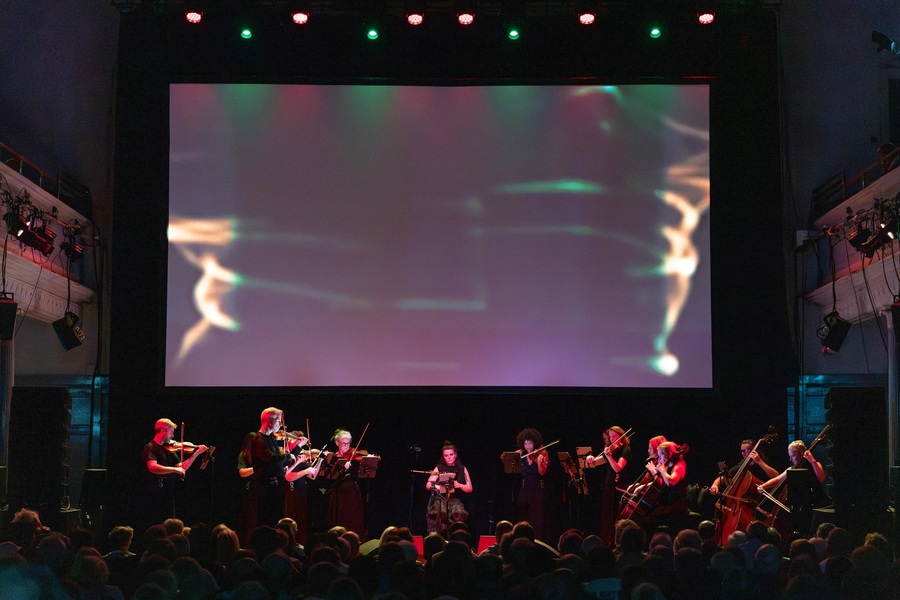
Image: Scottish Ensemble & Brìghde Chaimbeul at The Queen's Hall, Edinburgh, 23 Aug for EIF by Jess Shurte
The work therefore shows the audacity of a young talented artist, a certain Gen Z propensity to combine as vast a spectrum of elements as possible, to take in the widest breadth of influences possible. To this effect, the concert ends with a rendition of Music In Similar Motion by Philip Glass – a clear signal to the kind of traditions Chaimbeul intends to enmesh (or, to paraphrase the introductory narration, what “distinctions to intertwine”). There’s something like Tristan Perich to the recorder’s tone here as smallpipes are pushed to their limit in constant arpeggios; sound reduced to its basic clear tones, used to resounding effect. In other words, Chaimbeul sets herself out as a minimalist, first and foremost. It’s an effective pairing: the clockwork-like machinations of a Glass piece are stark in contrast to the expressive intensity of the preceding suite, but both are explicit showcases of the talent on display tonight.
The tailor in the introductory video, we are told, “made light” of the ghoul. Although this is meant to mean he mocked the ghoul, perhaps we can take it more literally – that he turned his fear into remarkable illumination. This collaboration offers nothing like a clear answer to any grand question on artmaking, shrouded in heady mystery as it is, but the work captivates and hypnotises regardless. Despite its ominous thrums and drone and experimentality, it shows brightness, like slatted moonbeams hitting a darkened cove.
Scottish Ensemble & Brìghde Chaimbeul performed at The Queen's Hall as part of the 2026 Edinburgh International Festival
Thanks to Alex Macphail for technical assistance with this review.