Fiona Soe Paing @ Glasgow Royal Concert Hall, 27 Jan
A pair of talented Scottish voices – Fiona Soe Paing and Quinie – are placed front and centre at tonight's striking Celtic Connections show
Josie Vallely, aka Quinie, begins by mentioning that the “pipes are on strike” – they don’t sound good in the Strathclyde Suite. So the opener is an unaccompanied song. This is no problem, however, for this is Quinie’s strength. Her voice is truly powerful – it soars to a trill, then comes down to an unassuming half-spoken hush, within one bar.
The accompanying quartet ebb and flow for the rest of the set. Half of the time they wait, then come in with meditative and patient soundscapes. Extended technique is deployed from the get-go; two violins, a mandolin and a double-bass is the crux of the band, though sometimes these are swapped out (one highlight is the use of an Armenian pipe instrument, the duduk). To these songs Quinie offers brief Scots spoken-word, a sung poem from Marion Angus, candid banter.
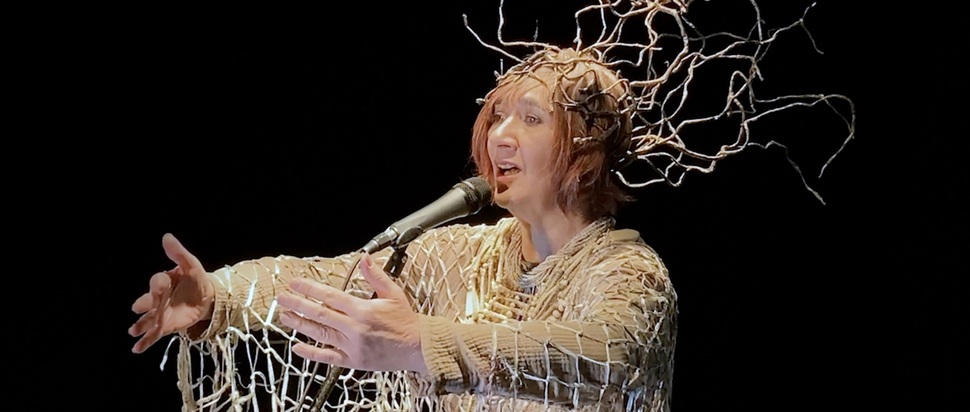
Quinie’s sparseness is complemented by Fiona Soe Paing’s ambitious multimedia set, developed in tandem with her recent album Sand, Silt, Flint. On a large screen the camera slowly zooms into an old map of Aberdeenshire, while an interview extract, laden with reverb, explains this is ‘the ballad county’. Then Soe Paing comes on – resplendent in a crown of abstracted wire evocative of lichen, or antlers, or coral, as well as a gold-beige mesh reminiscent of netting, plus pearls. She is the only figure on stage; she remains stage right, under a spotlight, for the entire performance. Acting as a high priestess to this audio-visual experience, Soe Paing lends her sonorous voice to tracks inspired by particular areas of the Scottish north-east (the camera traverses over the map as the backing track shifts to the next song, artificial vinyl pop in tow).
Fair to say, Fiona Soe Paing is the Björk of Torry. Her singing is Doric-futurist, a slipstream between dialects and languages. This, paired with distinct sound-design and elegant folk arrangements, makes for an evocative experience – where Ableton begins and strings begin is uncertain. Like Quinie, here there is a centring of the voice; archive recordings and interviews conducted by the Elphinstone Institute are weaved throughout. At a crucial juncture, a spoken mantra gives us the album title drop.
Sometimes the visuals are too sentimental, like an overexposed VisitScotland ad, but sometimes they are striking – tendrils of sea froth chromakeyed over a village, a seaside cave entrance like a rip in the sky. We let any tweeness slide; ultimately, this is an underrepresented area of Scotland being given the spotlight. Aberdeen is usually regaled to cultural sidelines in contemporary expressions of Scottish culture, so it’s gratifying to see it centre stage, in an innovative fashion no less. Considering how often phones are raised from the audience, to film extracts, we gauge Soe Paing’s performance is a glittering success.
Celtic Connections runs across various venues in Glasgow until 1 Feb / celticconnections.com
Follow Fiona Soe Paing on Instagram @fionasoepaing and Quinie @quinie.music