SMIA and Hen Hoose on their plans for Scottish music's future
Following the announcement of two major schemes to help futureproof the Scottish music industry, we speak to the SMIA's Robert Kilpatrick and Hen Hoose Collective's Tamara Schlesinger

Whether you're a listener, performer, engineer, label boss, or someone who works at a music venue in Scotland, chances are you'll have been part of conversations about the gig economy and the uncertainty of making a living as someone working in the music industry. Or you might have fears and anxiety around the future of the arts as the economy changes and funding routes seem more precarious than ever. Yet we know how integral music is to Scotland’s economy and culture – from Edinburgh and Glasgow’s vibrant music venues to the pubs in rural Scotland that host live music sessions. Scottish music is original; it both embodies and creates an evolving identity and shapes the cultural landscape.
A lot more can be done to ensure the wellbeing of the people who make up this essential sector, and the good news is that two organisations have taken on the mantle of this work. October has been a big month for the Scottish music industry, with two initiatives – the Scottish Music Industry Association’s (SMIA) Roadmap 2026-30 and Hen Hoose’s Safety Certification Scheme – hoping to change the sector for the better.
Robert Kilpatrick on SMIA's Roadmap
When Robert Kilpatrick first walked into the SMIA’s office, it was run by one employee sitting behind a desk. Now 12 years later, he’s the CEO of a membership organisation with a network of six thousand music practitioners that is integral to the very fabric of the industry it seeks to represent. The SMIA has big plans for Scotland’s music scene and lucky for us, they also now have a roadmap of how to get there. So what brought the idea around?
“Thinking about how important music is to our cultural identity and economy, how we know ourselves as a society and a nation, [and] how leanly resourced the industry was – obviously, it has gotten better since there’s more investment and reinvestment – with the SMIA’s work, it brings into focus how the music industry is this complex web and the support that it requires is very nuanced," Kilpatrick tells us. "Over the years we have tried to respond to the individual issues that come around when things like Brexit and COVID happened, but we recognised that until we fix the reasons for the issues, you will only ever be scratching the surface. So, the idea [of the Roadmap] was to zoom out as much as we could to try and look at it as a system and which bit of this system needs to change in order for it to function properly.”
The Roadmap defines the industry not just as consisting of artists, but to include the people and businesses that are involved in ‘creating, developing, performing, teaching, producing, distributing, promoting and experiencing music, and the infrastructure that supports this activity.’ The vision that the SMIA has for a stronger, fairer and more sustainable Scottish music industry is to be realised along the lines of five ‘change ambitions’ – that is, the broad changes that they hope to see in the sector by 2030.
“Over the course of the last two years, we did our own research, and it took the form of member engagement through surveys, member one-to-ones and ongoing dialogue with members and through the SMIA Summit," which happened last month, Kilpatrick says. “The idea is that we collectively are Scotland’s music industry – how do we move from here to there? So it’s about coming in as a member of a community and recognising that we all play a part.
"Then after we had pulled [the research] together, we went through a targeted validation stage where we took draft elements of the Roadmap to different stakeholders of the sector. So we liaised with everyone from Creative Scotland to Glasgow Life, South of Scotland Enterprise to sub-sector specific trade bodies like the Music Managers’ Forum or the Association of Independent Music, pulled all of their feedback together and now have a roadmap – it’s like a business plan for the entire Scottish music industry!”
One issue that the Roadmap brings up is that the Scottish Government should understand the importance of the music industry and to bring in policies that support and nurture it. “The timing of the Roadmap is key, because in July of this year the UK Government announced Turn It Up: Our plan for music,” Kilpatrick points out. “Obviously in Scotland with culture being devolved… there’s a £45 million package in the UK, a lot of that money Scottish artists and music businesses can’t access because it’s ringfenced to support activity in England.
“So with the Roadmap, even prior to this package being announced… it recognised that in Scotland we had really specific challenges that were making these barriers for us… So what we hope to do with the Roadmap is to bring this to light and show the Scottish government that this is where the sector currently is and unless there is an intervention made to address the priorities addressed in the Roadmap the disparities between the music businesses in Scotland and England will grow.”
The SMIA's five 'change ambitions'
Build the conditions in which music can thrive.
Make music careers and businesses more sustainable.
Secure greater and more strategic investment in music.
Connect Scottish music more effectively with audiences and the world.
Give music greater national weight.
Tamara Schlesinger on Hen Hoose's Safety Certification Scheme
An issue that both Kilpatrick and Hen Hoose Collective’s founder Tamara Schlesinger agree is a major challenge for the industry at this time is that of access. Who gets to be involved and heard, in what capacity, and what barriers face those who want to be involved?
Schlesinger started Hen Hoose during the 2020 lockdown, a decision she says was informed by the statistics on women and non-binary artists in the industry, especially their signings to record labels and publishing companies as well as the clear gender disparity in headliners for music festivals. Starting as a place for women and non-binary artists to create music together, Schlesinger noticed gaps in confidence and knowledge, which led to the collective providing educational opportunities through outreach and mentoring programmes on how to produce, release and market music.
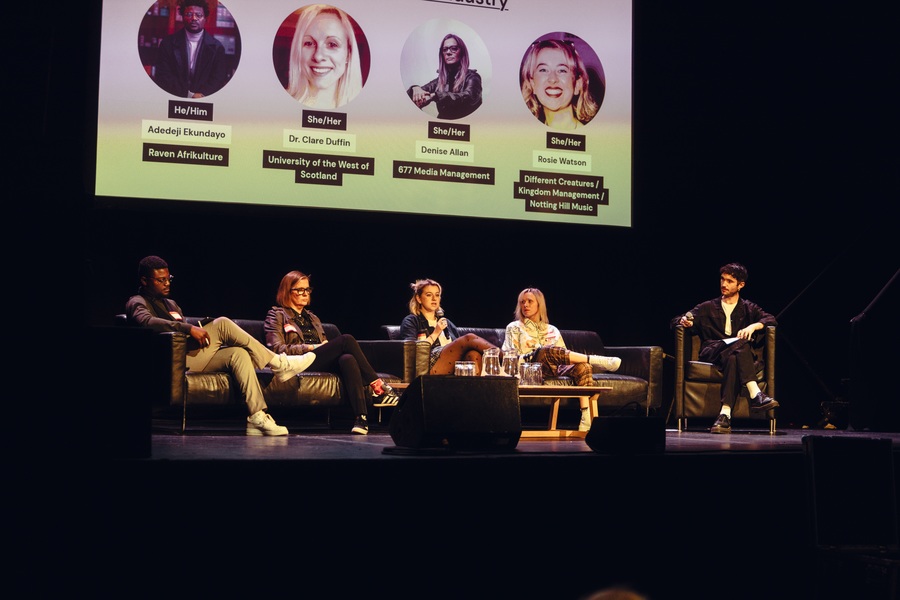
SMIA Summit 2025. Image: Daniel Blake.
Their recently launched Safety Certification Scheme has been years in the making, but part of the impetus comes from the report on sexual harassment and violence in the Scottish folk music scene funded through the University of Glasgow. “Following the report on harassment in the folk scene, we made a statement, and we wanted to speak to our community because we were getting a lot of DMs and a lot of messages saying, ‘this isn’t just the folk scene’,” Schlesinger says. “We thought, what can we do? So we called a town hall meeting… and so many ideas came up within that. I’d had the idea about the training and the Safety Certification Scheme anyway, and with the feedback from the community it felt like this was a first step, a stepping stone, someone visible, someone there that you can go to as a basic. Then you can look beyond that – but just a space where you know that there is someone you could go to.”
The Scheme will ‘provide free specialist training and establish identifiable safety contacts at participating venues, record labels, events and studios, giving artists, workers and audiences a clear person to approach if they experience or witness an issue.’ The nominated people will undertake training delivered online and in person, which will cover bystander training, equity, diversity, inclusion and accessibility training and cover topics of safety and wellbeing. The training will be created by Jayne Stynes and Dr Clare Duffin, lecturers at the University of the West of Scotland, alongside The FLAPS Project, an organisation which provides sexual and emotional welfare and specialist support services for nightlife and music festivals.
“We’re starting the content by reaching out further to the community and the industry and saying what do you need? What do you not know about? If you’re doing events, do you already have safeguarding policies in place or not? What would be good for you to learn? And we’re gonna design it for the Scottish industry," Schlesinger tells us. "But it’s the whole industry, not just live events – this is recording studios, practice rehearsal rooms, management labels – it’s everyone, because what we really need is a basic, for women to go to work safely. Before we promote our music, before we do anything else, we should be able to be in an environment and be safe.”
The pilot testing scheme, which is funded by Creative Scotland, will begin early next year, with a list of the participating partners available on the Hen Hoose Collective’s website. Once these organisations have received training, they will be certified and their names will be published by Hen Hoose as part of a publicly available directory, so that people can be aware of the support and services they have by being in a safer space.
These two developments – both announced in the same week – are ambitious in their approach to the future of the Scottish music industry. They bring practical and actionable points to a quickly evolving but often under-supported scene. Although it is early days for both projects, they inject hope into the modern bleakness with which we see the future. If the future follows along these lines, then it sounds good to us!
For more information about the SMIA's Roadmap and Hen Hoose Collective's Safety Certification Scheme, head to smia.org.uk/roadmap and henhoose.com/safetycertificationscheme