Drone Logic: Piping Live! festival returns to Glasgow
Piping Live! returns for its 23rd year, this time with an expanded experimental programme – we catch up with the team behind the festival to talk minimalism, guided improvisation, and Angine de Poitrine
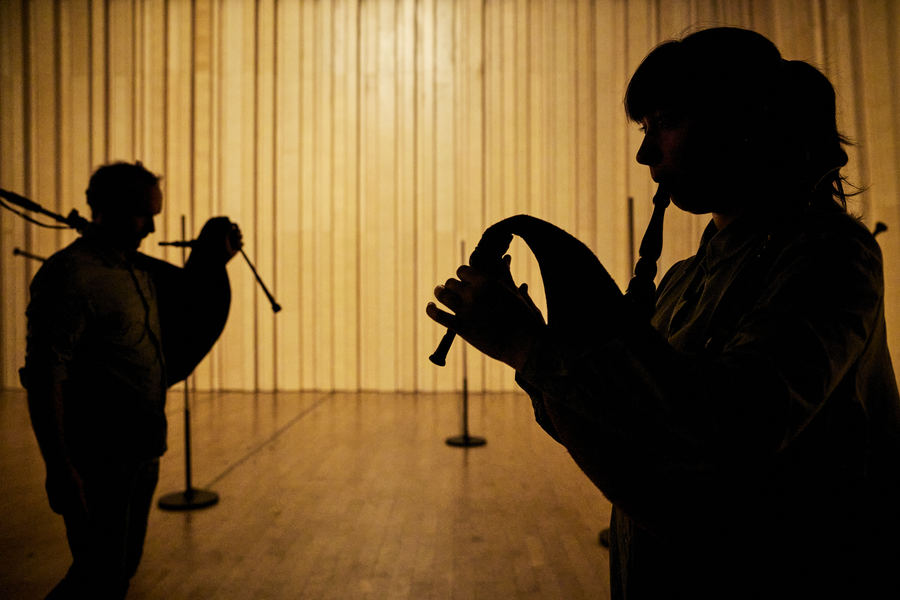
Piping Live! has been around for 23 years now, designed to coincide with the World Pipe Band Championships and bring the sounds of pipes from all over the world to the heart of Glasgow. The festival, in contrast to the tightly proscribed sound of the Championships taking place on Glasgow Green, serves to platform all aspects of the instrument (this year’s features everything from a make-your-own-chanter workshop to an album launch/underground electronic night at the GSA).
“A lot of the people that are coming for Piping Live! in general have – not a fixed idea – but a real understanding of what bagpipes look like in terms of the traditional structure and the traditional idioms that they play in," says Head of Events Helen Urquhart. “What we want is somebody to come for the whole day end to end. They'll hear some solo pipes and a trad group and a pipe band from a school, and then they come to [an avant-garde performance]... The essence of our festival is to try and give people that breadth of the bagpipe as a living, breathing, moving instrument.”
The experimental aspect has historically found a home in the festival’s dedicated Ceol Nua night – a gig in the basement of Nice 'N' Sleazy, dedicated to avant-garde and electronic music. This year, thanks to additional funding, the programme is expanding to four nights including ambitious performances of pieces by giants of the minimalist movement Terry Riley and Philip Glass, as well as a premiere of a new piece by Erwan Keravec in Kelvingrove Art Gallery.
The performance of Riley’s In C takes place at the Barrowlands – 20 Breton pipers in a circle on the dancefloor, in the dark but for their illuminated platforms. The audience can stand, sit, lie anywhere, listen however they like.
The piece is considered one of the foundational pieces of minimalism; its sheet music consists of 53 short sequences of notes which float, together but unconnected, across one sheet of paper. Performers play the patterns in sequence, at a pace of their choosing and with as many repeats as they like. But this is guided improvisation: the performance directions place limitations on the individual player such as to stay within two or three patterns of each other, or to come together in unison at least twice throughout the rendition. The most important instruction is for players to pay attention to each other (in Riley’s words, “this means occasionally to drop out and listen”).
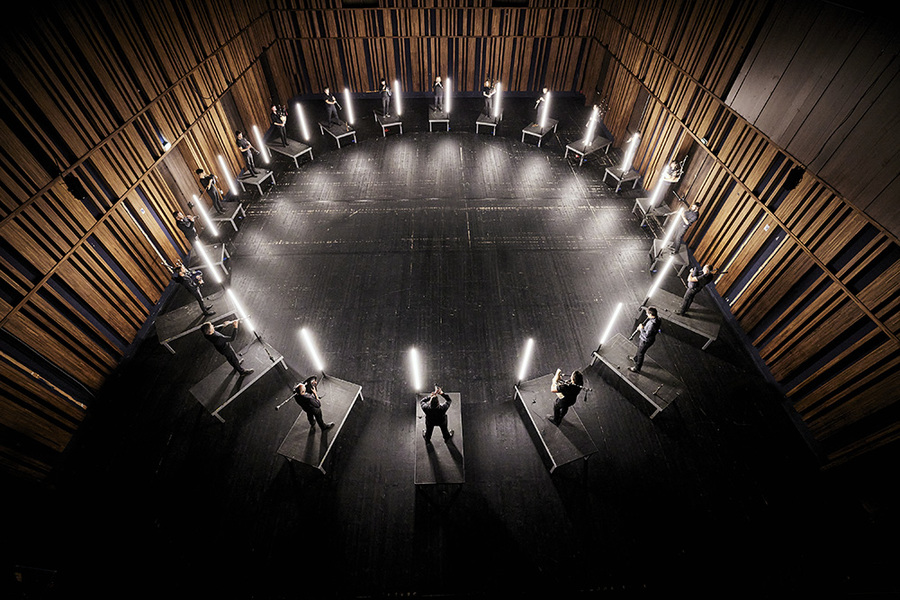
The In C Pipers. Photo: Christophe Raynaud-de-Lage
This minimalistic style poses a unique challenge for pipers – with only a nine-note range and a fixed dynamic output, the bagpipe has limited tools at its disposal for expression. Its players have worked within the constraints of the instrument and over time different, bespoke, metrics for success have emerged. Programme Director John Mulhearn explains: “One method by which we tend to do that within the traditional repertoire is in the very nuanced expression of timing, the very subtle rubato that you apply in places, the very gentle push and pull of phrasing in order to create balance and tension and release. That stuff doesn't apply to these rhythmic frameworks for the most part.”
Mulhearn has described the bagpipes as “a sort of proto-minimalist instrument” because of their use of drone, and at home and abroad a generation of pipers are currently exploring this to great success. Star of Scottish experimentalism Brìghde Chaimbeul has spoken about writing as a meditative process by which she tries to get right into the middle of a sound – you can see how her practice has been shaped by an instrument which literally has to be tuned to itself.
As Mulhearn also points out, the bagpipe uses a tuning system that sits outside of the modern western musical tradition. Instead, they have a sound that is more ancient – and which far pre-dates the minimalist movement of the 1960s.
“You think about AI and AI-generated music, and how much it's going to still lean into reinforcing tuning systems that are very much part of the Western tradition... and you can take Angine de Poitrine from Quebec, who are using these microtonal systems for their pieces as a way around the fear of machines taking over.” These instruments might then offer a glimmer of interest against the looming background of aesthetic hegemony. “Machines are not going to replicate that. They're not going to replicate this.”
Piping Live! runs at venues around Glasgow, 9-14 Aug
Ceol Nua, Nice N Sleazy, 10 Aug; In C // 20 Pipers, Barrowland Ballroom, 11 Aug; 8 Pipers for Philip Glass, The National Piping Centre, 12 Aug; Continuum for Bagpipes, Kelvingrove Art Gallery, 13 Aug