Play Time: Meet Scotland's Music Instrument Libraries
Music Broth, We Make Music Instrument Libraries and GLOSS tell us about the role of music instrument libraries in overcoming barriers to music tuition, reducing waste and connecting communities
In 2017, a Glasgow musician wanted to find a way to share the musical instruments they’d inherited. In 2021, a librarian running a youth music workshop in Muirhouse, Edinburgh realised that music learners needed instruments they could take home. During lockdown, an electronic musician wanted somewhere to share his skills with budding musicians. These three problems arrived at a common solution: music instrument libraries.
When Jen O’Brien co-founded Music Broth in 2017, there were no other instrument libraries in the UK and very few in the world. The Glasgow social enterprise now has over 4000 donated instruments at their site in Finnieston. "We wanted it to be a social enterprise that wouldn't be depending on funding and wouldn't disappear," O’Brien recalls. Membership has remained at £6 per month since the project began and members can borrow instruments for as long as their membership is active. But O’Brien emphasises, "We never ask anyone to contribute if they can't afford it; the whole idea is getting things out to people."
As well as the library itself, the charity hosts workshops and jam sessions for musicians of all ages and abilities. While many families find it an affordable way to allow kids to try out different instruments, projects such as their ‘build-a-band’ workshops are aimed at adults learning or re-learning to play. And Music Broth has found ways to reach people beyond Glasgow too, with regular pop-ups everywhere from Linlithgow to Stornoway.
Also aiming to reach people across Scotland, We Make Music Instrument Libraries is a campaign organised by Music Education Partnership Group and Tinderbox Collective that equips public libraries across Scotland with donated musical instruments that can be borrowed just as you would a book. Starting in Muirhouse Library in 2021, the project has already set up collections in almost 50 libraries and, last year, lent out around 1500 instruments. Through long-term loans and their educational programme, funded by the Scottish Government’s Youth Music Initiative, they have provided countless children with instruments they might not otherwise have access to.
Hannah McCooke, the project’s Coordinator, explains that every community has its own needs and thus every instrument library is different, whether they offer punk workshops for teenagers or music exploration for babies. "It's not a central person, especially like me, sitting in Edinburgh and deciding, 'this is what Culloden needs.' I don't know what Culloden needs, but the librarian does."
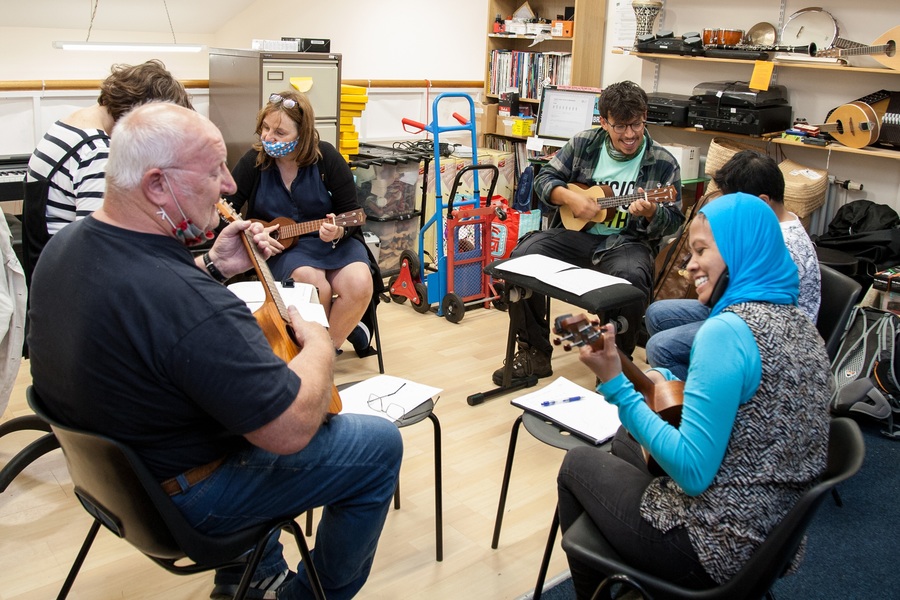
Music Broth. Credit: IEM Photography.
Both organisations have taken inspiration from other circular economy projects such as tool libraries, and repairing instruments is integral to their work. "The point is to try and take these old instruments that are often really good quality instruments because they're older and spend that wee bit of time and money to get that instrument back into circulation and not in a landfill," explains McCooke. "It's probably a romantic thought of mine," she adds, "but I just think instruments want to be played."
Similarly, Music Broth aims to be zero-waste. "If we can't make an instrument musical, we harvest it for parts to make another instrument musical. And even the carcasses that we've harvested, we try to make into something else," says O’Brien. The library often repairs electrical music equipment too, she explains. "We've had stuff come into us 'unrepairable' and we've fixed it and it's gone out and done 20 more gigs. And then we've repaired it again and it's done 20 more!"
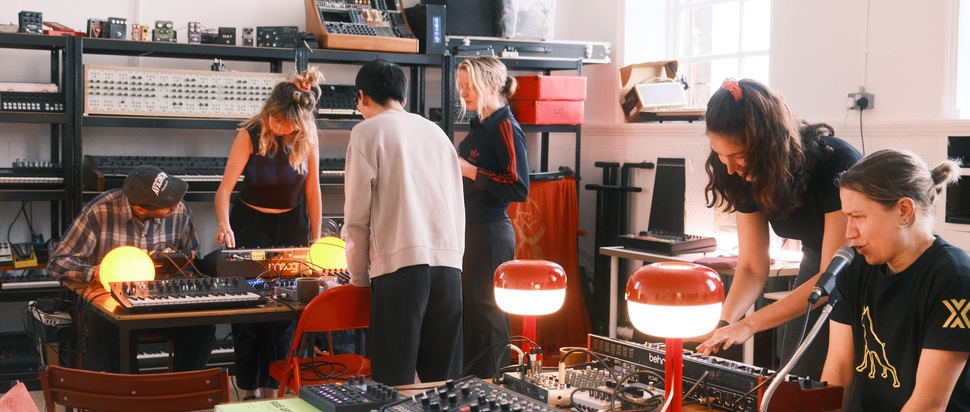
In the world of electronic music, accessing education and resources can be especially challenging. Lewis and Suzi Cook, best known as electronic pop duo Free Love, are co-founders of GLOSS (Glasgow Library of Synthesised Sound). "Although electronic music is new-ish, it still has developed its own conservatism within the tradition," Lewis reflects, noting that, despite a lot of its innovators being women, it’s still a male-dominated field. "We try our best to place ourselves outside of that and stay true to the ideals of the pioneers who were using electronic instruments as a way to subvert the norms."
GLOSS started as a series of online educational workshops during the pandemic and has since moved into its own space in the Gorbals, offering bookable sessions for visitors to use their wide range of synthesisers and recording equipment. "The first thing we say to anyone coming through our doors is that everything in this room is here for you to play with," says Lewis.
He sees the project as a reaction to the rise of AI music software, which, he argues, takes a view of creativity as an "obstacle" rather than a practice with value in and of itself. Central to the project is the opportunity for experimentation and collaboration. "It comes back to music being a social thing," he says. "Getting a chance to make your own music and present it to people, it's sort of fertilising the soil that allows things to grow bigger."
Since Music Broth began as a tiny Glasgow project, music instrument libraries have helped reimagine the role of community spaces. McCooke sees the potential of libraries as social hubs, where ideas are shared as much as things: "People getting tools, sewing machines, instruments, having a cup of tea and connecting with the people around them and getting educational opportunities… it's all connected. It's all building something that creates a connected community where people rely on each other."
Find out more about Music Broth at musicbroth.org, GLOSS at gloss.scot and We Make Music Instrument Libraries at wemakemusicscotland.org/instrument-libraries