Stay On Board: Skateboarding and collective connection
Helmet on, balance off – the skatepark’s ready to catch you. One writer explores how skateboarding can bring us closer to ourselves and others
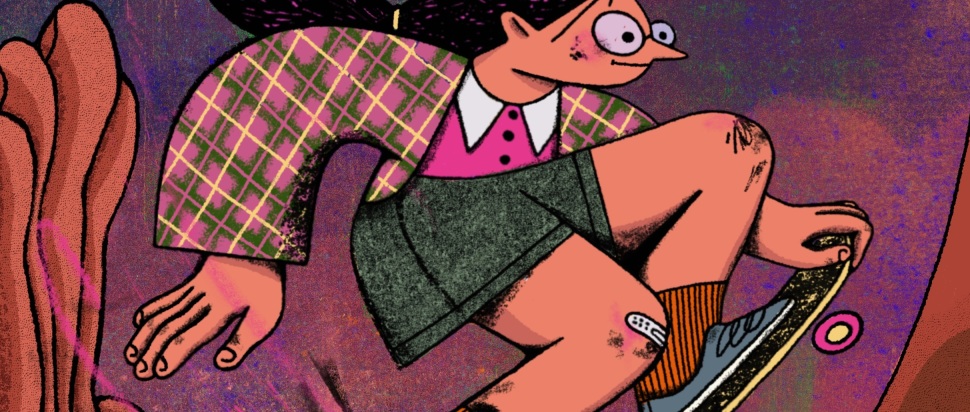
Two years ago, in my mid-30s (let's agree I'm still in my mid-30s and move on), I started skateboarding, which was not a sensible decision. By that point in life, I had developed a (fairly) functional understanding of risk. I knew that concrete is hard. I knew that falling hurts. I knew that learning a new physical skill as an adult is (often, almost always) humiliating. Yet despite all of the available evidence, I began repeatedly throwing myself at the ground. But it turns out that this was one of the best decisions I've ever made.
Learning something completely unfamiliar as an adult can be a truly transformational experience. By my age, life can begin to settle into humdrum routines. We become (semi) competent. We know what we're good at. We often stop putting ourselves in situations where we're visibly terrible at something. Skateboarding demands the opposite. It asks you to embrace failure very publicly and repeatedly, to spend weeks trying to learn something that a fearless 12-year-old can do in moments without thinking. And yet, that’s absolutely where the magic of it all is.
Every bruise on my knees, every graze on my elbows, every ache in my mid-30s hips feels less like an injury and more like evidence that I had a really good time. Skateboarding has reintroduced fear, excitement, vulnerability and play into my life. It has reminded me what it feels like to be a beginner. As someone assigned female at birth (AFAB), I don't think we're often encouraged to have that relationship with our bodies in adulthood. Many of us become disconnected from our bodies over time: through work and care responsibilities, through ageing and existing in a culture that constantly asks us to think about how our bodies look rather than what they can do. Bodies often become projects and things to improve. For me, skateboarding has shifted that entirely.
For an hour or two, my body is no longer something being observed; it's something being experienced. It's not about how my body appears; it's about whether it can stay over the board for another second. Whether I can commit to a drop-in. Whether I can get back up after falling. Whether I time turning my hips correctly to finally get that half-cab rock to fakie (my ambition this month). For so much of adult life, we're encouraged to think about our bodies as individual projects to improve, but skateboarding reminds me that bodies are relational. We learn through and with each other.
But while skateboarding has transformed my relationship with my body, the thing that has surprised me most is the community. I have spent years working in arts and cultural organisations, previously as a community development officer for a national arts organisation, currently (among many other things) as a researcher for community engagement projects with another national cultural organisation. We (in arts and culture) talk endlessly about community. We build projects around community engagement. We run consultations, outreach programmes and participatory events. Yet on reflection, community is often treated as something external. The community is always somewhere else. It is something organisations reach out to, invite in, work with for six months or a year, and that we return from to our own sacred art bubbles. Community in this sense is a demarcated and commodified and extractable Other.
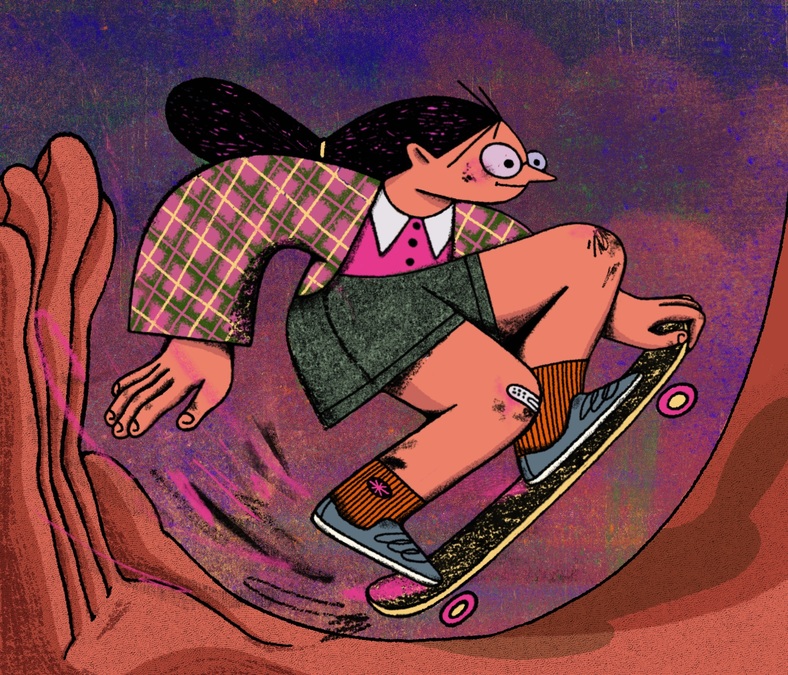
Illustration by Vaso Michailidou.
I started attending Cat's Friday Skate Club in Edinburgh and like many AFAB folk, I found the idea of walking into a skatepark alone completely intimidating. I didn't know anyone and I wasn't good. But instead, I found one of the most welcoming groups of people I've ever met.
Six months after joining, I started volunteering with the club. I've watched Cat (the organiser) and a group of volunteers work tirelessly to create spaces where people can learn, feel safe and have fun. Sessions move between skateparks and DIY spots across Edinburgh, held together largely through determination, care and a shared love of skateboarding. The encouragement people offer each other is extraordinary. There's no expectation that you need to be good. People celebrate effort. They celebrate trying. They celebrate you for just showing up.
The skateboarding community is genuinely intergenerational and wonderfully messy. People come from different backgrounds, different ages, different identities and different experiences. The thing connecting everyone is simple: we're all trying to have a good time on a skateboard. It's amazing what becomes possible when people gather around joy.
Skateboarders check in on each other too. Between ridiculous attempts and tricks, conversations drift towards relationships and family, work and mental health. The spaces between skating become places where deep friendships emerge. I jokingly refer to one of my closest skate friends, Katie, as my ‘skate wife.’ We skate together at least once a week. There's something profoundly intimate about helping another person do something they're scared of. Holding someone's hand while they try something new. Standing beside them as they fail. Celebrating wildly when they finally get it.
Two years after stepping onto a skateboard for the first time, I can honestly say that skateboarding has changed how I understand community, how I understand other people, and how I understand my own body.