To Protest & Post: The digital footprint of protest imagery
Encouraging or endangering? In an age of heightened surveillance, we unpack the ethics of posting protest photos online
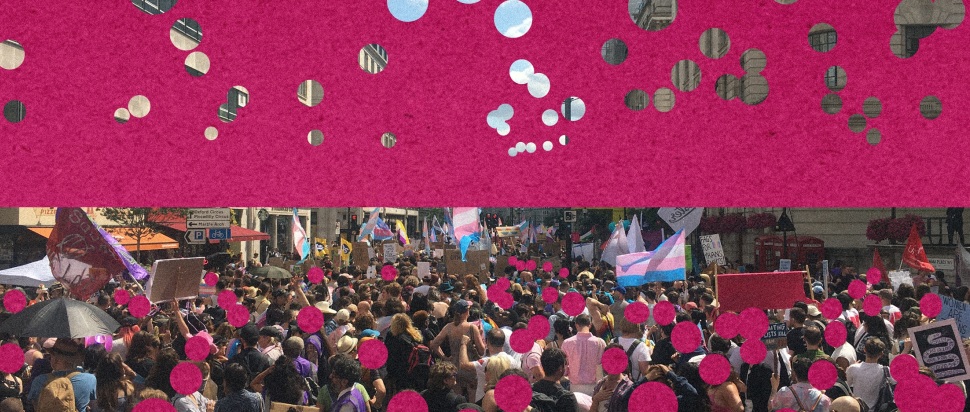
In the only photo I took of myself at London Trans Pride in 2024, I’m wearing a black face mask as well as my ‘trans people deserve better’ tank top. But the photos I posted on Instagram are of the flags and banners and the backs of people's heads in the 50,000 strong march. I took photos of the clever, creative signs and the trans joy all around me, but I made sure that the ones I posted didn’t include anyone’s faces. In 2026, we're used to seeing photos of protests on social media. Not because young people are unable to do anything without documenting it online, but because there's plenty to protest about.
And there's a real value to these photos – people posting photos of themselves at protests can encourage others to get involved. It was photos of people (including his friends) marching in London Trans Pride that led to Elliot getting involved in local organising. He now helps run two trans community groups and has got more involved in his local Jewish community, helping to “provide more alternative spaces to anti-zionist/pro-Palestine Jews.”
Elliot explains that the photos of London Trans Pride and people he followed on social media attending the Jewish bloc for pro-Palestine protests made him realise a lot: "I wanted my voice to be heard, I wanted to make it clear to the British public that the rights of minority groups are important and that there are a lot of people who support everyone of every creed having equal rights.”
Elliot wanted to find community but also to “be a part of something bigger than just [my] immediate community.” Rather than simply liking the photos on Instagram, he ended up walking in one of the first Sheffield Radical Pride marches – not just marching but actually holding the banner, “which was terrifying as I didn't realise we were going to block roads.”
It can be powerful not just to turn up and make your voice heard, but to share photos of you protesting too. Research published in October 2020 by Greijdanus et al reports, “In many cases online and offline activism correlate, either because people’s online and offline behaviours are intertwined or because one person’s online activism can mobilise others for offline protest.”
Arlo*, who is also involved in local organising, agrees: “Social media can help people feel ‘invited’ to join community actions because they actually understand who is there.” Despite such benefits, Arlo’s worries about having their photo taken has prevented them from attending protests that they would otherwise have loved to support. “I could potentially lose my job if the photos were taken out of context or I am seen to be undertaking ‘radical activity’. As a working class person I am reliant on my income for survival.”
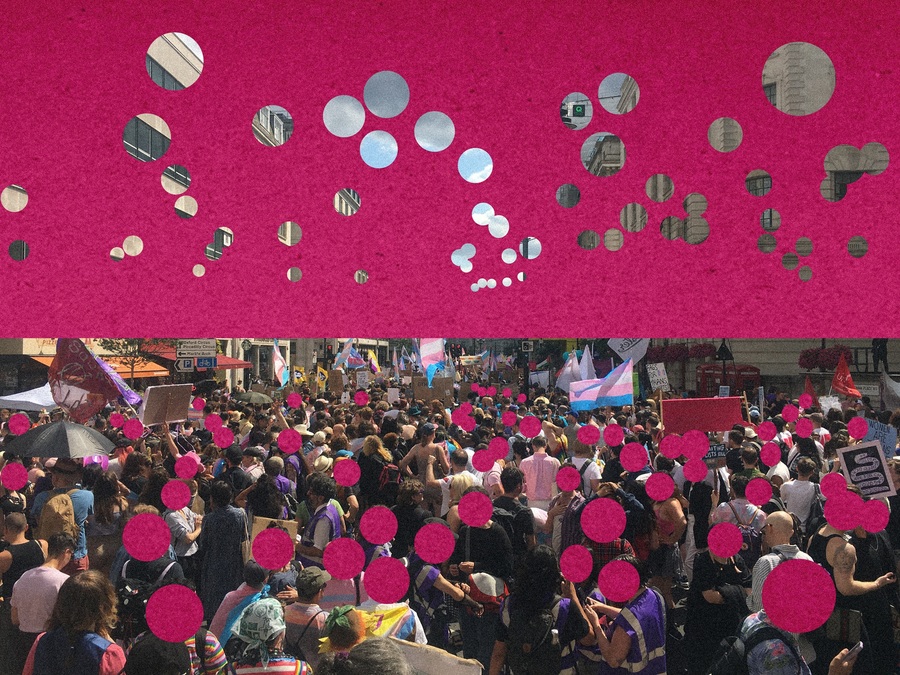
It’s entirely legal to take – and publish – photos you've taken in a public space, even if they include people’s faces. But something being legal and being ethical can be worlds apart. Arlo explains that “as a survivor of domestic violence and stalking, I am also worried about details being broadcast online that would give clues as to my location or where I live.”
While Elliot loves seeing photos of protests and is always excited to see himself here, being part of a movement and pushing for change – though he notes that he’s quite short so he’s usually hard to spot – he’s also conscious of people being doxxed so tends to mask up when they attend.
These fears aren't baseless; they're entirely justified. A paper by Gino Canella and Mary Angela Boc published in 2025 explores the ethics of journalists publishing photos of protesters. They conclude: “Protesters’ fears about their identities circulating online have been realized. US law enforcement and private vigilante groups have used facial recognition technology to identify people who participated in the 2024 pro-Palestine encampments.”
While Canella and Bock focus on the US, the same issues exist in the UK. You might say that showing up and being seen is why you go to a protest, but that ignores how state surveillance and anti-terrorism laws are being used (or, perhaps more accurately, abused) to drastically change the potential consequences of protesting in 2026.
And when the stakes are higher, putting your body on the line (or your face online) has different risks. James* – who is also based in Sheffield – admits that while he believes that visibility and accountability are “the whole point of a protest," he would think twice about being one of a small number of protesters, or if some part of the protest might be seen as “violent.” He is the parent of a vulnerable young person, and feels that “it would be irresponsible to put myself at a much higher risk of arrest."
Unfortunately, the UK puts the power to decide what counts as a ‘peaceful’ protest in the hands of the police. In January 2026, the Human Rights Watch released a report detailing how “protesters [in the UK] are increasingly detained, charged, and in some cases sentenced to multi-year prison terms for non-violent actions such as attending planning meetings.”
Posting photos of protesters might put them in very real danger. But the threat of repercussions for just showing up to a protest, which should be protected in the UK by Article 11 of the Human Rights Act, might actually be all the more reason to do so. Like Elliot, I love seeing photos of protests – they remind me that people do care, that they are out there trying to make a difference. They remind me that we have more power than we realise.
*Name has been changed for anonymity.