Flagging It: How flags dominated 2025
It’s near impossible to look back on the last twelve months without catching sight of a flag or two. We unpack how flags have risen in the political consciousness, and question the multiplicity in meaning they hold
In 2025, red, white and blue have claimed numerous lampposts and street signs. The cheap polyester flags sink in the rain, clinging all the more tightly to their makeshift masts. The flags remain for weeks, months; soon, their presence is accepted as not simply commonplace, but also somewhat permanent.
This summer – cloudy and impatient – brought with it another round of far-right riots. The Union Jack, unsurprisingly, flew high amid the violence. In September, Prime Minister Keir Starmer told the nation that he’s a “supporter of flags”. He even has an England flag pinned up in his home, he told us. We were expected to accept this as a symptom of unity and hope; we weren’t fooled. Our Labour government has insisted on digging its racist heels into the ground to make the lives of migrants all the more difficult: with current asylum reform proposals including an end to ‘Right to family’ claims and the removal of high value items from asylum seekers, it’s clear that not all are welcome. Meanwhile, a YouGov poll in October 2025 found that 27% would vote for Nigel Farage’s Reform UK in an upcoming general election. Amid this hostility, the flags remain.
Few of us are accustomed to thinking about flags this often. In school, some kid always had a thing for flags (and that kid was never me). They knew all the countries, all the colours. "Test me, test me," they'd say, thrusting a world map into disinterested faces. Nowadays, we think about flags often – sometimes, without realising it. Such is particularly true for people of colour. Sometime in October, an early Friday afternoon calls for post-works drinks at the local pub. We enter and I see only white and red – think of England and its flag – and panic, a little. But, no need: the red and white is simply taped across a low ceiling. It is a safety measure, rather than a warning signal. The pub is too crowded, we leave and I'm surprised to find myself relieved. I’m less surprised to find that my white friends weren’t seized by the same discomfort upon entering. We understand flags as universal; this year, I’ve learned that flags are anything but. Place to place, person to person, their meaning shapeshifts.
My early teen years played out against the backdrop of Scotland’s 2014 Independence Referendum. Much of the campaign was steeped in Scottish exceptionalism; however, there was a genuine collective agreement that Scotland wanted to be a country that welcomed anyone. It felt hopeful and, as a young person of colour grappling with my racial identity, I understood that I was allowed to share in that hope. Today, as our Saltire too-often joins the Union Jack on streets across the country, I’m less sure what it symbolises and what it wants to symbolise.
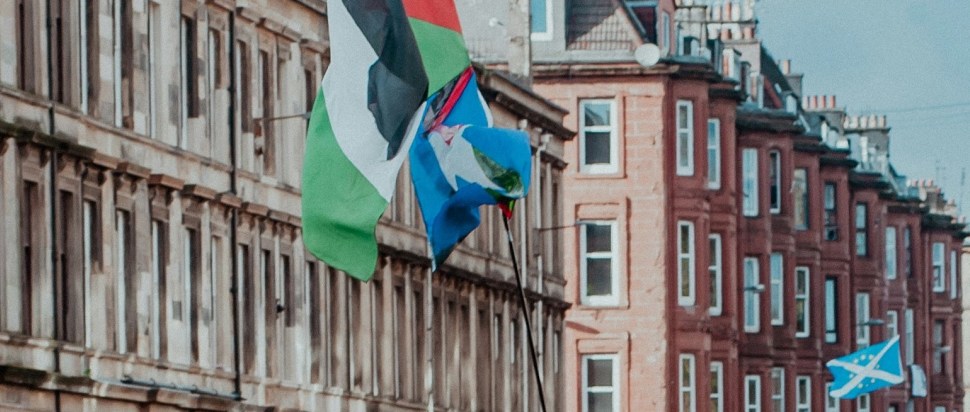
Then, in autumn, a new flag arrives. Palestine-Saltires appear around Glasgow and Edinburgh, claiming a particularly strong presence within Glasgow's Southside. One half of the flag holds the blue and white of Scotland’s Saltire; the other half holds Palestine’s red, black, green and white. In the weeks since their mounting, they’ve become well-documented on blurred and well-zoomed Instagram stories. As the flag’s presence has grown, its absence has become increasingly noticeable. Walking down a street in the Southside, it takes some time for me to realise what has changed, what has shifted: the Palestine-Saltires I’d become accustomed to had been removed. It isn’t clear why or by who, but it isn’t difficult to guess.
And so, I’ve sought flags, as much as I’ve avoided them. Palestine flags, trans rights flags, pride flags – they signal solidarity and, often, safety. It is an odd state of affairs: to reject a form so adamantly and then, also, hope for it. Such is partly because not all flags hold the same purpose: while some aim to intimidate and ostracise, others aim to welcome and celebrate.
In December 2020, Katie Goh, then Intersections Editor, penned an article reflecting on how statues had become "ideological battlegrounds" that year. Five years later, I find myself returning to it and thinking of flags. “It’s been some long-overdue, national soul-searching; but hopefully this look to the past will lead to a better future,” wrote Goh. Nowadays, calls to reflect on historic violence are largely drowned out by current violence. And so, 2025 doesn’t seem all that better than 2020. But, still, we hope for better – and we pin a flag to our coat while doing so.
In 2020, our conceptions of communal space shifted dramatically due to COVID regulations (and the inequalities they revealed) coupled with global Black Lives Matter protests following the murder of George Floyd. As Goh notes, statues cannot be the “final goal”; nor do we aim to win a nation-wide flag pitching competition. Rather, there must be safe and open access to asylum in the UK; there must be access to trans healthcare; there must be an end to the genocide in Palestine and our government must take accountability for their complicity in the violence. And so, in such times, now is paradoxically not the time to surrender our flags. With flags, we map streets of solidarity. No symbol will save us but in holding onto some, we’re holding onto each other.