Dating Outwith: On romantic relationships across ethnic groups
How does love orientate us? One writer explores dating someone outside her ethnic group and considers its impact on her Pakistani identity
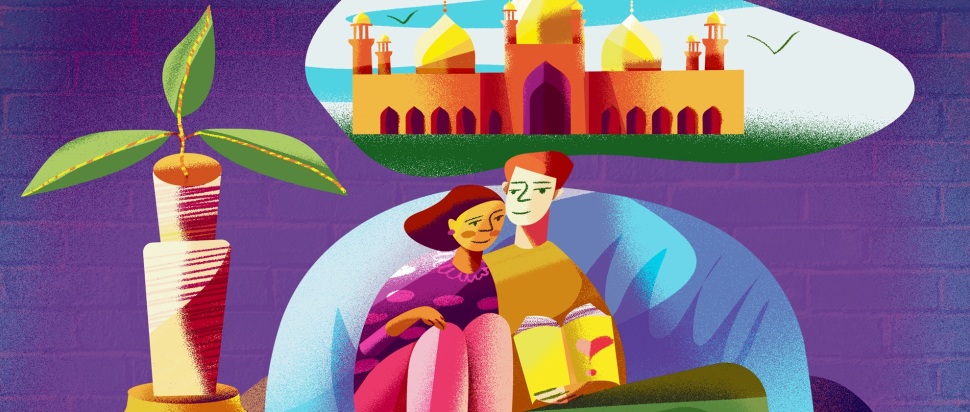
There are a few thoughts that keep me up at night: shiny, dark threads that feel capable of unravelling my life if I pull at them. There is one that I keep returning to, night after night. I lie awake beside my partner, listening to his soft breathing in the dark. I love watching him sleep: the perfect pout of his mouth, the way his glossy eyelashes fan gently across his cheeks. But as I look at him, my calm calcifies into a cold thought: I should be with a Pakistani.
Like the majority of second-generation immigrants, I have an unstable, sticky, overly romanticised relationship with my ‘country of origin.’ Pakistan was a place where I felt deeply understood as a child. But over time, my memories have dissolved into an amorphous mist; I can no longer distinguish between memory and fantasy. Standing now on the firmer ground of adulthood, I have tried to negotiate with that childhood wonder – to theorise it, contextualise it, diminish it, suppress it. But no matter which lens I approach it through, I cannot shake the feeling that Pakistan contains the possibility of an intimacy I may never fully experience elsewhere.
But I am not oblivious to my own reality. When I tell one of my Pakistani friends that my partner – who I live with – is not Pakistani, she raises an eyebrow. "Do your parents know about him?" she asks. I tell her that yes, they do. "You’re like the ultimate white girl," she replies.
I can see what she means. Pakistani people tend to find one another, even those born far from Pakistan itself. My Pakistani friends are getting engaged to each other at what feels like a startling pace. For some, perhaps there is familial pressure. But for most of them, I think there is also relief. I see it with my parents too: the shared language, the shorthand, the ease of recognition. The relief of not having to perpetually translate oneself.
In my own relationship, I often feel as though I am constantly decoding things for my partner. At family gatherings, I lean over to whisper urgent fragments of context that a Pakistani would instinctively understand. I translate jokes, stripping them of their euphemism, spontaneity and rhythm until they are rendered lifeless. A joke in English is not the same as a joke in Urdu.
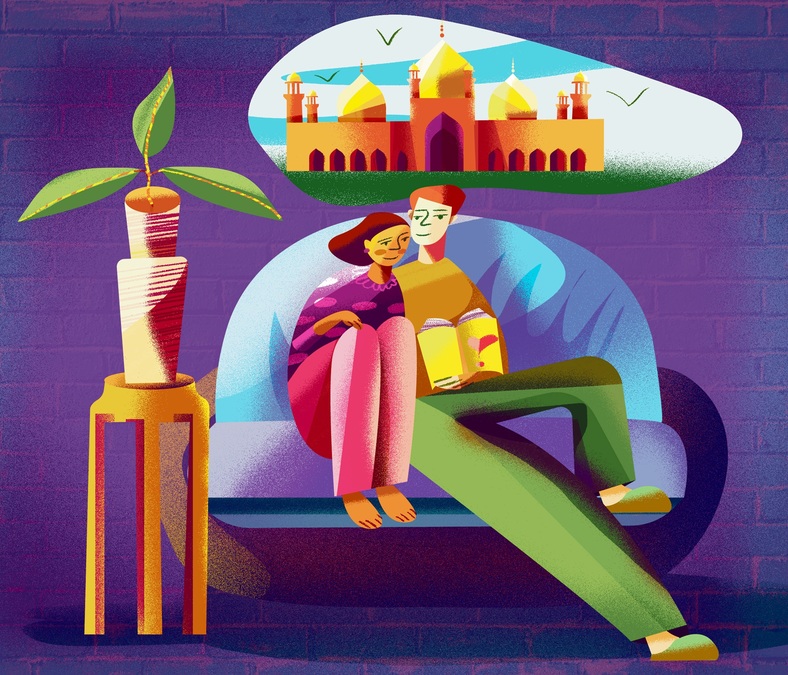
Illustration by Mahnoor Khan.
To belong to two cultures is to move constantly between different ways of understanding how bodies relate to each other. Each of these configurations of family, friendship, love, desire, and intimacy shifts shape across cultures. When I look at my Pakistani friends in relationships with one another, I see how seamlessly they embody these different configurations together. With my partner, I sometimes feel that no matter how hard he tries, there will always be parts of me he cannot fully inhabit.
And then there is Pakistan itself. My partner, who is easily overwhelmed and overstimulated, has never visited Lahore, famously one of the most populated and polluted cities in the world. Over the course of our relationship, visits to Pakistan have been something I’ve done alone, FaceTiming him from Lahore so that he can see it through the screen.
Part of why I guard my relationship to Pakistan so fiercely is because it no longer feels permanent. My grandparents died, so parents visit less now, which means I visit less too. The connection feels fragile, tenuous, as though it could disappear entirely if I lose my love for Pakistan. And when I look at Pakistani couples around me – people born abroad who have nonetheless managed to revitalise their connection to Pakistan through their relationships – I can’t deny my envy.
But when I survey my romantic life, I can’t deny that my choices have always privileged emotional understanding over shared culture. My partner quiets the chaos inside my head. I rarely feel like I’m holding myself together. He cannot resolve that for me, nor would I ask him to. But he does make each day feel less like a disaster. And who could turn away from such a gift?
In loving him, I have discovered a softer experience of time, and a sense of belonging that is not contingent on nationality or cultural symmetry. While my partner can’t be Pakistani himself, he accepts the possibility of multiple versions of me. He remains curious when it feels appropriate, and stops asking questions when it does not. He understands that, fundamentally, he will never fully understand. And in his acceptance of this fact, he has shown me that it is possible to hold multiple versions of myself.
What feels more urgent now is reimagining what belonging itself could look like outside the intransigent framework of identity. Of allowing it to be something constructed rather than inherited or married into; something chosen as much as received. Perhaps the real transformation is not that I might lose Pakistan, but that love has begun to loosen my understanding of belonging from the rigid boundaries of identity, and taught me that intimacy can create its own kind of homeland.