Stories of Space: Keeping the doors open to Scotland’s queer spaces
As Glasgow’s much loved Queer Theory celebrates its tenth anniversary, we speak to creator Dean Cargill and reflect on the highs and lows of maintaining queer spaces – from Kafe Kweer to Lavender Menace Queer Books Archive
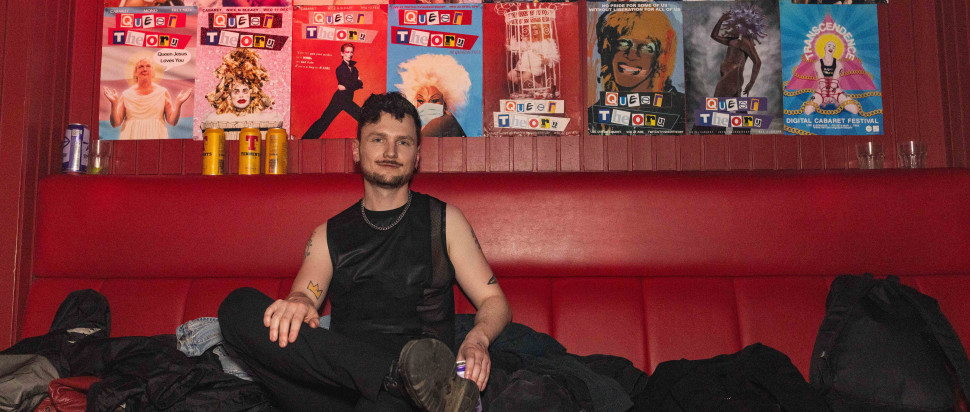
Scotland’s longest-running queer cabaret night, Queer Theory, is not for the faint of heart. “I didn’t want to produce something mainstream,” says Dean Cargill, the 33-year-old musician, DJ and creator of Queer Theory, ahead of its 10th birthday party at Drygate Glasgow on 25 April. “When I started the show I was very inspired by John Waters and the idea that queerness is meant to be transgressive... It’s supposed to be a bit filthy and to make you question the limits of straight society.”
The capacity for Queer Theory’s performers to genuinely shock audiences is part of the show’s attraction and its success. Whether it’s experimental legal theatre which culminates in the audience washing written indictments from the judge’s naked body (as per artist-scholar Kfir Lapid) or the sultry exploration of a woman playing a theremin with unexpected body parts (as per performer, artist and musician Chardonnay Emerald), there are few shows in Scotland which showcase such radical and diverse artists.
Nowadays, Queer Theory is often packed to the rafters. Yet such success did not come quickly. “For the first year a lot of the nights weren’t busy,” says Cargill. “It was mostly me, a few friends from the music scene and the Contemporary Performance Practice course at the Royal Conservatoire of Scotland. We never expected to be sold out or to make any money. But I stayed consistent and honed the perspective of Queer Theory being a show which not just welcomed but encouraged experimental performance... I always wanted it to be a place where acts which didn’t fit in a box or combined different artforms could be appreciated.”
As the genderfuck drag queen and host of Queer Theory’s 10th birthday, Mystika Glamoor, can attest, keeping any queer night or venue going for ten years in Scotland is a challenge. As well as hosting various shows across Edinburgh – from the long-running Glamoor at The Street to the new club night Konversion at People’s Leisure Club – Glamoor was also the co-founder of Kafe Kweer, a cafe and events space which closed its doors in 2025. “During lockdown I was scrolling through Facebook and saw a post about this shop looking for someone to take over the lease,” says Glamoor. “I shared it almost as a joke, saying ‘wouldn’t it be cool if we finally had a sober queer space and cafe’... My friend Zac commented saying we should do it and, well, we did!”
Kafe Kweer opened in September 2020 with Glamoor and their business partner navigating the opening of a new business amidst the deep uncertainty of the pandemic. For five years, the business succeeded both as a meeting point for LGBT+ people and as an independent local cafe.
But by September last year, financial challenges contributed to the decision to close its doors. “I think running any physical business is tough and it’s only getting tougher,” says Glamoor. “From inflation to energy bills, it’s hard. We looked at it all and decided we wanted to close on our own terms.” In closure, Kafe Kweer was added to a long list of Scotland’s shuttered LGBT+ venues. Amongst them is Lavender Menace, Scotland’s first gay and lesbian bookshop.
Sigrid Nielsen co-founded the bookshop alongside Bob Orr in 1982 and is now a director at Lavender Menace Queer Books Archive, which operates a free archive of LGBT+ books and preserves a slice of Scotland’s queer history. Lavender Menace and its later incarnation as West & Wilde closed its doors in 1997. Yet Nielsen says the archive – which opened in 2022 – provides continuity for a community that has historically struggled to safeguard spaces of refuge.
“When we first opened the bookshop, we didn’t know if we could last,” she says. “But we thought it was important to do it just because of the exhilaration of getting out there and saying who we were... In those days we weren’t optimistic about our survival.”
Nielsen cites the 1984 raid of Gay’s The Word bookshop in London, where HM Customs and Excise seized more than 140 titles from the shelves and charged staff with conspiracy to import ‘indecent or obscene’ material. After a two-year legal battle, the charges were eventually dropped. “If queer venues could survive open hostility from powerful organisations, then we can survive now,” says Nielsen.
The archive was initially backed by grant funding but now also welcomes donations through its Become a Menace scheme to maintain its catalogue of 3500+ books. According to Nielsen, the value of longevity for queer nights and venues in Scotland – particularly those which give voice to boundary-pushing performers and thinkers – is about much more than just future ticket sales or carving a safe space to hang out. It’s about the history of LGBT+ people. “I realise now that a real community is one with a history and with stories,” says Nielsen. “Every civilisation that has ever existed has had mythologies about how it came to be. That’s what’s stored in these books and this archive.”
As Lavender Menace preserves queer history, Queer Theory ushers in an even queerer future. In the times that we live, that’s something worth celebrating.
Queer Theory’s 10th Birthday Party (featuring performances from David Hoyle and Black Peppa, and a DJ set from Karen Dunbar), Drygate, Glasgow, 25 Apr