Stop AI Data Centres Scotland on the data centre fightback
We speak to the good folks behind Instagram page @stopaidatacentres.scot about holding the government to account, pushing against corporate greed, and mobilising for a just future
In 2017, the fracking industry came up against a position of no support from the Scottish government. Despite housing one of the world’s most productive oil and gas industries, the country halted the introduction of a new, dangerous and dirty means of fossil fuel extraction in a move that proved crucial to its future. It came as the endpoint of a long campaign by groups like Friends of the Earth Scotland, who managed to present an unignorable 60,000 petition signatures to then-Energy Minister Paul Wheelhouse. It’s a campaign that Rachael, Anna and Eleanor, co-runners of the Instagram page @stopaidatacentres.scot – with 10.6k followers, at time of writing – point to as an example of people power against extractive international business interests.
The page aims to share the criminally underdistributed truths about the 24 hyperscale AI data centres – large-scale computing facilities, built for handling huge workloads by providing scalable data, processing and computing capacity – proposed to be built across Scotland over the next few years, as well as updates from the various campaigns fighting back.
Rachael, a writer and journalist, and Eleanor, a stand-up comedian and author, met at a protest in June of this year outside Holyrood. After months of generalised anxiety about AI, they were galvanised into action by a shared feeling of outrage as the details of what ‘hyperscale’ really means began to emerge. Sure, Scotland has tech data centres already: in Airdrie, Newbridge, Medway and Glasgow, to name a few. But these are modest, relatively nondescript warehouses that popped up during the 2000s’ dot-com boom.
The biggest of these, according to the BBC, has a 12 megawatt (MW) capacity. By contrast, the two-dozen proposed hyperscale data centres range from 150 MW to 1 gigawatt (1,000 MW), almost 1,000 times greater than the capacity of the Airdrie site. Their plans show fields of whirring warehouses that stand tall at 40m high. Scotland’s longest-established environmental charity Action to Protect Rural Scotland (APRS) records the acreage of each site; three of the biggest – Killean in Argyll, Dunbar, and Chapelcross – span over 180 hectares (445 acres) combined. For reference, that’s around four 18-hole golf courses or about 240 football pitches' worth of warehouses standing taller than the Falkirk Wheel.
Anna, a Civil and Environmental Engineering student, joined Rachael and Eleanor soon after. She recalls attending a conference organised by Global Justice Now where she learned the “really scary” fact that the proposals involve more-than-doubling Scotland’s energy demands. “These will take one-and-a-half times the amount of energy that [all of Scotland’s] homes currently use at peak demand,” says Anna. Rachael adds that some plans propose the use of diesel back-up generators at a time when fossil fuel emissions should be going down, not up. While many of the companies proposing the sites describe themselves as green data centres, they haven’t yet had to explicitly define what they mean. Until recently, most weren’t even required to fill out an Environmental Impact Assessment (EIA) as a condition for approval.
We’re speaking in the afterglow of a small win in that department, with a 12-month pause recently voted through in the Scottish Parliament as a direct result of public pressure, during which time every developer of a data centre over 50 MWs will need to fill out one of these assessments. However, the vote fell short of a full nationwide moratorium on data centres, proposed by the Scottish Greens, until those directly affected by their construction can be better informed and involved; not just on the centres’ environmental impacts but also on what they’re going to be used for.
Rachael, Anna and Eleanor see Ireland as a case study for what happens when hyperscale data centre plans are pushed through under the guise that they’ll benefit local people. In Tech Policy Press, Louis Boyd-Madsen, citing University College Dublin lecturer Patrick Brodie, reports that in the last few years of Dublin’s data centre expansion, “vast public resources [have been] mobilised to serve capital-intensive digital infrastructure, even as shortages persist in housing, transport, and public services.”
The same fate risks being true for Scotland. While we know who the handful of companies proposing the hyperscale data plans are – DataVita, Apatura, CX Technology – there is little way of knowing at this stage who or what exactly they will serve. And the odds don’t look good. The market is dominated by a handful of Silicon Valley companies whose CEOs say it plain: Alex Karp, CEO of Palantir (a company named after the indestructible seeing-stone in The Lord of the Rings that corrupts men and which Sauron uses to manipulate people) recently told CNBC that “AI has to work for the warfighter [...] Palantir and a whole bunch of AI companies are leading on the battlefield.”
As noted by campaigner Coll McCail in a podcast debate hosted by The National, the UK Ministry of Defence just awarded US company Raytheon a two-billion-dollar contract for the training of 60,000 troops in AI literacy (an oxymoron if ever I’ve heard one). Add to that reports in The Guardian that UK datacentres will create only 25% of the jobs promised by the tech sector, and all signs point towards the proposed infrastructure supporting the military industrial complex and away from the money being reinvested into communities. Rachael puts it best: “There's this whole push for not wanting Scotland to be left behind and Scotland wanting to be a leader, but to me it seems like we are kidding on that we're in the mafia, but actually we're just [the ones] hiding the guns.”

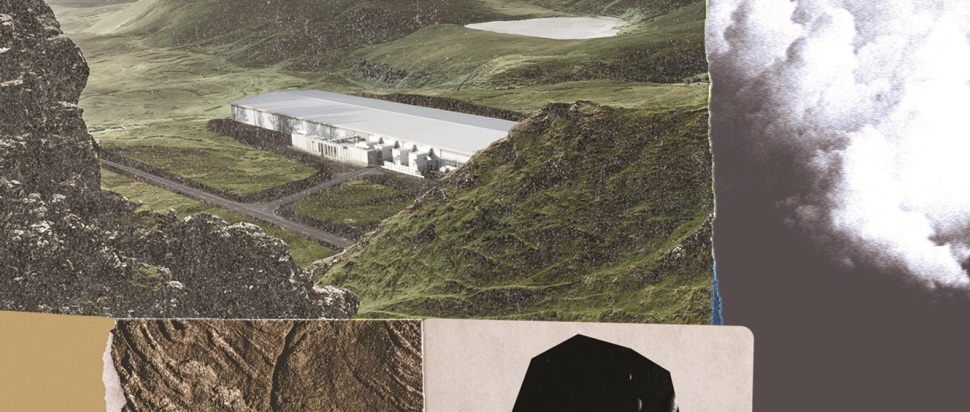
Collage by Phoebe Willison.
Thankfully there are a number of action groups across Scotland mobilising to give communities a fighting chance. APRS has created an interactive map of every proposed site; most links click through to the proposal from its respective developer as well as a link to the Facebook group for the regional grassroots campaign to stop it. As Rachael, Eleanor, Anna and I speak, the petition to stop Chapelcross – which would be the largest hyperscale centre in the world – is almost at 5,000 signatures. Yet recent news, published in The National, that the local authority isn’t publishing public objections to the proposal on its website further highlights the importance of @stopaidatacentres.scot, where the dissenting voices are amplified and the level of objection is undeniable.
While some are quick to ask if grassroots campaigns can really stop the seemingly inevitable encroachment of Big Tech, Rachael believes, well, yes, they can. Not only did a grassroots win against fracking prove that these things are possible in 2017, but also “most of [these] data centre developers have never built a data centre before,” she says. “They are speculative developers, they are in huge amounts of debt, and they are waiting for huge investments in order to build the site[s].” Without the planning permission and without funding secured, they won’t be able to build them. So there is hope.
Using Instagram “is a tricky duality to navigate,” says Anna. AI models are trained via posts made on that social media – including those of anti-data centre campaigners – but it is undeniably the best platform through which to reach as many people as possible. “A lot of campaigners I know have really conflicted feelings about this but unfortunately [with] the way information spreads now, we still have to use the Big Tech platforms.”
There are always going to be people who find being on these platforms hypocritical, adds Eleanor, “but it’s a way of dismissing the argument, isn’t it? That if you can find a single crack in it, that it must be completely pointless.” Such thinking is only beneficial to the companies trying to profit unchallenged.
Rachael agrees. She says that, as much as it would be great to be able to leave these platforms completely, “People are feeling understandably dejected about things and we need to reduce the barrier of entry to information and calls to action that can revitalise them. If everybody knows, then maybe 40% of those people will act, but that's still 40% of the population.”
Alongside Friends of the Earth Scotland, the trio recently announced a day of action, bringing people together with the myriad campaign groups to collectively say: “We weren't asked about data centres. It hasn't appeared in any manifestos. We haven't had a chance to vote on whether we want it or not. Instead, these decisions are being made for us and we're having to fight against them. And that's undemocratic,” says Rachael. “This is all about raising our voices as loud as possible and showing the swell of the movement against data centres across Scotland. We hope to see you there.”
Follow @stopaidatacentres.scot on Instagram and join the Stop AI Data Centres Scotland March in Edinburgh on Sat 14 Nov