Building Up, Pushing Out: Purpose Built Student Accommodation in Scotland’s cities
Vacant land? No problem – there’s an unaffordable and exploitative solution to that. One writer unpacks the impact of Purpose Built Student Accommodation looming large over our cities

March’s Glasgow Central fire has brought city planning – previously an unglamorous, jargon-filled policy area – to the front of minds whenever we enter a building we care about. How we feel in a space can be a powerful catalyst for considering what is contributing to, and taking away from, our ability to be in community with one another. As we are priced out of community hubs and warm spaces, another business is quickly springing up in our absence: Purpose Built Student Accommodation (PBSA).
PBSA companies argue that mixing business and residential space will boost local economies, provide employment and create blended neighbourhoods where people can rest and work. In reality, the model might work more for shareholders’ profit than for community good. And the sting is all the sharper when we see non-profit services that have a track record of improving wellbeing and providing employment pushed out to make way for PBSA developers.
So, what about their other aims, of student wellbeing and creating a one-stop neighbourhood for students? If you’re wealthy, you might be able to participate in this new community. But as the cost of going to university increases, especially for international students, many PBSAs sit empty. I speak to Sophia, an international student at the University of Edinburgh, who says: “They have a gym, laundry services, movie room, which is great if you can afford it, but £400 a week for a 15m² room was just too much for me.” As noted by property consultancy Allsopp, 47% of accommodation in new PBSAs is studio flats; this, therefore, primarily attracts students in the top income range. Meanwhile, universities face their own funding pressures and are outsourcing varied services to private companies. This leaves students stranded in a new city, facing a fight for limited spaces in the just-about-affordable university-owned accommodation, or being locked into unbreakable, expensive private leases, with very few renters' rights.
Kate Nevens, a Scottish Green Party candidate for the upcoming Scottish elections, says her constituents in Leith are isolated in “teeny-tiny bedsit-type rooms, really poor for people’s mental health.” When they’re marketed to international students, often coming to Scotland on their own for the first time, the effects are multiplied. “It’s difficult for international students to get guarantors and navigate the housing system while abroad, so PBSAs are exploiting that market.” As reported by the BBC, HESA (Higher Education Statistics Agency) found that 10,000 fewer international students came to Scotland in 2024. If this trend continues, the single-use limitations of PBSAs will add salt to the wound of empty buildings that could have housed multiple households, businesses and third-sector organisations currently fighting for survival in an economically hostile renting market.
In March, renters’ union Living Rent held a public assembly on PBSAs with over 100 residents in attendance. Secretary for Edinburgh, Aditi Jehangir, says: “Students are paying through the nose to live in poor quality developments that take up space where we could be building long-term social housing.” As the UK Collaborative Centre for Housing Evidence noted in their 2024 report, the rise in student homelessness is caused, in part, by a bedspace gap of 6,000+ in both Dundee and Glasgow and 13,000+ in Edinburgh. According to the Scottish National Union of Students, in 2021, 12% of students had experienced homelessness while studying. Jehangir says PBSAs are not the answer to student needs, calling on Edinburgh Council to “clamp down on more student accommodation being built through binning current projects, denying future developments and restricting what can be built and where.”
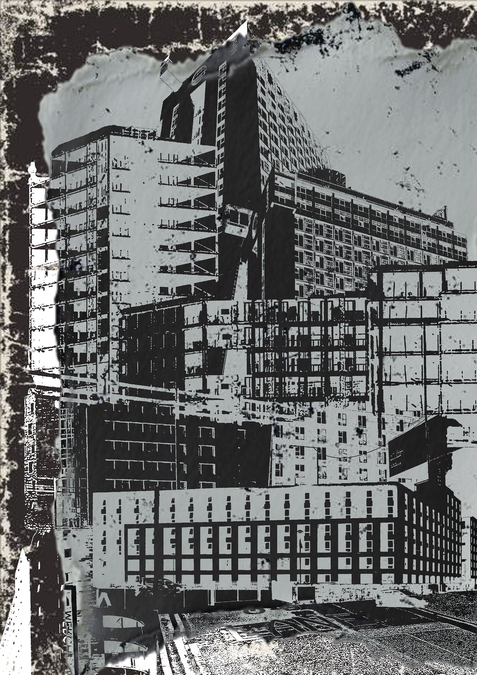
Illustration by Dalila D'Amico
Tim Pogson, Scottish Labour Councillor and Edinburgh’s Housing Convener, attended the public assembly and reflected to me: “If a developer wants to build student accommodation on their land, that is their decision. Whatever we think of PBSA, the council, as a planning authority, can only refuse planning permission based on robust, defensible policies.” Those policies are set by the Scottish Government, so “many PBSAs have been refused by the council only to be granted permission on appeal to the Scottish Government.” Furthermore, as the Edinburgh Chamber of Commerce highlights, the Scottish Government excluded PBSAs from their 2025 rent control legislation, leaving students vulnerable to unbreakable tenancy agreements. Tim Pogson points me to the council’s ‘Call for Ideas’ – a community consultation, taking place between July and September 2026 – to put forward suggestions for Edinburgh’s 2040 city plan; however, whether this plan can overturn the Scottish Government’s leniency on PBSAs is unclear.
Across Scotland, arts and community hubs, and independent businesses – longstanding social anchors – have been driven out by rising rents and a lack of will by the government and local councils to sustain them. The Scottish Government’s own research shows demand for rent and quality control, and more legislative rights in regards to PBSAs. But where is the action? Will these developers be allowed to continue siphoning off opportunities for community wealth building and dictating the design of our neighbourhoods? Or will the diverse range of students, creative groups, residents, local business owners, workers, co-ops and charities finally lead the design of the cities we’ve been building up for so long? Here’s hoping for the latter.