Future Funds: The Basic Income for Artists Scotland campaign
Low pay, precarious contracts – Scotland’s creative workers want change. We speak to organisers and artists involved in the Basic Income for Artists Scotland campaign about creative freedom, class inequality and the nation’s cultural future
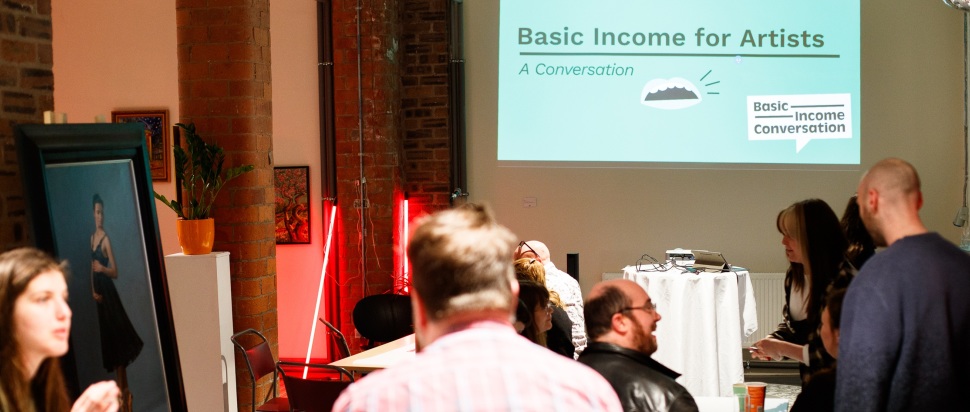
What is possible when we reimagine the value of artists and their practice? That’s one of the many questions at the heart of Ireland’s Basic Income for Artists pilot, and is now driving a potential pilot in Scotland.
Ireland’s landmark pilot scheme, Basic Income for the Arts (BIA), which trialled a basic income for creative workers, is now set to become a permanent scheme, open to 2000 artists every three years. Reports from the initial three-year pilot suggested that financial stability allows artists space to create, improves wellbeing, reduces reliance on the welfare system, and found that for every €1 invested, €1.39 was returned to the economy. With the scheme being made permanent, the Basic Income Network Scotland is calling for a similar scheme to be introduced for artists in Scotland and is working with artists to co-design a pilot through their current campaign, Basic Income for Artists Scotland.
The scheme has been backed by the SNP, who promised a pilot if re-elected earlier this year. Anna Selwood, co-founder of the Basic Income for Artists Scotland campaign, believes it is desperately needed to make the creative industries more sustainable for artists: “We're at risk of losing them before they've had the chance to fulfil their potential. As a society, we've become very comfortable reaping the rewards of artists' commitment while taking for granted that they are able to make work with little or no income.”
For so many creatives, finances dictate their access and capacity to work, worsened by the cost of living and various budget cuts, such as Creative Scotland’s temporary closure of the Open Fund for Individuals in 2024. Having a regular income could challenge how cultural practice is valued and who gets to shape it. “Being an artist isn't a frivolous career choice, it's not an alternative to a 'proper' job. It is work that makes a significant contribution to our economy, our wellbeing and our culture,” says Selwood. “I know too many talented young artists whose mental health is being eroded by the stress of financial insecurity.”
Details of the promised pilot aren’t confirmed, but the campaign advises it could be inspired by other models, including Ireland’s, where participants were paid €325 (£282) a week for three years. An impact assessment from Ireland’s Department of Culture, Communications and Sport concluded that those participating in the pilot scheme spent 11 hours more per week on their creative practice than those not part of the scheme, therefore helping the nation’s cultural scene to flourish.
For many artists, access and finances are too often limited further by their working-class background, shares artist Emma Jayne Park: “As a working-class artist, I’ve had to make some pretty severe life choices to stay in the arts. I’m angry about that, but also know how lucky I’ve been, while watching friends and peers get squeezed out by money, time and exhaustion. Class still shapes who gets through the door. Most of the opportunities I now have were completely invisible to me until my 30s, which feels like a massive systemic failure.”
Park hopes that a basic income will also help reimagine how art by working-class artists is valued by “giving arts workers and communities more freedom to make, see and shape what is classed as 'culture’.” It’s vital that working-class artists have space to not only create work that won’t be demonised or fetishised, but to really be part of the industry’s fabric.
For Matt Hickman – musician and Head of Engagement & Advocacy for Creative Balance, a research project centred around the mental health and wellbeing of Black & Global Majority artists in Scotland – a basic income for artists has the potential to further support those who aren’t currently well reflected, due to factors such as race and gender. Alongside this, Hickman wants us all to consider the unseen work that is essential to art projects. “As someone working in the music sector, often there is so much unpaid time from writing an album, to its production and even in rehearsing to tour that album. This is the same across so many art forms. Those moments in between work are so precarious, but necessary to a practice.”
While a basic income has the potential to support those in the arts, there are concerns that the scheme shouldn’t be limited to artists. Co-founder of Basic Income for Artists Scotland, Cleo Goodman, explains that piloting a basic income scheme with artists isn’t so much about prioritising artists but highlighting to the government the potential for widespread success. “The best way that we can make progress towards a universal basic income for all is to win the basic income or the targeted pilot policies. These incremental changes that build towards universality, I think, are the best way to make that case for us all.”
And there is a collective understanding to push the scheme beyond artists. “In these rooms, artists are saying this is something that everybody should be given as a right, that it shouldn't just be artists, and I think that also feels like part of a reason why this feels so exciting to me,” Goodman adds.
Currently, the Basic Income for Artists Scotland campaign is working towards a report based on conversations with practitioners, set for publication this autumn. The campaign is hopeful: this is a scheme that could revitalise Scotland’s cultural landscape and truly challenge who gets to shape it.
Editor's note: Following the initial publishing of this article, the Scottish Government has confirmed a pilot of the Basic Income For Artists. The specifics of the programme are yet to be confirmed, but this announcement alone provides some much needed relief for Scotland's struggling arts community, thanks to the hard work of the people at the Basic Income for Artists Scotland campaign. Find out more at their Instagram @basicincomeforartistsscot