Dear Screen Place: What happened to all the Glasgow films?
In recent years, there have been plenty of films shot in Glasgow, from comic book movies to zombie apocalypses to sci-fi dystopias. But what happened to all the films *set* in Glasgow telling local stories?
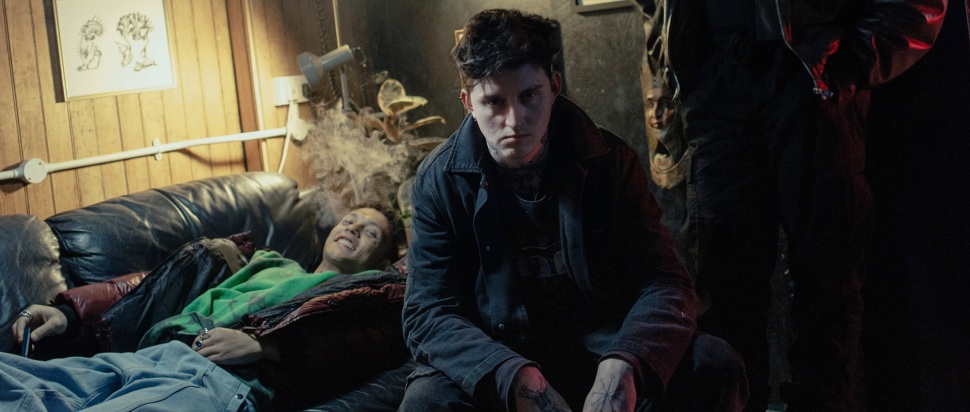
Scottish filmmaking is in a parlous state. Don’t let the slew of big-budget Hollywood movies shot in Scotland fool you into believing otherwise. The Running Man (2025), Indiana Jones and the Dial of Destiny (2023) and The Batman (2022), all shot in part in Glasgow, boost our economy by flooding the coffers of hotels and restaurants and provide work for local craftspeople. But they’re not culturally Scottish, and don’t contribute to our nation’s rich cultural tapestry. They certainly don’t, authentically, represent Scotland. In fact, they go out of their way to efface Scotland altogether. Buchanan Bus Station is Boston Bus Station (in The Running Man); George Square is Philadelphia (in 2013’s World War Z). Looking at Glasgow as a microcosm of the state of the Scottish film industry more generally, the picture is worrying for those of us who love film, and who relish authentic representations of our city and our people.
But first, a brief history of filmmaking in the city. For my book, Scottish Films, published last year, I watched and wrote about feature films set, at least substantially, in Scotland. 427 are covered; 72 of these are set in Glasgow. Earlier films set in Scotland were usually placed in a romanticised Highlands or glamorous Edinburgh. The first to take place in our biggest city was 1940's Hoots Mon, a vehicle for the comedian Max Miller, made with strong ‘Britain together’ propaganda supporting the war effort. Two more films were set in Glasgow in the 1940s: The Shipbuilders (1943) and Floodtide (1949), both based around shipbuilding.
In the 1950s, five features were set in Glasgow. These are a varied mix, from a comedy repurposing the University of Glasgow as ‘Skerryvore’ University (1952’s You’re Only Young Twice) to true-crime (Madeleine, 1950) to the social realism of The Gorbals Story (1950). From 1955 through 1978, there were TV movies set in Glasgow (most notably, Peter McDougall's contributions to the Play for Today series) but only one cinematic feature – the torrid German crime story The Devil’s Girls (1967) (it’s a hoot).
Everything changed in 1979, however. Bill Forsyth released That Sinking Feeling, which was exceptional for being a truly Glaswegian production, set and shot in the city with a Scottish director and cast. Fifteen more films were set in Glasgow in the 1980s and '90s. Some were international productions taking advantage of Glasgow’s heritage; others were inspired local films made by Scottish directors.
By the 2000s, the floodgates had opened, driven, in part, by Glasgow’s attempts to attract filmmaking. Jet Li’s 2005 hit Unleashed, for example, a UK/US/French co-production, includes a credit to 'La Ville de Glasgow'. Glasgow was opportunistically chosen for the versatility of its location and its burgeoning network of filmmaking support facilities, combined with UK-wide tax incentives. In all, 22 features were shot here in the 2000s, and 25 in the 2010s. Alongside the ‘could be anywhere’ films like Unleashed, there were still plenty of truly Scottish films. Among them were works directed by Peter Capaldi (Strictly Sinatra, 2001), Peter Mullan (Neds, 2010), and Robert Carlyle (Barney Thomson, 2015); David Mackenzie made Young Adam (2003) and Perfect Sense (2011). Glasgow-based May Miles Thomas made three films, and Andrea Arnold shot the superb Red Road (2006).
But in this current moment of filmmaking abundance in Glasgow (Spider-Man: Brand New Day's shoot created huge excitement last year; The Batman 2 should generate a similar buzz when filming begins in the city this month), homegrown stories are few and far between. In the 2020s, I count only two Scottish fiction films that are substantially set in Glasgow: Ciaran Lyons' micro-budget feature Tummy Monster (2024) and Adura Onashile's Girl (2023). While there have been fine Glasgow-shot documentaries in this period (My Old School (2022), MOGWAI: If the Stars Had a Sound (2024), Janey (2024)), lots of small screen productions (The Nest (2020), Nightsleeper (2023), Fear (2025)) and a relatively thriving short film scene, the paucity of fiction films coming out of Glasgow is alarming.
The reasons for this downturn are myriad. COVID clearly took a toll on feature filmmaking here, as it did in most territories, and filmmakers have accused funding body Screen Scotland of focusing too much on supporting films, rather than the career development of Scottish directors (although it appears changes are now being made, with Screen Scotland announcing last year a new talent development initiative called Talent Builder). And many of our finest filmmakers are choosing to make films on a bigger stage, and who can blame them? Mackenzie’s most recent film, Relay (2024), is set in New York; Lynne Ramsey’s Die My Love (2025) is set in the US, as are all her films since Morvern Callar (2002).
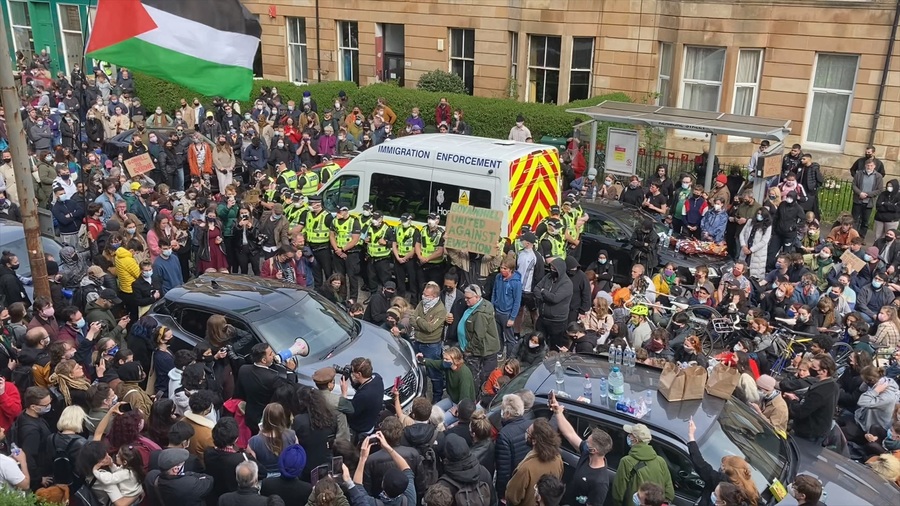
A still from Everybody to Kenmure Street, directed by Felipe Bustos Sierra
This year does look slightly rosier for both Scottish and Glaswegian cinema. A record-breaking seven Scotland-made films have been selected for this year's Sundance Film Festival, among them Felipe Bustos Sierra's documentary Everybody to Kenmure Street, which centres on Glasgow citizens' civil resistance to a Home Office dawn raid on the eponymous Southside street. Glasgow Film Festival, meanwhile, will close with James McAvoy’s eagerly-awaited California Schemin’ (2025), which is set partly in Glasgow. These titles offer a glimmer of hope that local stories can still be told on the big screen, but the truth is, Scottish filmmaking, which has never had real strength in depth, is now in a precarious state.
Scottish Films is published by Luath Press