Teenage Sex and Death at Camp Miasma
Jane Schoenbrun returns with their much-anticipated third feature, Teenage Sex and Death at Camp Miasma, a meta repurposing of the slasher genre starring Gillian Anderson and Hannah Einbinder
In her essay Her Body, Himself, academic Carol Clover famously wrote about the ways in which gender is central to the slasher film. She theorised that the final girl – the term she coined for horror film's last survivor – is “a physical female and a characterological androgyne: like her name, not masculine but either/or, both, ambiguous”.
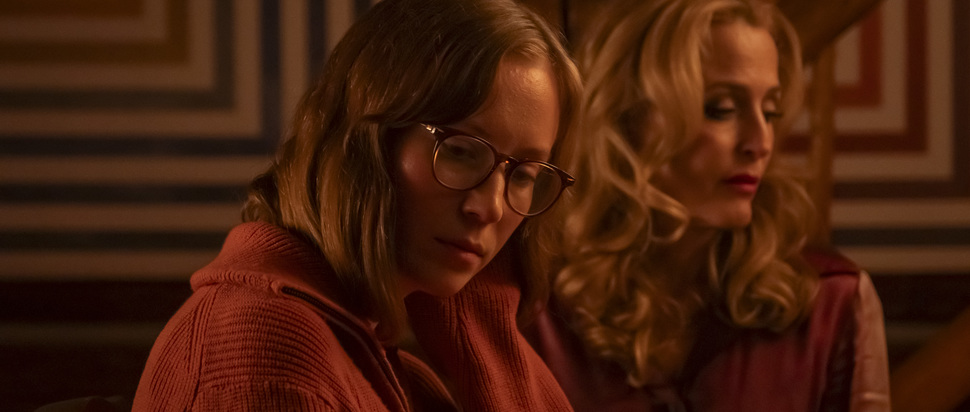
Clover’s fingerprints are everywhere in Jane Schoenbrun’s Teenage Sex and Death at Camp Miasma, a bold send-up of classic slashers that turns the genre into a heady playground for a gender and sexual awakening. It takes a stab at today’s franchise-obsessed remake culture, too. We follow Kris (a delightful Hannah Einbinder), a 29-year-old filmmaker who's tasked with resurrecting the “zombie IP” of Camp Miasma, a slasher franchise that was a cult classic in the 80s and has had diminishing returns across its numerous sequels. Despite their misogynistic and transphobic tropes, these films have long been a source of fascination for Kris. Schoenbrun’s film opens with a montage that adds a rich texture to its world, detailing the franchise’s history through newspaper clippings, VHS tapes, a tie-in board game, and blogs about a doomed Quibi spin-off.
That lived-in texture extends to the lush production design that dips into fantasy, with matte painted backgrounds and vibrant lighting that gleefully eschews reality. Kris drives into the wintry wilderness to meet Billy Presley (Gillian Anderson), the Norma Desmond-esque recluse who starred in the original Camp Miasma flick before hiding away at the same campsite where the first movie was shot. Hoping to recruit Billy for the reboot, Kris’s passion explodes when she pitches the project, effusively explaining how her work explores the intersection of queerness and depictions of monstrosity. Billy, however, wants to take Kris out of her own head and reminds her that, at its core, a slasher is “flesh and fluids”.
Schoenbrun doubles down on themes they explored in I Saw the TV Glow: how pop culture shapes our identities, and how nostalgia is an elusive feeling that can never be replicated. “If it gets too real, you can always turn it off,” reads the tagline for Camp Miasma's movie-within-the-movie home video release, but the profound effect that the franchise has had on Kris’s sense of self can never be switched off.
Schoenbrun's latest work is even more ambitious, stacking ideas about horror as a vehicle for getting in touch with your own body and sexual pleasure without ever getting lost in itself. The film doesn’t shy away from overt metaphor: with a name derived from the French term for orgasm, the movie's killer, Little Death (Jack Haven), is bullied for his transness and wears a TV-like metal vent on his head. When the film is at its most satirical, Schoenbrun flips the genre’s most misogynistic tropes into euphoric gender expression.
Teenage Sex and Death at Camp Miasma also reflects Schoenbrun coming into their own as a filmmaker, and reckoning with their anxieties about working in an industry that attempts to stifle their singular voice. Kris interacts with her squash-playing agent (Sarah Sherman) and studio executives who only see her as a means to make the franchise “woke”. It's a little inside baseball, but Teenage Sex and Death at Camp Miasma is never short of entertaining pleasures on all fronts. In one moment, Kris is tearfully opening up about her stunted sexuality, and the next, blood spurts like a geyser from a severed head. It's a tricky tonal tightrope, and few directors are navigating it as well as Schoenbrun.
Teenage Sex and Death at Camp Miasma had its world premiere at Cannes Film Festival 2026, with a UK cinema release on 21 Aug via MUBI