Sound of Falling
This century-spanning drama from Germany tells the story of trauma across generations through the eyes of four young protagonists
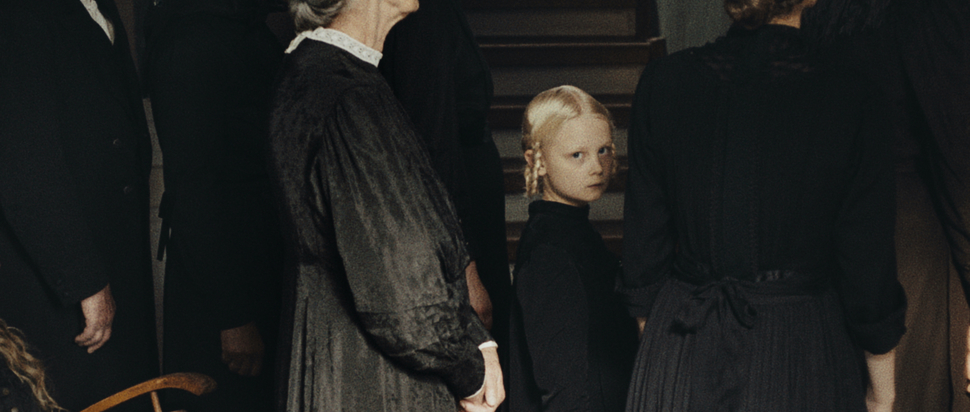
Mascha Schilinski’s Sound of Falling uses a narrative structure reminiscent of a 3D puzzle. Following four generations who live in one German farmhouse across a century, the story unfolds in a non-linear style by seamlessly moving from one era into the next, and then back again. Schilinski concertinas the lives and dramas through the eyes of four young protagonists: Alma, Erika, Angelika and Lenka.
A key visual device, similarly deployed in Schilinski’s 2017 debut feature Dark Blue Girl, is the child’s point of view. The full picture of events is obscured as glimpses of unflinching adult life are exposed through keyholes, holes in walls and below doorframes. This is alternated with a drifting, omniscient, otherworldly perspective. Life sounds give way to an audio motif of breathy winds, further suggesting a haunting presence.
The families’ intertwining stories coalesce piece by piece, particularly around the experiences of young women and girls and their struggles against the gazes and hands of, often abusive, men. Layering and intercutting the different time periods suggest everything is always happening at once, constructing a central theme of generational trauma and repeated patterns.
The ‘stone tape theory’ posits that traumatic energy imprints into the walls of houses; this family home is pregnant with it. An oppressive weight, these traumas push people across veils and borders, from life and death and family lines, to the other side of the farmhouse river and a different Germany. The film ultimately achieves an intricate uncovering of hidden and unspoken truths, revealing their influence across time.
Released 6 Mar by MUBI; certificate 18