Sophy Romvari on her debut feature Blue Heron
Sophy Romvari's extraordinary debut, Blue Heron, explores the unmoored nature of memory. She tells us how she uses cinema as a way of grappling with the past and filling in the gaps in her memories that may not have even existed in the first place
Sophy Romvari’s debut feature Blue Heron is, she insists, a work of fiction. Like her, the protagonist, Sasha, is one of four children born to Hungarian immigrants in Canada. Like her, Sasha’s childhood is shaped by the increasingly troubling behaviour of her oldest brother, Jeremy, whose lapses into anger and threatened violence consume the family’s everyday existence. And like her, adult Sasha becomes a filmmaker, preoccupied by the tragic enigma of her brother and struggling to make sense of it through her craft (Romvari’s critically acclaimed short film, Still Processing, confronts the loss of two of her brothers through family photos).
Yet Blue Heron, for all these parallels, refuses the limitations of autobiography, becoming instead an investigation into the nature of memory, and the gaps that exist between our childhood and adult subjectivities. “I struggle now to remember much of my childhood,” Sasha confesses in the film’s very first line. “It only comes back to me in small fragments.”
“The way I define it is it's true but not real,” Romvari says of her film’s fictionalising approach. “I think those things are very different. There are scenes that are complete fiction [and] scenes that are drawn from memory, but memory is very subjective. So many of the memories that we have as adults come from being told stories about our pasts and not necessarily from images we remember; from photographs or videos which we reinterpret into memory.”
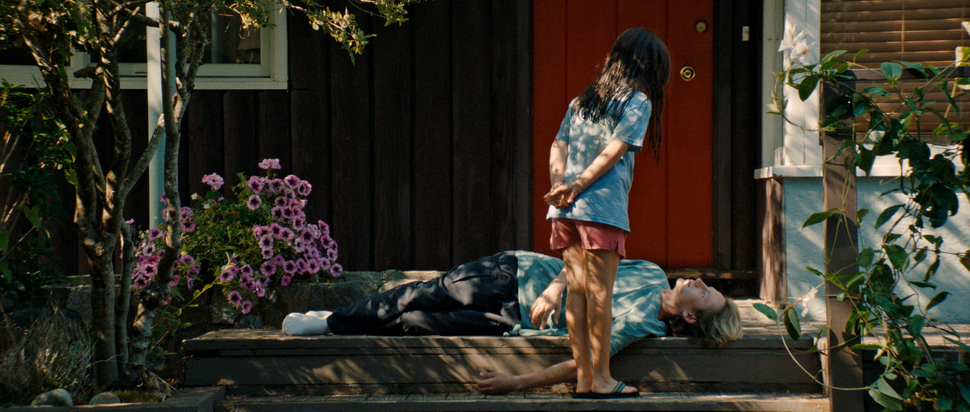
Like his cinematic offspring, Romvari’s father was drawn to photography and documentation, resulting in a rich archive of family images from which Romvari continues to draw, not only in what they depict, but also in what she fails to remember from them. She points to a scene towards the beginning of Blue Heron, where Jeremy lies on the front step of the house and refuses to move for hours. “Jeremy lying on the front step is based on something that my brother used to do,” Romvari explains. “I've seen photographs of it, but I don't remember it happening, so it's not based on a memory. I know he did that, I was around, but do I have memory of it? No.” The scene has emotional resonance not only because of what it shows – an unwell child, anxious parents, nervous siblings – but because it's not really remembered at all.
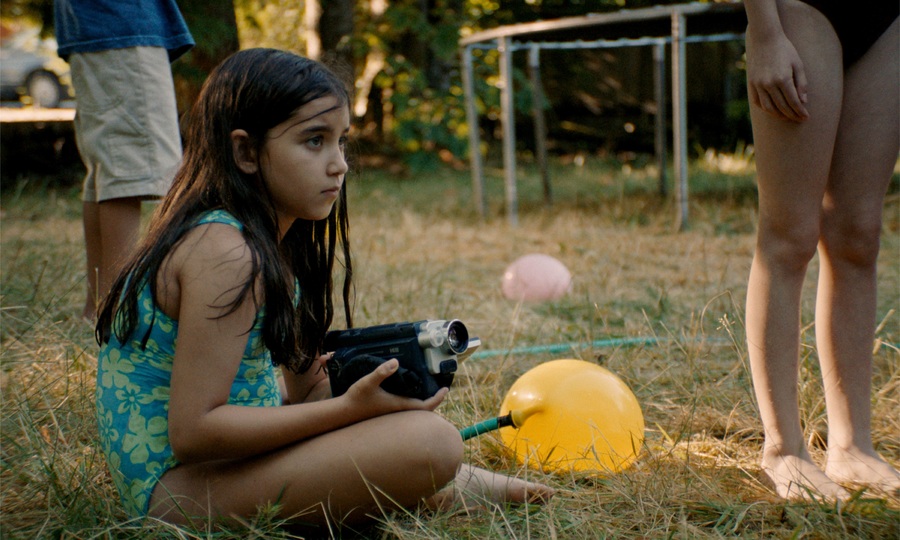
For Romvari, understanding the inherent falsity of memory was an act of compassion, both for herself and for the brother she lost. Rather than moving towards catharsis, Romvari uses filmmaking as a way to concretise the gaps that exist within families – between people, between memories, between their past and present selves – that are quietly devastating precisely because of their inability to be resolved. The fictionalising approach of Blue Heron is an acquiescence to the impossibility of ever fully understanding another person or the trauma that binds you together, married with the need to try.
“It feels like evidence that the past existed in a way that is forever solidified, but also inaccessible,” Romvari says of the act of documentation. “A lot of my work is balancing between those two things. You can't access it, but you know it happened. Part of the making of the film is the acceptance of the inability to recreate this person.”
Sasha, too, has to move towards this acceptance. Blue Heron is split into two halves: the first shows a hazy, half-remembered summer in Sasha’s childhood; the second sees an adult Sasha interviewing social workers (played by actual professionals), speaking to her parents and revisiting her childhood home where so many of the events from which she is drawing took place. Romvari’s bifurcating structure is deliberate, accentuating the gap between the bewildered innocence of childhood and the shattering realisation of adulthood.
“Traditionally, what you have in a film like this is flashbacks,” Romvari says. “All the difficult things that Sasha is told about her brother. But she never had access to those scenes. This is what happens when you become an adult: you’re told information and you have to apply it to your understanding of the past. I didn’t need to sensationalise that [by showing it]. I’m doing a lot of ‘tell, don’t show’, which is the opposite of what you’re supposed to do in a film. But to me, it was not about seeing Jeremy do those things. It was about having Sasha come to terms with the things she didn’t understand.”
“I think there’s a lot you don’t remember,” adult Sasha is told towards the end of the film. For Romvari, this act of simultaneous forgetting and remembering has become her creative touchstone, from her short documentaries to the tender transience of Blue Heron and the grace it lends to a family stuck in their present and past. Filmmaking is her way of coming to terms with memory, the past that it recalls and her own uncertainty around it. “It is,” she explains, “proof that something really happened.” In Blue Heron, so much of what happens is not real. But it is, in spite of this, proof of something devastatingly true.
Blue Heron is released 26 Jun by Conic
Sophy Romvari will take part in Q&A screening of Blue Heron at Glasgow Film Theatre on 30 Jun and Cameo, Edinburgh on 1 Jul