Seán Dunn on The Fall of Sir Douglas Weatherford
Edinburgh-born, New York-based filmmaker Seán Dunn discusses his new comedy, The Fall of Sir Douglas Weatherford, the use of Scotland as a Hollywood backdrop and finding inspiration on a Harry Potter tour
When Seán Dunn was seven, growing up in Craigentinny in Edinburgh, his aunt gave him a journal filled with questions. One question he remembers quite clearly was: 'What do you want to be when you’re older?' He wrote three answers: ninja, basketball player and film director.
Like many millennials who grew up on the cinema of the 80s and 90s, he had one film director in mind: Steven Spielberg. “I would watch all these amazing films when I was a kid,” recalls Dunn, “like Jurassic Park and the Back to the Future and Indiana Jones films, and I remember being blown away when I realised that there was this one guy who was involved in some way in making all of them. That attracted me much more than, like, being an actor.”
Dunn made good on that ambition. After completing an undergraduate degree at Dundee, he won a place at Columbia University's film programme. That was in 2013, and he’s lived in New York ever since. He now teaches film at Columbia as an adjunct professor, has several acclaimed shorts in his filmography, and has just released his debut feature, The Fall of Sir Douglas Weatherford, which made its bow last month at the Rotterdam International Film Festival and will have its UK premiere at the upcoming Glasgow Film Festival.
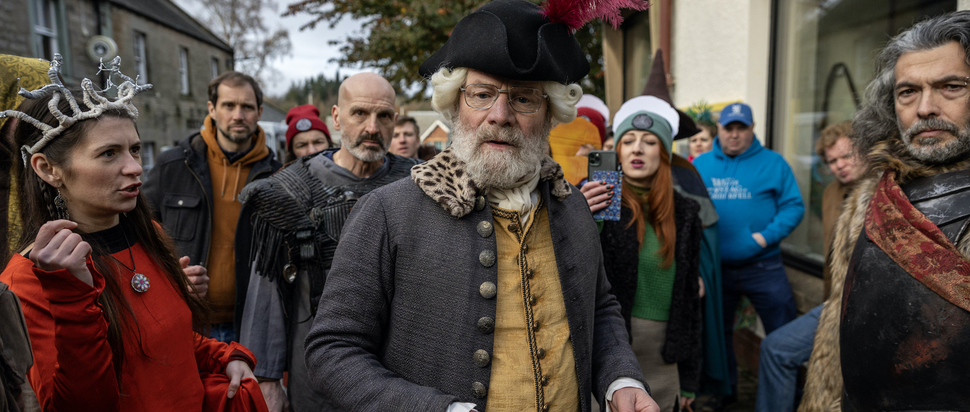
It’s a darkly comic study of ageing and identity set in the fictional village of Arberloch. Our ostensible hero, Kenneth (played by Peter Mullan), works as a tour guide at a crummy visitors’ centre dedicated to the eponymous Douglas Weatherford, an 18th-century renaissance man who’s described as David Hume, Adam Smith, David Livingstone and Walter Scott rolled into one.
Kenneth, a distant relation to Weatherford, tries to keep the (heavily exaggerated) achievements of Arberloch’s most famous son alive by proudly recounting them to indifferent tourists. These tales of valour are completely overshadowed when the production crew for a new series of The White Stag of Emberfell, a blockbuster fantasy show featuring dragons and warring gentry (any resemblance to Game of Thrones is entirely intentional), rolls into town.
Dunn’s inspiration for the film came while on a trip back to his hometown. “I was showing my wife around Edinburgh for the first time," he recalls, "and basically we ended up in Greyfriars Kirkyard, and there was this tour with people wearing cloaks and waving wands.” Who among us hasn’t found themselves among a throng of Harry Potter nuts while wandering the Old Town? “Basically, we ended up at Tom Riddle’s grave. I don't know much about Harry Potter, but my wife explained, ‘That's Voldemort!' Then this tour guy did a wee magic trick in front of this grave and then all the people started doing an incantation.”
While the crowd were waving their wands, Dunn was thinking about the real person whose bones they were trampling. “I was reading the gravestone, and it said he was in the British Army and died in Trinidad in, like, 1803. I thought, that's weird." Dunn did some digging and figured out that was around the time Britain seized control of that Caribbean nation. "I was just so interested in how history can be whitewashed in that way, or simply replaced. Literally, this guy is now just Voldemort forever.”
Scotland is particularly guilty of this kind of historical erasure, he reckons. “The Scottish Enlightenment is a source of pride for us, and we love to list off all the inventions that were made here, but that's about as deep as we get. It's like, the English are the bad guys, and we don't really take any accountability for our role [in the Empire].” There’s a similar obfuscation of reality in the sort of fantasy TV he’s satirising in the film. “I don't want to be mean-spirited. There are great things that come from the fact that these shows employ and train so many people in our industry. But culturally, yeah, I feel like we can often be a backdrop to somebody else's story.”
The Fall of Sir Douglas Weatherford explores these ideas of cultural erosion with much style and wit. A sardonic narration, seemingly provided by Weatherford’s doleful spirit, recalls Barry Lyndon, while the film's comic tone morphs to something darker and more experimental as Kenneth falls deeper into fantasy. In moments, it’s practically Lynchian. That reference came quite naturally, says Dunn. “Exploring the duality of Scotland, what’s been hidden... obviously with Lynch, that's the root of all his films – the darkness underneath the wholesome surface.”
Dunn’s film's trump card, however, is Peter Mullan, who’s both hilarious and poignant as the exasperated tour guide. Even more importantly, the Glasgow actor had an intimate understanding of what the film is satirising. “Peter still lives here, so he knows the whole Outlander thing. And being pretty anti-establishment, those big production companies coming into Scotland, I think they do rub him the wrong way. But also ironically, he's the Dwarf King in that Lord of the Rings show. So I think he just got it.”
And despite a career of playing various shades of hard men and psychopaths, Mullan clearly has a sharp sense of comedy. “Absolutely,” says Dunn. “Peter, he’s so funny and very big on improvisation. He would always go for it, play with the dialogue. And to be honest, he always came up with better ideas than what was written.”
The Fall of Sir Douglas Weatherford screens at GFT on 4 & 5 Mar as part of the 2026 Glasgow Film Festival