Scotland on Screen: Scottish Ballet's These Violent Delights
Scottish Ballet's These Violent Delights is more than a simple dance performance on film. Its co-directors explain how this update of Romeo and Juliet utilises cinema and dance to create a unique experience melding the two art forms
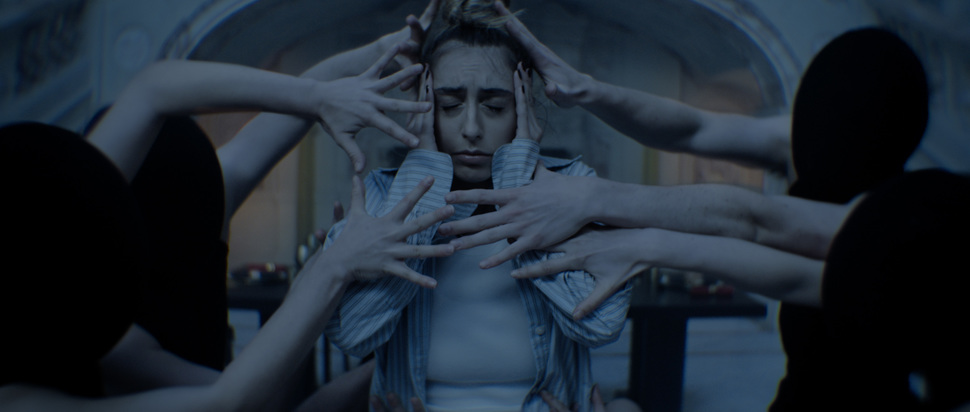
A dancer’s performance usually takes place live on a stage, but filmed performances have become a larger part of Scottish Ballet’s repertoire since 2020. Their latest, and their first filmed-for-cinema piece, is These Violent Delights. Co-directed by the company’s Chief Executive Officer and Artistic Director Christopher Hampson and filmmaker Oscar Sansom, the film’s abstract take on Romeo and Juliet premiered at Edinburgh International Film Festival back in August and will soon reach audiences across Scotland on cinema screens. It’s a “new and odd” experience for Hampson. “With live performance, there's a lot of tension that is then released and birthed into the world,” he explains. “With the film, it's ongoing.”
Sansom is more familiar with cinema’s rhythms. “The premieres are nerve-wracking, but you’ve done everything you can at that point,” he says. “It’s that moment we send our child off into the world, and we're excited to see how audiences react.”
These Violent Delights was explicitly created for the screen and shot on location – a very different experience for ballet dancers. “Performers are working on concrete and old wooden floorboards and adapting the movement and choreography,” says Sansom. “It was a big challenge.”
“The logistics were immense,” Hampson adds. In addition to the huge effort of finding and dressing venues, where designer Sami Fendall brilliantly created “three distinct worlds”, steadicam operator Sean Corbett became their “unseen dancer”. “He really had to learn the choreography,” Hampson says of Corbett. “He seamlessly became part of the action. The dancers really got used to this ‘dancer’ no one sees on camera.”
These Violent Delights started with weeks of rehearsals, with cameras and camera operators, before moving to a ten-day shoot. Both practices were unusual for the dancers and intense, but Sansom saw upsides. “That’s one of the beauties of working with dancers who work live on stage,” he says. “Getting a second go is really exciting.” The rehearsal footage also gave the team a second storyboard to refine. “Sean had this full film to look at and rehearse in his head,” Sansom says.
The source material is so familiar that they were able to take a sideways look. “Rather than adapt it, we explore the story,” Hampson says. “The only words are remnants of some Shakespeare. But you don't really need those, so it’s widely accessible”. The film’s perspective character is Juliet. “Being able to explore the story from Juliet's viewpoint, and the way she interacts with the people in her life, was the starting point to play with an audience already knowing the outcome,” Hampson explains. “We wanted to explore the complicity of all of the other characters in Juliet's life. This dreamscape opened up so many opportunities choreographically.”
“It’s a blessing and a curse to work with a story that’s so well known,” Sansom adds. “But you don't have to over-explain or add every detail. It gives you freedom to experiment, and we've really leaned into that. The story is Juliet’s emotional journey, opening the potential to be instinctual. We wanted the story to always make emotional sense, even if it didn’t make linear sense.”
Scottish Ballet’s ongoing dance-on-screen practice means the company has developed vast knowledge in the area. “There’s a kind of held knowledge now within the company, so that when dancers come to work with Oscar and me there’s an ability for them to tap into some kind of wisdom that sits within the company now,” Hampson says. “That really helped us on this particular film.”
Dance on screen also opens up new audiences. For Hampson, it democratises the art form. “Screens are part of our lives now, and it's important as a national company that we are in people's lives in a variety of ways,” he says. “I hope this allows more people to experience dance and to access their national company in Scotland, but also globally.” In addition to the world premiere in Edinburgh, there has already been festival screenings of These Violent Delights in Barcelona and San Francisco.
Hampson and Sansom are keen to distinguish between made-for-screen pieces and filmed live performances that end up on our screens, such as the Royal Ballet's cinema seasons. These Violent Delights and films like it are a true melding and evolution of two distinct art forms. “There is a place for staged productions that are broadcast to cinemas, but at Scottish Ballet, anything we film is conceived for film,” Hampson says. Even works that utilise staged productions, like The Secret Theatre and Starstruck (also directed by Sansom), are reworked extensively. “The experience can only belong on screen,” says Hampson. “If you come to see a live performance, you'll see something completely different.”
As an example of These Violent Delights' uniquely cinematic quality, Sansom points to the intimacy of a scene where Juliet is pulled in several directions by other characters, which was achieved through a single, meticulously planned take. “The choreography and the camera choreography were created together, and it doesn't exist other than through the lens.” Was there more choreography off-screen or on-screen? It is impossible to say, but the result is nothing short of cinematic magic.
These Violent Delights is released in UK cinemas by Tull Stories from 21 Oct, with screenings at GFT and ODEON Braehead in Glasgow; Filmhouse, Cameo and ODEON Lothian Road in Edinburgh; and DCA in Dundee.
Find a full list of screenings at tullstories.co.uk/films/these-violent-delights