Scotland on Screen: Paul Wright on Mission
Film fans have been waiting a long time for the new Paul Wright movie. The Scottish director has once again paired with George MacKay for Mission, a beguiling study of urban alienation that continues Wright's interest in diving into disturbed psyches
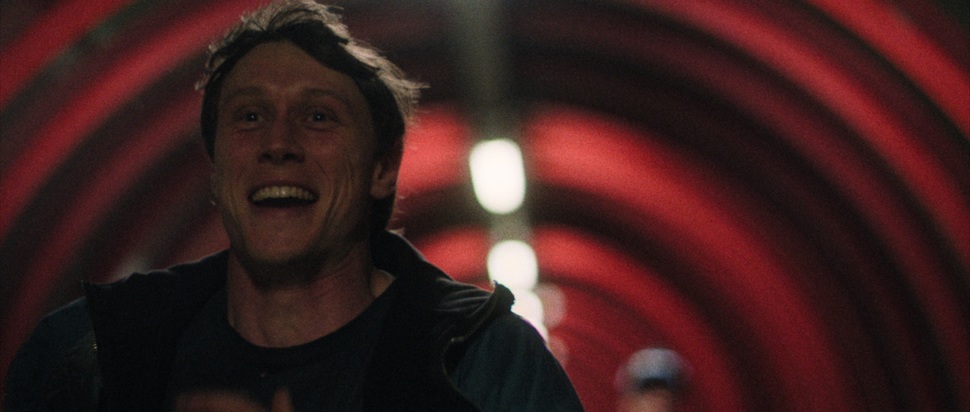
Much like skinning a moggy, there is no one way to make a movie. Paul Wright is testament to that. He’s only made a handful of fiction films since graduating from NFTS in 2007. Two shorts, Believe (2009) and Until the River Runs Red (2010), and his knockout debut feature, For Those in Peril (2013), a haunting drama about a young fisherman (George MacKay) racked by guilt after surviving a tragedy at sea. Across this slim body of work, Wright has developed a singular style that's all his own. Narrative is less of a concern than his films’ ecstatic, mosaic-like visuals, which take the form of a swirl of impressionistic images, symbols and emotions using various visual formats. “I think I always felt drawn to work that was maybe a bit more left of field,” Wright says as an understatement.
This impulse to do things differently, however, is partly why fans have had a long 13-year wait for Wright’s new narrative feature, Mission, which has its world premiere at Edinburgh International Film Festival. “Making films in general is tricky,” he admits, “and making films that aren't immediately commercially obvious is doubly difficult.”
He kept busy between projects lecturing in filmmaking at the University of West Scotland. “The teaching’s great,” he says. “You’re always learning from the students, so it keeps your finger on the pulse.” And in 2017, he made the striking found-footage documentary Arcadia. It was a commission from Hopscotch Films and the BFI to make a film from the latter's rural archive. Despite being a for-hire gig, Wright’s remixing work was deeply evocative and highly personal. The experience also helped immensely on the new film Mission. “Obviously, Mission does have narrative,” says Wright, “but [Arcadia] taught me to be braver with stripping some of that back and really leaning into the sensory powers of film: the image, sound, music, and how they can all play together.”
The starting point for Mission was a disquieting feeling the filmmaker couldn’t shake. “I imagine a lot of people have experienced this, but it was a sort of low-level anxiety,” Wright recalls. “A feeling that maybe you don't completely connect with a lot of the things in the world around you, a feeling that maybe there's a way to feel more intensely. So the film began by tapping into that feeling, rather than it being, you know, a conventional story with a lot of cause and effect and plot.”
Like For Those in Peril, it’s an existential study of a mind in crisis, and once again Wright is working with the talented George MacKay. He plays Dylan, a lonely young man who’s become numb to the world. One day, he walks out of his dead-end job as a hotel waiter and gives himself a week to push himself mentally and physically to start experiencing life. His missions include finally asking out the girl he fancies, hedonistic nights of clubbing and troubling experimentation with sex, drugs and violence.
As Wright hints at above, Mission is even more fragmented and hallucinatory than his previous work. His sound and images plunge us headfirst into Dylan’s unstable psyche. “The fragmented nature [of the film] means there’s a lot of different textures and types of visuals coming out.” As well as scenes set around Glasgow following Dylan as he attempts to start living, Wright incorporates other media – archive film, news footage and grainy VHS home movies featuring two children who we come to realise are Dylan and his sister, Claire (played as an adult by Rosy McEwen). “The idea is that all those images are in [Dylan]’s bloodstream, whether it's memory or daydream. Sound is obviously a huge part of that as well, the sound playing with the image. But the aim is that you're transported into the main character almost.”
This type of subjective filmmaking only tends to work when you have a great actor as your focus. For Those in Peril was MacKay's breakout role as an adult, and in the intervening decade, with films like Rose of Nevada, 1917 and Femme on his CV, he’s proved himself one of our most versatile and daring young actors. He clearly chimes well with Wright’s more freewheeling way of working. “All actors are different, but certainly for me, it's not about doing the same take ten times. It’s about saying, OK, we've got that shot, is there something else we could be getting here by tweaking something slightly or changing it quite radically even? In this respect, George and I work really well together. He enjoys being able to roam for a 30-minute take and seeing where it goes.”
Where Mission goes is to some intense places. Wright asks a lot of MacKay: he bathes naked in a freezing river; cakes himself in mud; at one point he has to pull off being dressed like Gene Simmons. It’s a remarkable performance. “George is an amazing actor,” says Wright, “and once that connection is made with the character, he’s fully committed. We had to hold him back a few times, if anything, because he’s absolutely fearless.” Doesn't that take a toll on your lead actor? “The amazing thing with George is that once the cut happens, he's very much back to his normal self,” says Wright. “So it's interesting: making the film was actually an enjoyable experience, even though a lot of the material is quite heavy and dark.”
Mission has its world premiere at EIFF on 15 Aug (additional screenings on 16, 17 and 18 Aug)
Filmography: Mission (2026), Arcadia (2017), For Those in Peril (2013), Until the River Runs Red (2010) and Believe (2009)