"Hope is a Privilege": Raoul Peck on Orwell 2+2=5
In Orwell 2+2=5, Raoul Peck uses the life and writing of George Orwell as the connective tissue to tell a wider history of totalitarian power and media manipulation, past and present. We find out more from this trenchant political filmmaker
There was a bit of a stooshie at the recent Berlin Film Festival when Wim Wenders, this year's jury president, suggested films should be a "counterweight" to politics. “We [filmmakers] should stay out of politics,” he said. Perhaps he should read some Orwell, who was of the mind that “the opinion that art should have nothing to do with politics is itself a political attitude”. Or, for an example of urgent, political filmmaking, Wenders should watch Orwell 2+2=5, the blistering new work from Haitian director Raoul Peck.
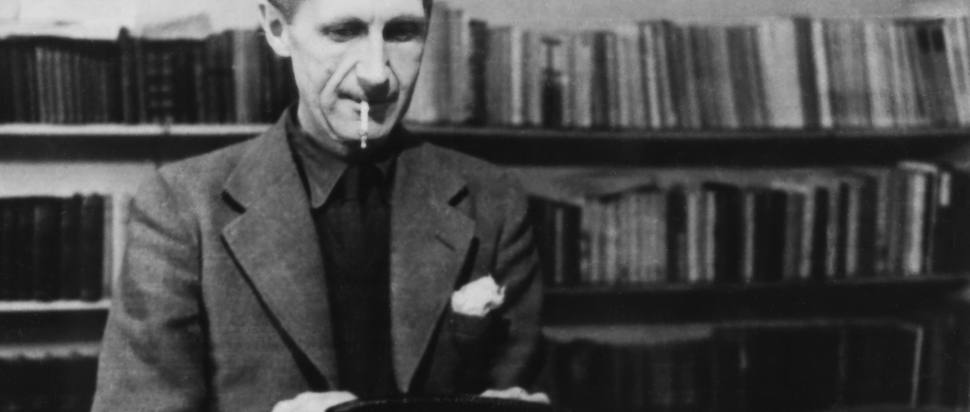
The documentary opens on the Isle of Jura in 1946, where Orwell is ill with tuberculosis and attempting to finish writing his masterpiece, Nineteen Eighty-Four. From this jumping off point, Peck creates a sprawling, mosaic-like visual essay that uses the work of Orwell to explore how his ideas have played out in world politics, weaving together the contemporary events of Gaza, Ukraine, and the rise of Trump, with other horrors of the past.
Peck covers a lot of ground in Orwell 2+2=5, digging into the archive to blend news footage, film clips (practically every version of Nineteen Eighty-Four and Animal Farm get an airing) and extracts from Orwell’s writing read by Damian Lewis. The results are dazzling, but also a little depressing, with no easy solutions to the world’s myriad traumas and conflicts. We spoke to Peck at the London Film Festival to find out more.
The Skinny: A key line in the film is Orwell stating that his starting point for writing was injustice. What's your starting point for making a film?
Raoul Peck: Well, quite similar; that's why I felt very close to Orwell. He described it in general terms, but he said the moments of history in his life have pushed him towards political art. That's what happened to me as well. I went into cinema because of my political engagement. I never dreamt of being an artist. Coming from Haiti, being an artist is a privilege. So I had no choice in the kind of filmmaker I became. I wanted to take myself seriously; I wanted to be able to go back home to my friends in Haiti and look them in the eye. I couldn't afford to play the privileged artist.
When did you first connect to Orwell’s writing?
Well, of course, like a lot of other people, I read Animal Farm and Nineteen Eighty-Four in school. But that’s obviously just one aspect of his writing. It took me a long time to discover Why I Write, and The Road to Wigan Pier, and all those different essays and books. He's not a totally different person or anything when he writes those essays, but let's say, it's more interesting and more direct to what I do today, to my political thinking.
Orwell has always been relevant, but he seems more relevant than ever just now.
Well, that's the thing: he would have been relevant anytime. I started this project four or five years ago, and while I was making the film, I was convinced that Kamala Harris was going to be president. But despite that, the film was urgent for me, because [Harris being president] wouldn't have changed anything fundamental. It would be just another US administration, and I've been fighting that world for the last 50 years. Even Obama was still representing the status quo.
So it’s clear to me that Orwell will always be correct, because the foundation of his work is to say, if you're a citizen of a country, you need to be awake. History is not something that just exists. You have to be part of it. Democracy is not something that you can just consume, or buy your ticket and it's there forever. No, people in power have always had the tendency to misuse that power. So your job as a citizen, as somebody with common decency, is to make sure that it doesn't go off track. So Orwell is always acute; he’s always current.
It’s interesting you mention past presidents, because you see people now looking back with nostalgia at people like George Bush, which I think shows how far we’ve fallen.
People forget. You know, people loved Ronald Reagan but he started most of this. Or look at Tony Blair. I mean, OK, in the UK people now criticise Blair, but at the time, he was like the young, new brat on the corner, like Clinton was. But they are also responsible for the decline of democracy, for the absurd government that we have today.
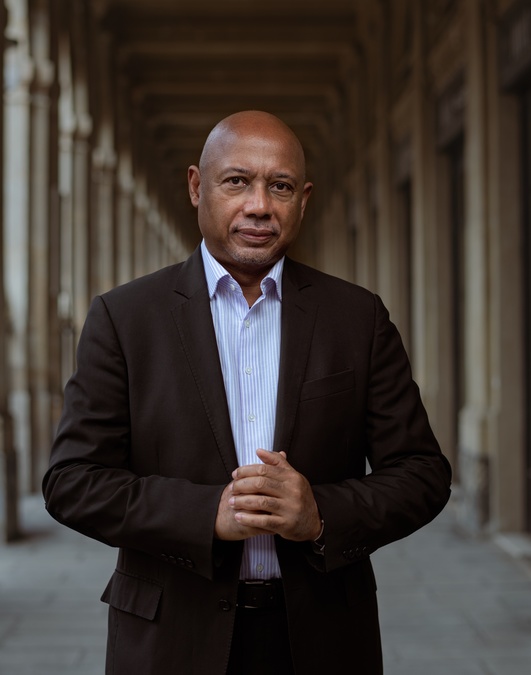
Raoul Peck. Photo: Matthes Avignone
Another key line in the film that Orwell wrote was “the very concept of objective truth is fading out of the world”, which seems to perfectly describe today, but he wrote that in the early 40s.
And what's her name, [Kellyanne] Conway, just came up with 'alternative truth', as if she got it from Orwell directly. But they have no shame in saying something like that, which, of course, is bending reality. That's why the title is two plus two equals five. They want to bend reality to the absurd. So Orwell had basically coined all those terms, and we are in the middle of it today.
All the Newspeak, you mean?
Exactly. I grew up with Newspeak, because I was coming from Haiti and hearing the US President talking about democracy while he was supporting dictatorship in my country. We never could understand, what is this doublespeak? So I grew up learning to deconstruct. I grew up learning to deconstruct Hollywood movies because something was wrong. I was seeing, you know, Indians being killed, or Vietnamese being killed, and I was thinking, ‘Oh, I look pretty much like those people. So that's what they’re doing in my country as well.’ [The US] likes to pretend to be the most democratic country on the planet, so those contradictions were always part of my life.
Can you talk about the framing of your film? We open in Scotland with Orwell trying to write Nineteen Eighty-Four. Why start there?
I know that for the magic of cinema to work, you have to make a film. It's not about making a propaganda piece or a PhD. So a film means a story, and a story needs a character. So in that sense, Orwell is the character, and I had to find, what is the story? What is the dramatic moment in his life where there is a dramatic curve?
After a while, I come up to this moment, the last years, where he's struggling to write Nineteen Eighty-Four, where we don't know if he's going to achieve it. Obviously, we know he does, but in the film, it creates a sort of suspense. Is he going to die before finishing? So when you have such a simple storyline, it allows you to go everywhere else. You can digress because you know you're going to come back to the main thread, so you don't lose your audience, even though the film asks a lot of you. So it's my way to keep you awake until the end, and it's my way also to introduce different storylines to the audience.
You certainly do that. The film unfolds at such a pace and creates a mosaic of all the conflicts that are happening around the world. It’s quite an overwhelming experience.
Because that's the state of the world, and it’s been like that for a while, but you might not know it the way the news functions. It’s like they choose a menu every day or every week or every month. A little bit of Gaza today, a little bit of Indonesia tomorrow, a little bit of China. But people like me, and a lot of people from the Global South, they live every day with those conflicts. I have friends in many of those places. I call Haiti almost every evening to know how it's going. So the film basically gathered all those moments in one place. And of course, people are overwhelmed, because suddenly it's not that they didn't know each one, but they didn't realise it's at the same time. So it's a lot to swallow.
And then it gets even more complex when you begin to layer on history.
But that’s also a hidden criticism of Eurocentrism. Because Europe, or let's say, the Western world, if we have to give it a title, has always seen itself as at the centre and everybody else is in the margins, whereas it is in fact the contrary. I wanted to show that Orwell's ideas came while he was living in a world of colonialism, because sometimes people, you can hear even today, say the excuse, ‘yeah, but, we didn't know at the time that slavery was unacceptable’. No, there were people fighting slavery in the UK, in France, in the US. It was not ‘generally accepted’. No, it wasn't. You knew what you were doing, so it's really crazy that you still hear that today, that we didn't know. You have to have the courage to recognise it.
And Orwell did in his writing. Your film shows how Orwell was a member of the British Imperial Police in Burma in the 1920s, and he knew he was doing wrong, and the shame of it led him write Burmese Days.
Can you imagine? He wrote that [Burmese Days] in, I think, '34, and it would have been the easier thing for him to just say nothing about it, because at the time that was how the British treated those colonial subjects. But he decided to denounce his own role in it, and he took it personally. It was not just about accusing the British government, it was about himself, writing about what he did personally. And of course, he criticised the system as well, but that takes courage to take responsibility.
Your film doesn’t offer any easy answers to the many struggles it lays bare. Do you see the film as a hopeful one?
That's a terminology I don't use, because it's like giving the responsibility to fate. And hope is also a privileged question. Most people have to struggle. And if you're struggling, you don't have time to reflect, 'Have I won this battle?' No, you have to survive, you have to live, you have to fight. So it's a concept that I never use – same with pessimistic or optimistic? No, history will not wait for you. Either you're part of it or you're just a victim. Orwell would always say, 'if' there is hope, he doesn't say that there is hope. He returns it to you. You have to do something. It won't happen by itself.
So rather than inspiring hope, is your film about waking people up?
I would say more modestly, I'm giving you the elements to connect the dots. Now it's your turn. Do whatever you want, but don't look me in the eye and say you didn't know.
Orwell: 2+2 = 5 has its Scottish premiere at Glasgow Film Festival on 2 Mar, and is released by Altitude on 27 Mar