Oliver Laxe on survivalist road movie Sirāt
Sirāt takes audiences on a wild, nerve-jangling journey through the Moroccan desert. Its director, Oliver Laxe, tells us that it was important that his survivalist road movie provided an existential trip as well as an intensely physical one
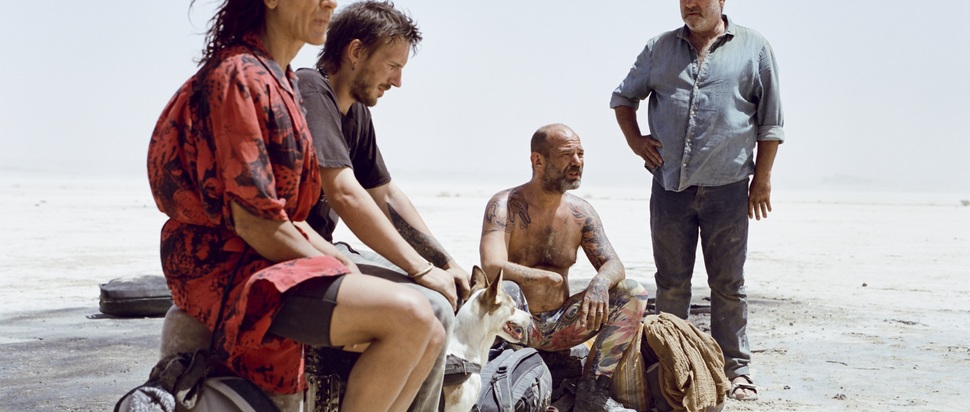
“The first step for me is always an image.” So explains French-Spanish director Oliver Laxe as we discuss his visually and sonically striking new film, Sirāt, which is fresh from receiving two nominations for this year’s Oscars. And that first image was of trucks crossing a lonely desert. “I’ve had these images since 2011, when I moved to the south of Morocco after living in Tangier since 2003 or 2004.” His new home and the party scene there also helped inform the film. “I started to go to raves and through that, developed the script,” he explains. “Dancing on dancefloors, I developed these images further. I think I also had this intention of meditating on death. It's something I learned in Morocco, you know, to be more connected with death, to experiment with death. That's what I wanted to achieve.
Sirāt is, undeniably, an impressive melding of all these elements: it's a desert-crossing road movie, a film about rave culture, and an unblinking face-off with mortality. The results reach for something almost mythic. “I'm really interested in mythology, universal archetypes, these heroic books – from all civilisations,” Laxe explains. “Here in the UK, you have the Arthurian tales, you know? The grail quest. And these mythological books have these two dimensions: you have the physical path and, at the same time, a metaphysical one. The knight is being forced by external obstacles to look inside. So, that was the idea with Sirāt, to start on a physical journey that slowly becomes more spiritual.”
The knight, in the case of Sirāt, is Luis (played by Sergi López, the only professional actor in the cast). He, along with his young son, is searching Morocco for his missing daughter. He believes she is part of the local rave culture and so falls in with a group travelling to the next festival. “I was living on a palm grove, and [a travelling rave community] came there to organise a New Year's Eve rave. I met some of these people, and that was the moment when I realised that while I had these trucks in my imagination, this imagery found a place to land right in front of me.
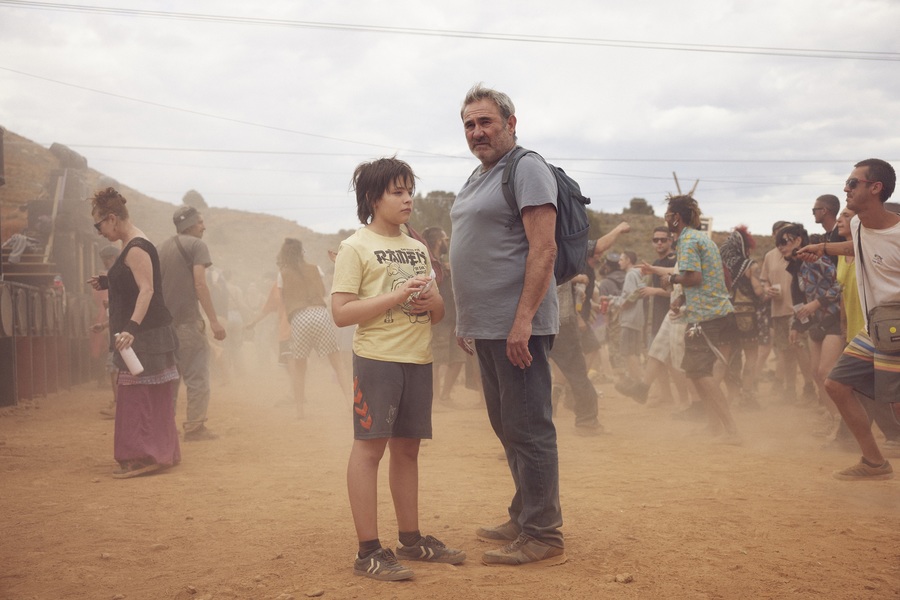
“It was perfect,” he continues. “These communities, they live in these trucks. Rave culture is not just about partying for them; it's also about travelling, it's about being disconnected from this world, in a way. So, this idea of movement, this idea of dissolving yourself, going through your limits, it was like a sort of spirituality. Rave culture is about transcending your limits. It’s kind of like a really antique ceremony that we’ve been doing as human beings for thousands and thousands of years. Ravers almost hold a memory of this ceremony, this ritual, praying with our bodies on a dancefloor. When you are on a dance floor, you connect with your wounds. It's really healthy.”
In reviews, critics have cited many films as an influence on Sirāt, from the late William Friedkin’s Sorcerer and Henri-Georges Clouzot’s The Wages of Fear to George Miller’s Mad Max films, but Laxe’s mining of this sacred understanding he describes above also evokes Trances, Ahmed El Maanouni’s 1981 documentary film about the Moroccan avant-pop band Nass El Ghiwane, not least because of Sirāt's astonishing soundtrack. A blend of both enveloping rhythmic music and a more abstract soundscape, it was created in collaboration with David Letellier, A.K.A. Kangding Ray. “I had a clear sense that at some point we had to go from techno to something more ambient,” explains Laxe. “On previous projects, I've bought the rights to existing tracks, you know, like I did with [2019 film] Fire Will Come. This time, I really wanted to work with someone and to build more unity, to build a sonic landscape with the same textures and grain [as the film].“
Working with Letellier, the aim was for the music to reach for something close to transcendence. “When you analyse sacred music, you understand that it is when music transcends melody,” Laxe explains. “We often think of sacred music as being related to classical, but I don’t agree. I think [it's closer to] electronic music. Electronic music's vibration is electromagnetic; it's like the sound of the universe. Another thing that electronic music has is that you don't know the source of the music. There is an abstraction, the same abstraction that you have on a dance floor. You are just in front of the sound. Experiencing the sound. It's transcendental.”
To that point, Laxe clarified some of his influences. While he confesses that critics have been correct, the likes of Sorcerer and The Wages of Fear were absolutely in his mind when making Sirāt, but their chief influence was in the evocation of the film's physical journey. In terms of Sirāt's existential journey, he had a whole other set of works as touchstones. “For that, we were more inspired by American cinema from the 70s that's existentialist – you know, Two-Lane Blacktop, Easy Rider, Apocalypse Now, Vanishing Point. These films were talking about a specific time. Some of them I don't even understand, but I feel them; they are organic, they are inhabited. They talk about the dreams and fears of the people from this time. That's what we wanted. Let’s see in 20 years if we can claim the same thing about Sirāt.”
Sirāt is released 27 Feb by Altitude