Hasan Hadi on The President’s Cake
Hasan Hadi’s directorial debut, The President’s Cake, sees a young girl go on an odyssey to bake Saddam Hussein a cake. Hadi explains why it was imperative that the film be shot in Iraq and his ambitions for it to encourage more filmmaking in the country
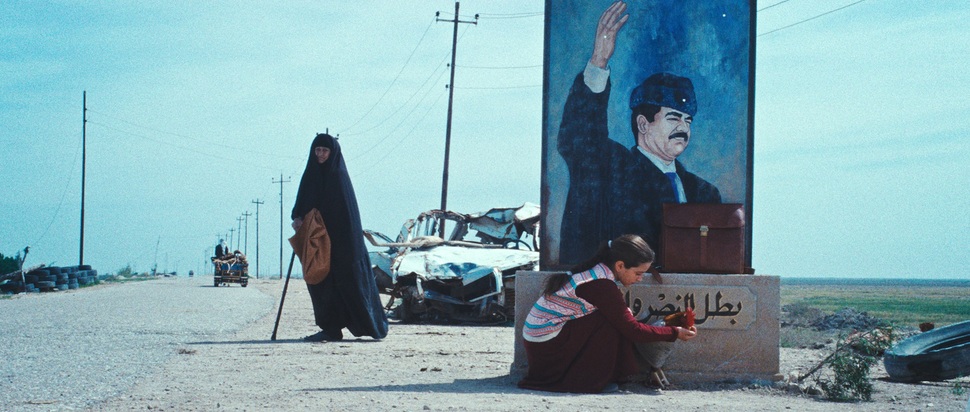
When asking early-career filmmakers about how their interest in moviemaking was first ignited, you’ll sometimes hear fond memories of sneakily watching revelatory but age-inappropriate films at the cinema as a kid. But for Hasan Hadi, the Iraqi writer-director of The President’s Cake, watching even family films was essentially off limits.
“When I was growing up, cinemas were closed in Iraq,” Hadi tells me at the London Film Festival, “even though Baghdad had actually been one of the earliest places in Arab countries to have cinemas. But because of sanctions, films, film photography, even pens were forbidden from being imported to the country because they had chemical substances that could be used in weapons. So, my love for cinema was actually born on an 18-inch TV with a VHS [player]. I had some family friends and relatives who were particularly interested in films or had connections, and they would send me to a regular house to be like, ‘Hey, can I get something. Can you bring it out?’ Smuggling of VHSs, basically.”
Despite all the restrictions, it sounds like the underground VHS network had a little bit of something for everyone. “From Japanese Godzilla to, I don't know, Baby’s Day Out, to Tarkovsky. I felt transported by all these films, though sometimes they didn't have any subtitles.”
The magic of 1994’s Baby’s Day Out may not have had a direct influence on The President’s Cake, beyond Hadi proving himself to be an excellent director of child performers. Set in the 1990s, the film sees nine-year-old Lamia (remarkable first-time actor Baneen Ahmad Nayyef) get assigned a dreaded task. It's ‘draw day’ across Iraq, when schools randomly select students to bring items to mandatory local celebrations of President Saddam Hussein's birthday. Lamia’s name is called for the most challenging task: making a birthday cake. And ingredients aren’t easy to obtain for a little girl who lives with her grandmother, Bibi (Waheed Thabet Khreibat), out in the marshes. She has no choice but to accept, going on a pilgrimage with her pet rooster and Bibi.
Refusing to bake the president’s cake could mean imprisonment or even death. But completing the task could also be a trap. “My friend had to make the cake,” Hadi tells me. “And my friend failed miserably. His fate changed completely because of that, because then he got recruited to Saddam’s child army.”
Hadi’s own fate was changed by leaving Iraq as an adult. “I grew up in a society where filmmaking was just a hobby,” he says. “My parents never allowed me to be just a filmmaker. They asked me to study something else [as a safety net], so I did for my undergrad. For my graduate studies, I applied to New York University and got a full scholarship there. When I went to New York, it was like a candy store. You see all these theatres that show just old films, and you start experiencing films from a different perspective. You just hope that you, too, can tell some stories that can move people.”
Premiering in Directors’ Fortnight at the 2025 Cannes Film Festival, The President’s Cake won both that section’s Audience Award and the Camera d’Or prize for debut features from any competition strand of the festival. The film’s journey to Cannes was helped, in part, by the prestige of Hadi’s experience with the Sundance Institute Directing and Screenwriting Labs, and the support of mentors [director] Marielle Heller and [screenwriter] Eric Roth. “We got offers to be fully financed under the condition we do not shoot the film in Iraq,” Hadi says. “But I would rather risk not shooting the film at all over shooting anywhere outside Iraq, because stories really have DNA and have rules. And sometimes, you cannot fake that.”
The film’s success at various festivals and awards ceremonies has been thrilling for Hadi, but also intimidating for what comes next: “All I hope for is that this [encourages] artists in my country to make more films. There’s no way we can make a cinematic industry in Iraq without both proper governmental support and [additional] private institution support that doesn't interfere with creative freedom. Without that, cinema in Iraq will remain as individual attempts and trials. [The Camera d’Or] actually has had an impact inside the country, sparking new conversations about how cinema [in Iraq] is actually important. I’ve had so many people come up to us and say, ‘I never knew Iraq looked like this.’ Shooting this film outside Iraq with non-Iraqi actors would have produced something that couldn’t really survive even a few months later, let alone years.”
For audiences experiencing heightened political turmoil in their own countries, the film may be resonating for its exploration of how the actions of tyrannical politicians can lead to ordinary people embracing morally dubious behaviour just to survive. “Sanctions are a very violent tool,” Hadi says. “God forbid if a rocket falls on a building, we can rebuild that building in a few years. But when you destroy the ethical fabric of a society, the spirit of the nation, it really takes a lot of time to rebuild it.”
The President's Cake is released 13 Feb by Curzon