Daniele Rugo on new Gaza documentary Life Support
Daniele Rugo's devastating documentary Life Support follows international medical professionals who are bringing out images and first-person testimonies of the humanitarian crisis unfolding in Gaza
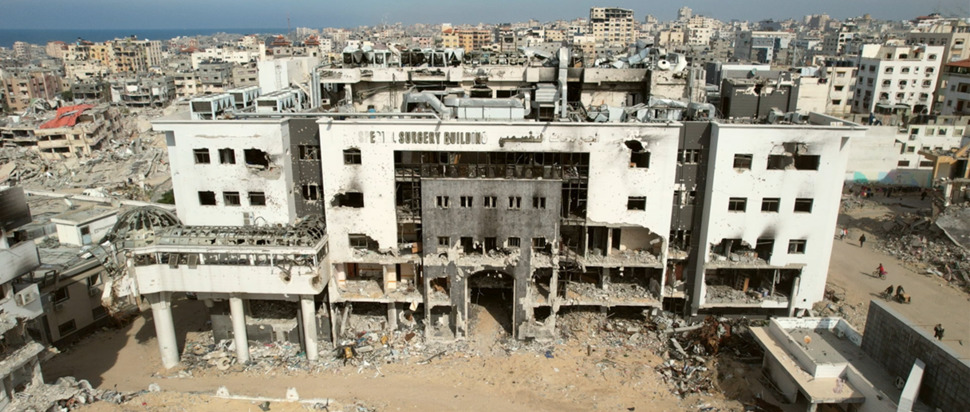
In early 2024, Italian filmmaker Daniele Rugo already knew that his next documentary would be about the sustained onslaught on Gaza by Israeli military – the International Court of Justice having already determined it plausible that Israel had committed genocide in Gaza. The exact angle Rugo would take with the eventual film, Life Support, presented itself during an encounter with producer William Parry at a screening of Rugo’s 2023 doc The Soil and the Sea, about atrocities of the Lebanese Civil War. Parry mentioned that there was a group of doctors meeting in Oxford, some of whom had been able to enter Gaza on emergency medical missions to support Palestinian healthcare workers.
“We attended one of the small gatherings,” Rugo tells me, “and Professor Nick Maynard [a leading gastrointestinal surgeon] was giving evidence to a group of colleagues after having just returned from his second trip to Gaza. I think their first mission was at al-Aqsa Hospital in Deir al-Balah, which had been hit while they were there, and he showed pictures of damage to one of the hospital’s external walls. This was key evidence. We knew this was happening because Israel has been doing this for the best part of 40 to 50 years – has done it in Lebanon, in the West Bank and so on.
“In spring 2024, it was clear that Israel was not going to allow international journalists to go in and report from the ground, and already it was very evident that Israel was going to go after Palestinian journalists speaking via various outlets to the rest of the world. But when the evidence comes from a doctor who’s there on a humanitarian mission, who’s completely independent [with] no relation to any of the groups on the ground, that hits in a different way.”
Rugo and Parry pitched their documentary on the crisis in Gaza to Maynard as one that would be told via the testimonials and personally recorded footage of international healthcare workers, and they found a keen participant. Maynard helped establish a network of other doctors willing to help. Additionally, the NGO that had sent Maynard to Gaza, Medical Aid for Palestinians (MAP), was also happy to collaborate and grant access to footage the doctors were taking. “It was already clear in MAP’s view,” Rugo says, “that [while] the doctors were [helping] clinically, really they were there to bear witness and to try, then, to relay to more sympathetic media what was going on; to counter talking points that the Israelis were communicating and the propaganda emerging.”
Some of the participants had been going to Gaza since 2009 to help and grow the healthcare system there, and many of them, particularly the junior doctors, frequently faced professional consequences for their advocacy upon returning home. “They’ve really struggled, but they’ve never stopped,” Rugo says. An issue, though, especially since late 2023, is their entry into Gaza. “The World Health Organisation supports the mission, but Israel ultimately decides who [enters] and when. It’s completely arbitrary; you don’t find out you’re not on the list until you’re in Jordan and about to board a bus, or in Egypt before they destroyed Rafah.”
The participants had already been filming their trips before coming on board, though Rugo notes that after committing, there was a noticeable increase in the detail they were capturing, including talking to Palestinian colleagues on video and getting their experiences documented. “Some started recording more of daily life outside of the hospitals, because we weren’t really getting reports of how people were living amid a forced starvation,” explains Rugo. “The famine had been denied many, many times. And then you see the material the doctors bring back, and it’s so very evident that there’s no food, absolutely no aid coming in.”
In terms of other collaborators from the West, Life Support includes Susan Sarandon, Paul Weller, Melissa Barrera and Asif Kapadia among its executive producers, while Robert Del Naja (aka 3D from Massive Attack) and Euan Dickinson are on co-scoring duties. “We worked with Habib Shehada Hanna, this wonderful Palestinian composer who composed the oud-based material,” long-time Massive Attack fan Rugo says. “I love their music and it really helps the film, but I thought we needed [additional material] because [it’s] ultimately a story of Western doctors going to Gaza. We need to bring another musical element speaking to [both] that and the ominous nature of the threat; the intensity of the violence.”
Life Support also has two credited Gazan cinematographers, Mahmoud Abou Hamda and Suleiman Hejjy, one of whom nearly lost his leg living through the famine. “They brought really stunning images out, from both before and [during] the genocide,” Rugo says. “The doctors are limited to the hospitals’ surroundings. They can’t go around as they want. [The two cinematographers] are professional image-makers who know how to frame and think of lensing differently. My goal was to have an aesthetic that would balance the urgent, first-person material of the doctors with a compositional beauty to a certain extent, which could give back some dignity to the Palestinian people – who ultimately continued to live and, as much as possible, build life amid absolute annihilation.”
Life Support is released 10 Jul by Dartmouth Films. A new album curated by Massive Attack’s Robert Del Naja will be released alongside the theatrical run, with proceeds going towards NGOs supporting Palestinian healthcare workers