Cristian Mungiu on his Palme d'Or winner Fjord
Cristian Mungiu has got critics in a tizzy. His new film, Fjord, pits secular Nordic liberals against an Evangelical Christian family from Romania and refuses to take a side. He talks to us about escaping our cultural and societal bubbles
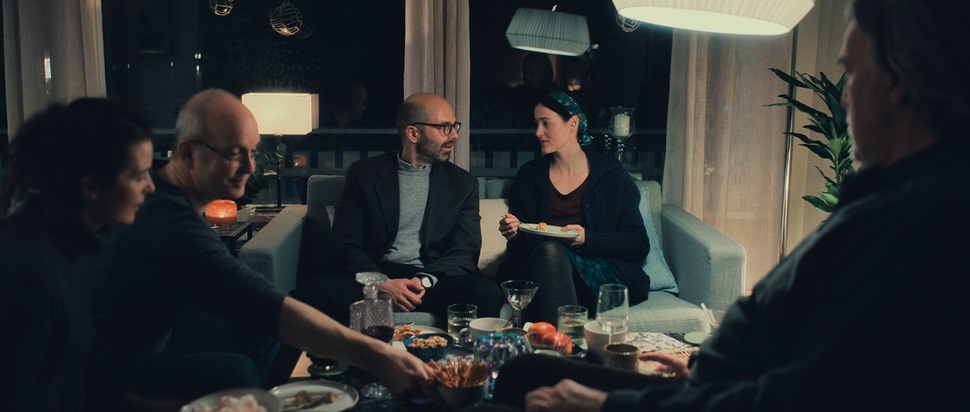
When Palme d’Or winners spark controversy, it tends to be months later, once the films are properly released and out in the world, when many more people can square the hyperbolic reception in Cannes against their own thoughts. This year's winner Fjord, by contrast, was controversial right off the bat: this tense drama, starring recent Oscar nominees Sebastian Stan and Renate Reinsve, proved incredibly polarising among festival attendees well before Park Chan-wook’s jury awarded it the top prize.
For Romanian director Cristian Mungiu, the divisive reception would seem to justify his reasons for making the movie. The now two-time Palme d’Or winner – having previously won for 4 Months, 3 Weeks and 2 Days nearly 20 years ago – wanted to get people talking with Fjord, which reimagines a real-life Norwegian court case through an intended ‘neutral’ perspective that neither fully backs the accused or the accusers, nor outright demonises them either.
“It started from a true situation very close to what you see in the film,” Mungiu tells me at the London Film Festival. “A big scandal. It wasn’t just a piece of news; it went on for years because the press were following. There were lots of protests. And for a long while, I was just watching it as I do with a lot of cases like this, just putting material aside in a folder on the computer. But I decided some seven years later to consider this for a film because I felt that through this story, I could talk about something bigger, which is this reality of the societies in which we live today, which are very polarised with very radicalised people, and with these parallel slates of values and these bubbles that don’t talk to one another.
“I identify this as one of the most important themes of today,” he continues. “This need to try to communicate with others because we’ve drifted so much apart that everybody watches their TV, their films, they talk only to people in their bubble that share their views. It’s dangerous in a way because there’s so much aggression in society, so much hatred today, that it’s good to try to get back to engaging in some sort of a dialogue while we still can, because the next step would just be very violent, as we can see in a lot of societies. So, I thought of telling the story from this neutral perspective of an observer [wishing] to talk to both these bubbles at the same time, because one of the aims of this film is to also generate this conversation.”
In Fjord, devout evangelical Christian parents Mihai (Stan) and Lisbet Gheorghiu (Reinsve) leave everything behind in Romania and move with their children (some teenage, some younger, one a baby) to a remote village in Norway, hoping to rebuild their lives. They grow close to certain neighbours, despite clear tension with some of the local populace due to their conservative views. But this fragile peace starts unravelling when one of the family’s kids arrives at school covered in bruises, prompting a teacher who also works with Child Welfare Services to raise the alarm. Mihai admits to police that he occasionally spanks the children, and acknowledges some cultural differences in his approach to raising his kids, but he and Lisbet vehemently deny having abused their children. Despite the couple's protestations, Child Welfare puts all their children in foster care – even the infant who's still being breastfed – and a criminal investigation is opened.
Crucially, Fjord is a film that withholds information. We never see the actual cause of the bruise that raises the alarm, for example. We only have people’s word to inform our own reaction.
“If [I was] judgmental with the characters, if I took one of these sides, the other side is not going to watch it,” Mungiu says of his camera's neutrality. “It was important to try being as objective as I possibly could and to present two slates of values in front of the audience. Everybody’s so convinced of having the truth, but this is why we should try to engage in conversation, because we all believe we are right. And this starts by listening to the other side and by giving up the idea that there is just one truth and it belongs to your way.”
Mungiu and Stan (who’s also Romanian) had wanted to work with each other for years, and the latter recommended Reinsve (whom he acted alongside in A Different Man) for the part of Lisbet. ‘Casting’ the very specific fjord-side location Mungiu had in mind was trickier: “My director of photography [eventually found] a couple of houses in this field on Google Street View. We were relieved because the place looked majestic. Then we entered the more difficult [task] of convincing the neighbours to let us shoot there. You knock at the door and say, ‘Hi, we wish to make a film. Could you maybe move out of your house for two or three months?’” Unlike the conversations in and surrounding Fjord, it sounds like those discussions occurred with much less friction.
Fjord is released 13 Nov by Picturehouse Entertainment