Bi Gan on Resurrection
We are living in the Bi Gan era! This hugely talented Chinese filmmaker discusses his latest work, Resurrection, a dazzling epic spanning the history of cinema
A century-spanning fantasy using largely disconnected vignettes to, in part, comment on cinema’s past and perhaps its future, Resurrection feels like the sort of maximalist, often elegiac epic made by a master filmmaker in their twilight years, throwing every theme, every visual or aural idea they’ve had brewing for decades at the screen. Nobuhiko Obayashi’s final film, Labyrinth of Cinema, is a shining example of this. For some people, that seems to be how they responded to Francis Ford Coppola’s Megalopolis. The key difference with the remarkable Resurrection is that its Chinese director, Bi Gan, is not an octogenarian filmmaker in the late stage of his career looking back – he’s currently 36 years old.
While his Jury Special Prize win at Cannes suggests he’s vindicated in having done so, what could possibly make a pesky millennial think he’s got something to say about the history of cinema so far, on such a grand canvas? Well, while Bi acknowledges that his third feature absolutely engages with the entire lifespan of moviemaking to date (intertwined with a rumination on the past 100 years of a rapidly changing China), that is more the method than the inception point. “In 2020, everything was experiencing huge changes,” he tells me. “The creative impulse of this project was to consider the meaning of existing in the new world.”
Looping back to late-career maximalist experiments from established greats, Bi’s film may share a spiritual connection to Akira Kurosawa’s Dreams, a collection of eight tales based upon the director’s own recurring dreams. In Resurrection, the opening section places us in a society where people have stopped dreaming in an effort to extend their lifespan. Those who continue with the outlawed activity have become shrivelled, monstrous creatures known as deliriants. When one such dreamer (Jackson Yee) is caught by an agent (Shu Qi) hunting him, the captor takes pity, allowing the weakened deliriant to dream one final time as he dies. The agent watched the dreams via the aid of a magical film projector that presents the dreams like movies on a screen.
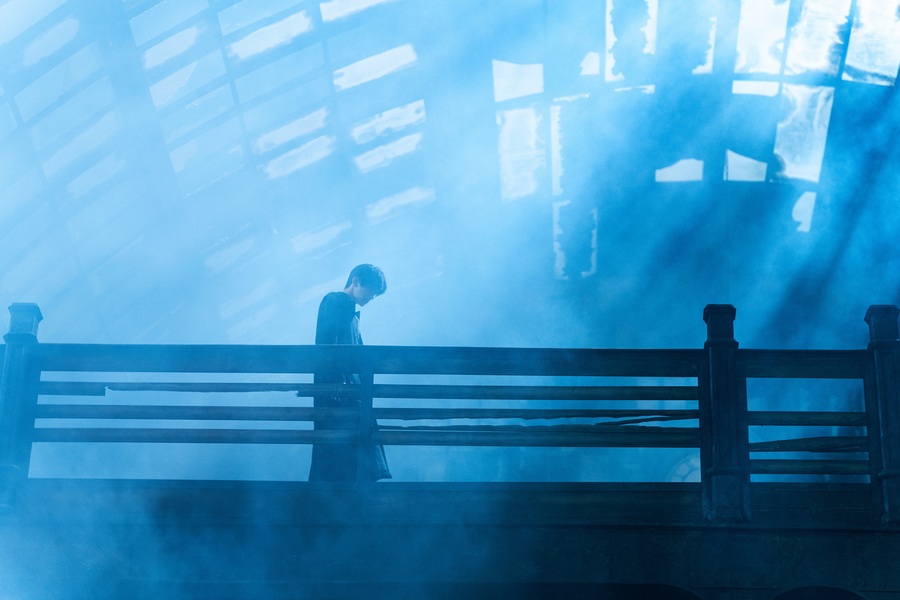
Jackson Yee in Resurrection.
From there, actor Yee – minus his monster make-up – plays the protagonists of several short stories set across the 20th century, each aesthetically influenced by wildly different periods of filmmaking (e.g. the heyday of film noir) and loosely revolving around the five human senses; changing up aspect ratios, visual resolution and performance styles each time. Even the opening bookend section is itself a movie pastiche, the world of deliriants and their pursuers presented as a silent cinema wonderland with shaky cardboard sets and choppy frame rates.
“The similarity between dreams and films is that they are fragmented,” Bi tells me. “And their logic is hidden under all of this fragmented storytelling. Also, they are the opposite of technology. Unlike technology, which has a very clear trajectory or pathway of expression, films and dreams are sometimes drifty and vague. I think watching a film is like dreaming. We can watch someone's dream, watch a film, and we can also share that dream, share a film.”
Although Resurrection is an anthology film in a sense, its stories are ordered linearly in terms of time, starting with an alternate version of the 1910s/20s and concluding – minus the closing bookend – with a tale set on New Year’s Eve, 1999. “We mainly drew inspiration from silent films instead of drawing from Shu Qi’s past films,” Bi says of directing the Taiwanese superstar for the first section. “We had [her] watch a lot of materials and documentaries related to silent films. She could see how those actors make their facial expressions and present their bodies. But the key was not for her to imitate them, but to understand why they have such dramatic facial expressions. We wanted to make Shu Qi’s movements more like a dance.” There’s also a dance-like quality to the millennium eve sequence, which sees Yee playing a hoodlum entranced by an enigmatic gangster’s moll (Li Gengxi), who might be a vampire. The camera is as much a dancer in this section, though, pulling off moves as astounding as those of the onscreen actors.
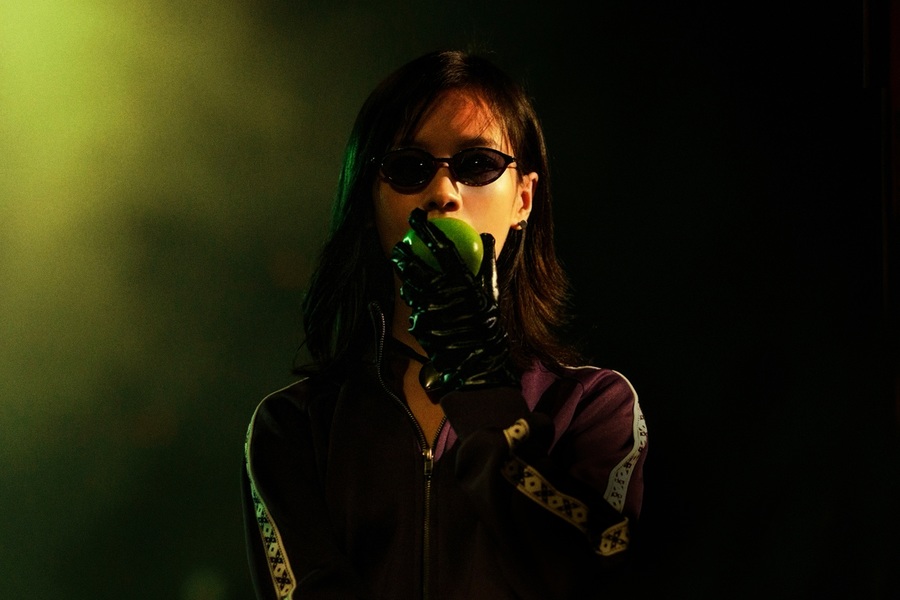
Li Gengxi in Resurrection.
Ambitious, extended, unbroken tracking shots that cover lots of ground have been a signature of Bi’s cinema ever since his debut feature Kaili Blues. His skill at long takes reaches new heights in the extraordinary back half of his second film, Long Day’s Journey Into Night, with a shot that's a nearly hour-long, hallucinatory oner – in 3D! – where time and space collapses. Resurrection’s big unbroken set-piece is a bit shorter (30-ish minutes), but no less impressive for how it condenses hours of time without cutting away. Rather than a showy gimmick, the technique is a necessary tool for translating the temporal language of dreams to the screen.
“The biggest challenge was that we had to work from 2am into the daytime,” Bi says of the stunning scene, which apparently took three tries to nail. “The difficulty of the long take is about how to balance this youth story through a heavy technique. I would call a long take a heavy technique because it's strenuous, but the story itself is light. It’s romantic, it’s about the chemistry between two young characters. This is what makes [the balance] challenging.”
Resurrection is released 13 Mar by Trinity CineAsia