Ben Wheatley on micro-budget sci-fi BULK
Ben Wheatley went from big-budget Hollywood behemoth Meg 2: The Trench to his new film BULK, a micro-budget wonder that he's taking on tour across the UK. This protean filmmaker discusses the freedom he finds in making sci-fi on a shoestring
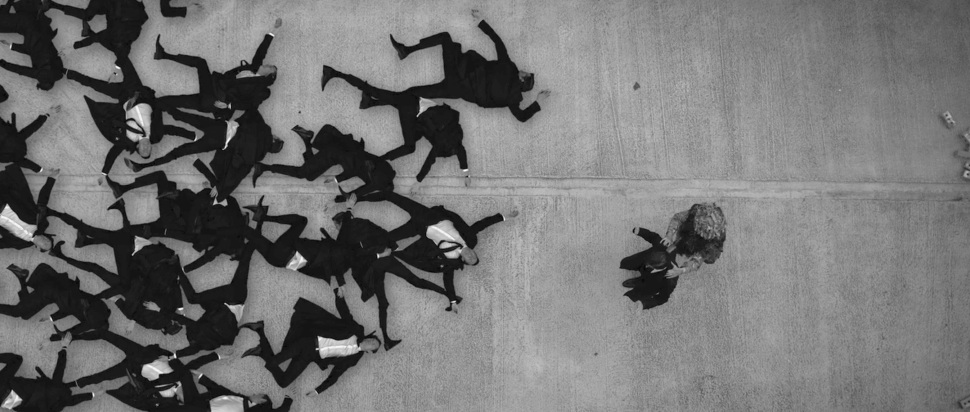
Ben Wheatley is one of today’s hardest-to-pigeonhole filmmakers. He returns to the world of micro-budget B-movies with his new movie BULK, a time-and-space-hopping caper centred on a quest to find an eccentric inventor and stop his string theory experiments before the world changes beyond any normalcy. As wild as the plot is the film's release strategy: Wheatley is taking BULK on a 15-day, 20-stop Q&A circuit across the UK (including stops in Edinburgh, Glasgow, and Dundee – Wheatley’s first time in the latter city, which he’s particularly excited for).
BULK came about thanks to a four-month gap in filming schedules; what better opportunity to shoot a movie inspired by his recent work in comics and graphic novels, as well as what he loves about science fiction? “I missed the elasticity, boldness, and madness of sci-fi,” Wheatley says, taking cues from the Quatermass series and Eraserhead in BULK’s tactile models and single-room settings. It's not his first overt citation to low-budget cult cinema: he made 2021's In the Earth on the budget and schedule of Halloween. “The world of the B-movie, of scientists gone mad, is a very interesting place. As a filmmaker, it was exciting,” he says, noting that many now-classic films are “not that expensive or complicated.”
BULK’s retro aspects, including unsynced sound recorded in post-production, contrast thrillingly with its futuristic subject matter. The clarity and artificiality of post-recorded sound is something Wheatley wanted to do for a long time, inspired by French New Wave films and Studio Ghibli animations. “Every sound is purposeful,” he says; “the worlds feel empty but specific.” Other influences include Alphaville (just post-New Wave), Blade Runner (though this calls back to Alphaville: “all these movies are interconnected,” he notes), and 1970s Doctor Who.
Wheatley finds directing low-budget indies and big-budget blockbusters (his most recent cinema release is the giant shark sequel Meg 2: The Trench) similar in practice but not intent. “On the floor, they’re essentially the same,” he says. “But with a bigger budget, you’re talking to a broader audience and have to be conscious of that. Meg 2 had to play in San Francisco, Paris, and Hanoi, making for a very different kind of filmmaking.” Budget is a double-edged sword, wielded to suit circumstances. “It is an incredible privilege, but if you make something that doesn't play, you've wasted that money,” he notes. “You might not get to work again, and possibly the people around you don't either. With something smaller like BULK, you can be more niche and take more chances, but you’re talking to a much smaller audience that already likes a certain kind of sci-fi. If you talked to a tiny audience with a tentpole budget, you’d be in real trouble.”
Making fanzines, preparing the BULK tour (prioritising indie and grassroots exhibitors), and the still-breaking news of a Warner Bros acquisition clarify some of Wheatley’s thoughts on the stories he tells and how he tells them. “There's a real awakening in the UK of people setting up cinema clubs, defining their own taste, and refusing to be told what they get to see,” he says, excited to see community exhibitors popping up across the UK, boosting films that might not break into the mainstream. He recalls attending a screening of his trippy psychological horror A Field in England at Manchester’s Cultplex and a young audience member saying she goes every week “because they show mad shit” – a curatorial and viewing attitude he finds “brilliant” in its openness and curiosity. He cites the films of Bergman, Kurosawa, Jodorowsky and Lynch as having created this appetite for the weird, and his fondness for the tradition of “midnight movies” is evident in BULK.
“BULK is light on its feet,” he says. “It doesn't have a massive budget. There isn't the pressure to get the money back. It's not a disaster if it has a modest showing.” To that end, he plans to keep touring, taking the film to audiences rather than waiting for them to discover it on streaming. Indeed, BULK will remain a roadshow, cinema-only event for the foreseeable future.
While calling back to cult classics, BULK relishes undercutting narrative clichés, including when the protagonist discovers his story is no Campbellian hero’s journey but rather a bildungsroman about a “naïve dunce.” Wheatley stresses the importance of telling stories you love – if only for yourself. “I write all the time,” he says. “If I like a character from a comic, I won’t get the rights, but I’ll write a spec script so I can read and enjoy it.” He recently found a home for a script written 20 years ago – not a plan, but an opportunity formed by following his interests. Then, “test your taste against the world’s taste,” he says, “because it might be different, divergent, and difficult.” It is all part of the art, science and business of filmmaking. “When you get an audience, it’s incredible," he says. “But if you’re making stuff, if you like it and feel it hasn’t been compromised, that's okay. Writing it, reading it back, and enjoying it is a success.”
Ben Wheatley takes BULK on a tour of UK cinemas, from 15 Jan to 1 Feb. He comes to Scotland with a matinee Q&A screening at Edinburgh Filmhouse, followed by an evening Q&A show at GFT, on 18 Jan, and a Q&A screening at DCA on 19 Jan. For the full tour dates, head to rookfilms.co.uk/pages/bulk-narrative-tour