Bassam Tariq on Your Mother Your Mother Your Mother
Mogul Mowgli director Bassam Tariq is back with Your Mother Your Mother Your Mother, which is both a heartfelt family drama and a kickass hitman movie. Tariq discusses the film alongside two of its actors, John Cho and talented newcomer Adia
Assassins in cinema are no strangers to unusual choices of weapons. John Wick alone has killed people with horses, books and pencils. But fairly early on in Your Mother Your Mother Your Mother, writer-director Bassam Tariq (Mogul Mowgli) presents an inspired, improvised combination that might not normally occur to a screenwriter or action choreographer actively trying to plan something cool.
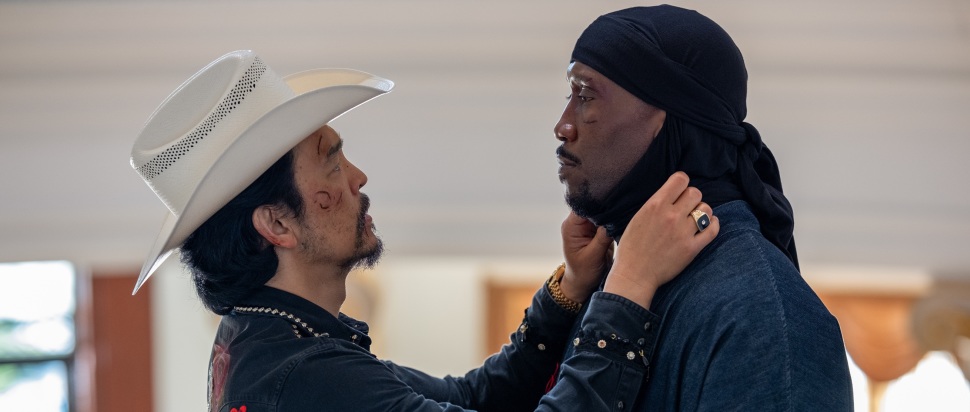
Latif (Mahershala Ali), a devoutly religious Muslim hitman for hire, is in a private room of a strip club that’s being converted into a church by violent Christian extremist pastor Hwan Yoon (John Cho), with whom he’s engaged in a tense negotiation. Latif's obstacle to getting out of the place isn’t an inability to take down Hwan in one-on-one combat then and there: it’s that his baby daughter is also with him for complicated reasons we’ll not spoil here. As the conversation reaches boiling point, Latif assesses what he’s got near him to temporarily stall his opponent and his heavies. In the room: glass that can be smashed. In his diaper bag: petroleum jelly he can apply to his hands. Mix the two and you’ve got yourself an exit strategy. To paraphrase David Bowie, Latif is putting out this fire with Vaseline.
“I think it was Tony Gilroy [the creative mind behind the Bourne films and Star Wars spinoff Andor] who said that the best way to build an action scene is to go put your characters in a room and then figure out what’s exciting in the room,” Tariq tells me at the London Film Festival. “That was something I tried to keep in mind. This is a resourceful man, so how can we have some fun here? And how do we give him some kind of a weapon that feels exciting as well, while also still connected to him being a dad? I didn’t want to ever lose that element of him being a father in those moments.”
Set in Houston, Texas, Your Mother Your Mother Your Mother follows the recently widowed Latif as he struggles to hold his family together, which includes teenage daughter Fatiha (magnetic newcomer Adia), cheeky younger boy Qadir (Jahleel Kamara), and the aforementioned infant Aziza (Brooklyn and Jaxon Hughes), who’d been getting breastfed before and is seemingly allergic to baby formula. Alongside struggling to navigate convoluted welfare systems for consistent breast milk support, Latif, who has so far kept the real nature of his work a secret from his children, also has complications with his usual hirer, Mike (Laith Nakli).
Latif received the phone call about his wife’s death during a job, and that led to a sloppier clean-up than usual and subsequent media attention for the killing. Despite grieving his own loss, Latif is pushed towards aiding in the elimination of Pastor Hwan, who, with his small army of followers, is threatening the life of Mike’s nephew Hatty (Abubakr Ali), who runs an ostensibly legal porn business out of a Houston mansion. Hwan wants to take him down because he believes Hatty is trafficking women.

Mahershala Ali in Your Mother Your Mother Your Mother, courtesy of Amazon MGM Studios
Your Mother Your Mother Your Mother is a remarkable showcase for Mahershala Ali as both dramatic actor and action star, though it’s also notable for allowing the ever-reliable John Cho – no stranger to action scenes thanks to Star Trek and the short-lived Cowboy Bebop remake – to get a proper meaty part as an intriguing and chilling primary antagonist for really the first time. Hwan’s origin story as a believer stems from his unlikely survival in life-threatening circumstances during military combat. Brandishing a cowboy hat and a full set of gold grillz on his teeth, Hwan’s outlandish look could so easily have led him to become a cartoonish cult leader in both the wrong actor and wrong writer’s hands.
“I’m so happy you feel he’s not a cartoon because I don’t think he’s a cartoon,” Tariq tells me. “The first big question that John asked me at the beginning was, ‘Is this guy a charlatan?’ No, this dude really, truly believes. He was saved by a miracle and now he’s not just going to have survivor’s guilt; he’s going to do something about it, and I think that’s where a lot of the complexity comes in. But the reason why I also wanted him to be a religious person was because I wanted the element of grace to play through the film. And the only one that would believe that what happens in the [final act] is miraculous is someone that would’ve experienced a miracle themselves.”
“I was nervous about the introduction to Pastor Hwan in the strip club [turned] church,” Cho tells me. “Sounds absurd as I say it, but it was going to be with an actor that I really admire. I thought the scene was going to be tough because we’re both lying. Both characters are lying to one another and yet there has to be a real moment of clarity between them. Everything’s on the table for someone like [Hwan] to accomplish his divine mission. Everything’s a tool.”
That first dialogue-based confrontation between Hwan and Latif directly precedes the teased setpiece involving the contents of a diaper bag. For the action scenes in general, Ali and Cho apparently did about 80 percent of their own stunts, while Tariq’s influences for the staging and filming of them leaned towards Japanese cinema rather than anything American. “This film called The Twilight Samurai has only two action scenes in it and the fight scenes are quite small,” says Tariq of one of his touchstones.
“The last one’s incredibly well blocked, the way they use this old house and how he doesn’t want to kill this guy. And the first fight scene is literally just one move of him jumping up and then standing. He almost stands on the sword, and he knocks [his opponent] out, and then he falls back down. It’s all done in this beautiful wide shot that is this slow dolly move in and it’s excellent. You wonder how they did that. There are no close-ups. That’s how I wanted to do our action. And Harakiri, of course, has phenomenal action scenes and we tried to base our final fight scene off of that.”
Although Atlanta was used to double for Houston, both Tariq and the film's co-star Adia give high praise to cinematographer Katelin Arizmendi, costume designer Deirdra Govan and production designer Akin McKenzie for their work in creating a tactile version of the latter city that you can almost taste and smell, and that the actors could believe in. “You get the sense of that hot, humid vibe just by watching the film,” Adia says. “[Katelin]’s incredible with her camerawork.”
“Houston immigrant communities, man, there’s a lot of colour,” Tariq says of the sets in particular, one highlight of which is the porn mansion full of vibrant pinks and purples. “I think there’s a lot of plastic-y type colours in immigrant communities and I wanted that kind of kitschiness in it, too; kind of a high and low.” Cho, a former Houston resident himself, is also complimentary of the production’s often eye-popping realisation of the place. “It brought me back, for sure,” he says. “Houston is like if Atlanta and Los Angeles had a baby; the brightness of it and the arid light, then combined with the moistness of the air. But there’s a cultural fabric there, too. It’s a church town. There was a lot that felt familiar.”
In addition to the film being an extraordinary showcase as her first movie role, Adia also had an interesting story going on during production: she was simultaneously taking a course to become a doula. Considering that she has so many scenes where her teenage character is caring for both a younger sibling and an actual baby, she reckons her busy schedule informed the role in beneficial ways. “Even working with the babies, because we had twins on set that were playing Aziza, just being able to handle them and knowing that I felt confident to hold them, I think that was really helpful,” she tells me.
“[As] I was in my training, what was lending itself to the filming process was the fact that there is so much that goes into parenthood,” Adia continues. “I was learning a lot about parenthood in my studies and in filming, and just how multifaceted one must be to be a parent. And you don’t really know it because you’re learning as you go, especially as a new parent.” Hopefully the film’s lesson of how to improvise a weapon from a diaper bag won’t carry over to real life, though.
Your Mother Your Mother Your Mother is released 20 Nov by Amazon MGM Studios