Kelburn Garden Party 2026: The Report
This year's Kelburn Garden Party may have been plagued by rain, but the festival's spirit of caring and sharing well and truly prevailed
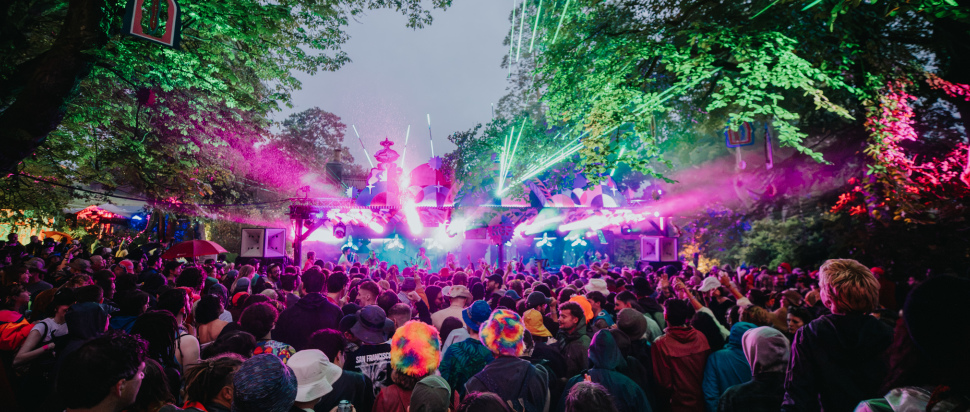
Water always wins. The rain – vast, hard, fuzzy, slow, but always unrelenting – hammered home this lesson to attendees of the 2026 Kelburn Garden Party, even the most prepared of campers reduced to shivering paupers sleeping in puddles by the festival’s end. It breaches every barrier, soaking our tents and merging our clothes into a sodden film clung to our backs. By the end, everything – even the stages – seems to have dissolved into one communal mush.
Kelburn is not so much a festival as a state of grace draped over a 3,500 acre estate. With its kaleidoscopic crowd and its overwhelming spirit of caring and sharing, it seems to exist in a world where May ‘68 was never compromised, the pavement ripped up to reveal the beach underneath. Located on a vast estate not unlike a small national park – complete with castle, settlement, gleann and beinn – the site itself, and the potentials it holds, is the main draw.
With the physical space saturated by water, clothing and dancing both become decidedly practical. There’s an easy communality felt underneath the trees; groups of anorak-less strangers huddling together, preserving one another from the rain beneath a shroud of music. As a guiding principle, there’s an unspoken yet total conviction in the good faith of everyone around you. Points of difference between revellers seem to melt away in their interactions – your joy is my joy, and mine yours.
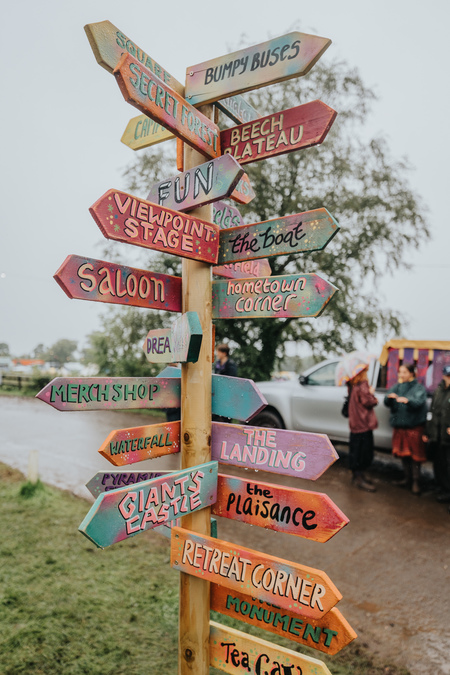
Part of this is because Kelburn seems a locus of a new, contemporary Scottishness, one that’s not symbolised by words like “dreich” and “dour”; not rooted in a masculinised, grey, urban identity and a tendency to pull the heads off sunflowers. The festival juxtaposes urban and natural environments, bound together by a Celtic-queer sensibility. Consciously historical-geographic aesthetics (Celtic runes, writing, symbolism and music; wicca-adjacent ornamentation) are synthesised with the modern visual and sonic language of “the club”, creating a world that neither quite belongs to.
This creates a surreal third space, the site for a hybridised Scottishness that, in reconnecting present with past and urban with rural, destabilises the monolithic Scotland these concepts individually represent. These hallucinatory place-narratives bleed into a shared discontinuity – a new Celtic eclectism taking its lead as much from 1982, Janine as the Kailyard. Tales of selkies filtered through nights at Ponyboy; Hugh MacDiarmid dancing to SOPHIE with a thistle between his teeth – you get the idea. The past ceases to be one big, endlessly renarrated defeat; the only certainty is the uncertainty of tomorrow.
Inevitably, there are missteps in which this process doesn’t produce the right alchemy – The Landing Stage doesn't land, its eerie industrial cornucopia jarring in the otherwise primordial-seeming environment, like a spaceship cratering a field – but broadly, it works. Valtos, whose glittering Celtronica lights up a packed Square Stage on Sunday night, are maybe the most direct reflection of this aesthetic sensibility within the music itself.
Whether these new possibilities can persist outwith Kelburn’s leaf-cushioned environs remains to be seen (although Pieute deserve flowers for their efforts), but encountering their enactment is striking. On Sunday evening, we cut loose from the sludge under the stretched awning at The Beech Plateau – a leathery oasis of wood, mud, mist and house that peers over The Neverending Glen – and hang a right to the Boat on the Hill, where Femme 45 are playing a Lust for Life remix. The heavy sky breaks into a grin above Arran, rendering the crowd more clearly: fairies and gnomes and freaks and hippies and squares and punks; dolls and bams, psychonauts and old skool ravers; acid casualties fresh from their nine-to-five graves, hugging the soundsystem, smiles cut so deep in their face that the rain cannot wash them away.
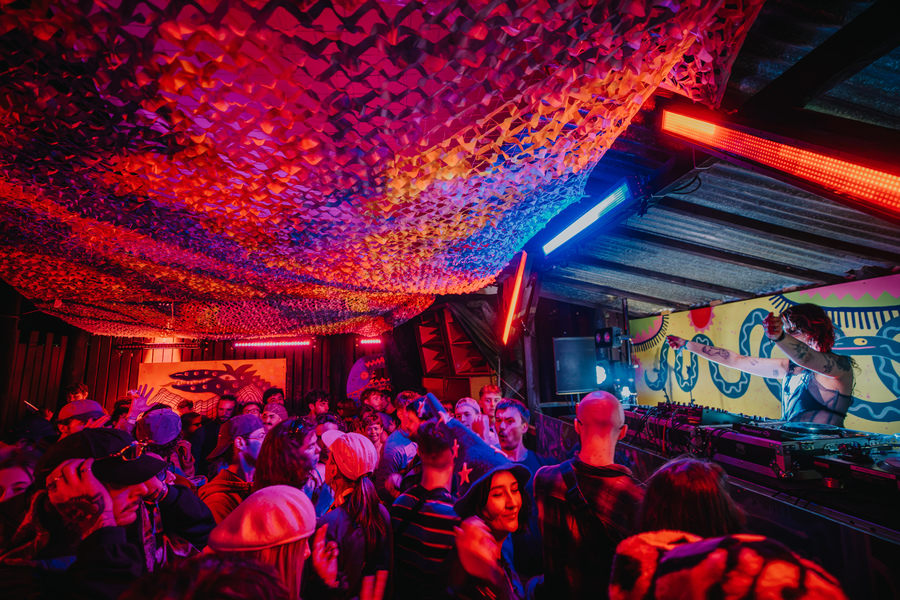
The Saloon is a similar (if tamer) affair, parents and kids dancing with club rats done up for fairie pool-Berghain under a canopy of iridescent blossom chains. Unfortunately, I quite regularly lose track of time here, and the acts I want to see, I invariably miss (Isa Gordon, Lacuna, Paranoid London, SOAPBOX, Athens of the North, Kai Reesu, Leon Vynehall – sorry!).
The artists I do see, I’m immediately taken with: at The Pyramid Stage, Rubie’s mercurial transmutations of funk to electro to rock‘n’roll and back to funk and beyond has me in awe, her excursions into the crowd deftly destabilising the performance/audience boundary. Mairi Sutherland’s folk prog is softly evocative and endlessly inventive – her refusal to settle into anything approaching a stately chord progression dynamises the crowd, which swells over the course of her set. At The Viewpoint Stage on Sunday afternoon, Ari Tsugi construct blistering jazz, establishing melodies before fracturing and reforming them through the different perspectives of the players. The whole band beam throughout as the love from the crowd grows with every progression. The looks on their faces, swapping between bashfulness and exuberant disbelief in their shared glances, is the best thing I see all weekend.
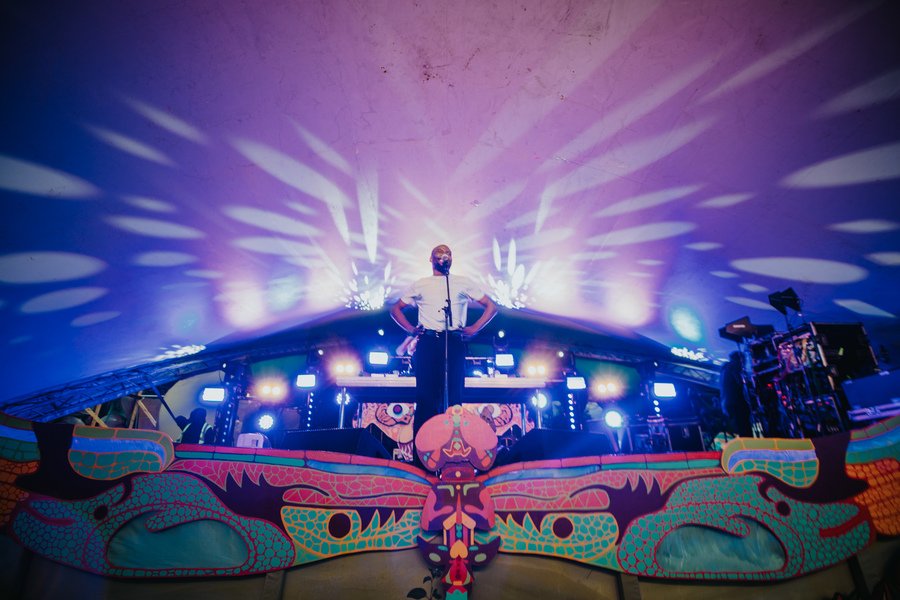
The night before, Joshua Idehen's show is like watching a radical minister deliver variations on Underworld’s Two Months Off from the pulpit. His sermonic charisma enamours The Square Stage. While our focus wavers throughout the middle of his set, he snaps us to attention with Mum Does the Washing, as he adroitly spins a thread of vignettes of the ideological underpinnings of approaches to your mum doing the washing ('Liberalism: You watch your mum do the washing. And feel really, really bad… Surrealism: The washing does your mum'). Confident in our newfound understanding of Hegelian Dialectics, he finishes his set by imploring us to love and enjoy ourselves and each other. Gazing out at a sea of smile-flecked ponchos and anoraks, he paraphrases a meme from the early internet of an interview with a gurning Russian clubber: “There is so much pain and suffering in the world – but not at this festival.”
Kelburn Garden Party 2027 takes place from 1-5 Jul at Kelburn Estate, near Largs
Photos by ReCompose