Alaa Shehada on his new Fringe show The Bridge
Alaa Shehada of the Palestine Comedy Club follows the award-winning The Horse of Jenin with a new Fringe show on the Allenby Bridge, Palestine's only land crossing
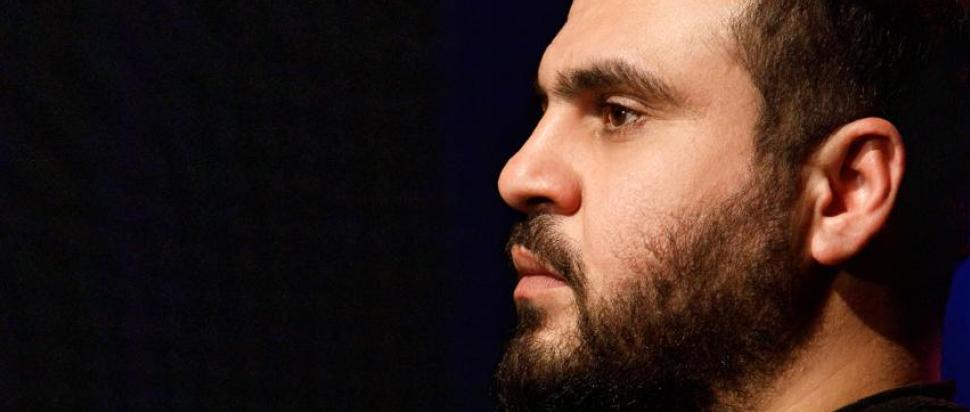
If you are Palestinian and living in the West Bank, there is only one way to leave your country by land. This is the Allenby Bridge – named, appropriately, after British imperial general Edmund Allenby who led widespread campaigns throughout the region in the early 20th century – also known more familiarly as الجسر, or the bridge. It spans the border between Jordan on one side and Palestine on the other, crossing the Jordan River close to the city of أريحا, or Jericho. It is Palestine’s only land crossing, manned on one side by Jordanian authorities, and on the other by Israel’s security forces. Palestinians queue, often for hours or days, to move between the two.
The Allenby Bridge is many things – a bureaucratic nightmare, a distillation of border violence, an encapsulation of the suffocation of the decades-long occupation. More recently, however, it is also the subject of Palestinian comedian Alaa Shehada’s latest show The Bridge, which explores the history of the crossing through his unique blend of storytelling, comedy and clowning. Shehada is no stranger to telling stories of the occupation through comedy: his previous show The Horse of Jenin showed at the Fringe last year to both hilarity and acclaim. With The Bridge, Shehada exposes the absurdity at the heart of the journey through an account of a journey he makes from Jenin to his aunt’s house in Amman.
“It’s always been in my head, how rich this story is,” Shehada says. “It’s thousands of details, it’s suffering, it’s three checkpoints with three different mentalities and identities and behaviours.” Shehada drew from his own experience, having crossed the bridge “more than 100 times,” as well as testimonies from other Palestinians, whose different stories speak to both the multiplicity and collectivity of experience under the occupation. “I go to visit family in Jordan, or to take an airplane to Europe for my shows,” he explains. “But some people go to have operations in Jordan. Some people visit their families, or go to America, or go to Turkey. I talked to taxi drivers who receive all these people, who take these people from their house to the bridge.”
There is a particular power, Shehada believes, in telling such fraught stories with laughter. Co-founder of the Palestine Comedy Club, a collective dedicated to nurturing and platforming stand-up comedy in Palestine and bringing it to the wider world, Shehada has long been dedicated to drawing out the warmth and humour that is inherent to Palestinian culture, and that is largely erased within traumatic media coverage. “It's part of who we are,” Shehada stresses. “When I [was] home just two weeks ago, the amount of jokes that my aunts and my uncles and my mother tell, how much they make fun of each other, how much they make fun out of nothing…” He pauses. “It challenges the stereotypes about Palestine because the image you have in your head is black and white. And comedy draws new colours for you.”
The story of the Allenby Bridge, as with the story of the Horse of Jenin – a sculpture created from rubble left behind after the Second Intifada and destroyed by the IDF in October 2023 – is heavy with legacies of violence, but it is in the collective space of theatre and comedy that this weight can be, if not lightened, then carried in a different way. There is a politics of togetherness that comedy can extend, Shehada suggests, that speaks to the broader issues around his plays. “It brings us closer together as humans,” Shehada explains. “We feel the same thing when we laugh. If I meet you for the first time and we laugh, it is a totally different connection. We accept each other differently.” And while Fringe audiences are distinctly more reserved than Palestinian audiences (“back home, people's reactions are way out there. They express, they laugh, they comment, they stop your show,” Shehada laughs. “They don't fucking care.”) there is still a power in that moment of unified laughter and emotion that expands our ability to understand and empathise.
For Shehada, part of this journey of cross-cultural empathy is understanding the different dimensions of the occupation: both the violence that is experienced, and the hope that sits on the other side of it and pushes back. In the case of the Allenby Bridge, this hope is encapsulated in the idea of a Palestinian airport that would allow direct and independent travel outside of the country. “The idea of having an airport, it feels very dreamy,” Shehada explains. “How it will look, who will run it, who will the pilots be. The people commenting on the planes, pretending that they know everything about planes when they know nothing.” It is a vision that is – perhaps – far away, yet still achingly familiar. It is in this space that Shehada believes that hope thrives.
“In every story of the hard reality in Palestine, there is hope to live and move on," he says. "Wake up the next morning, go to school, get married, go to university. People fight hard after their dreams. Here, the hope is to kill this idea of suffering around the bridge.”
The Bridge, Assembly Roxy (Upstairs), 6-16 Aug, 7.40pm
The Horse of Jenin, Pleasance Courtyard (Beyond), 18-30 Aug, 1.15pm