Human Connections: Christiane Jatahy and Lucas Paraizo on A Trial
Brazilian writers Christiane Jatahy and Lucas Paraizo introduce their latest play, A Trial, presenting a new point of friction for each audience, every night
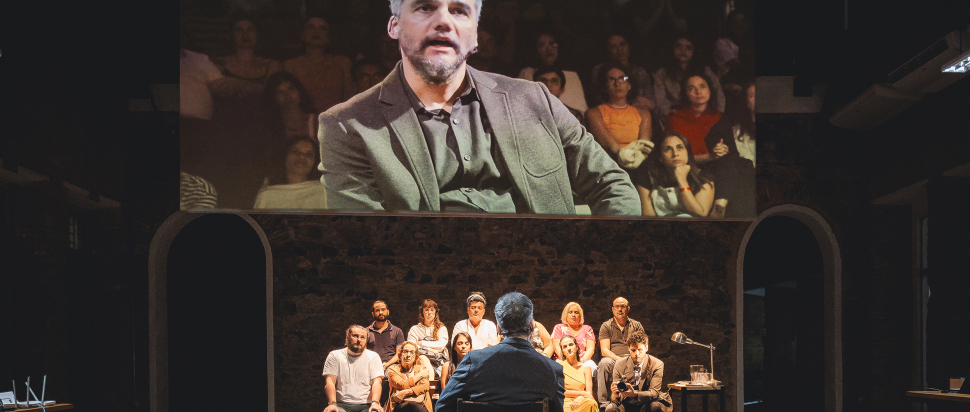
There is magic in the making of A Trial – after an Enemy of the People. Written by Christiane Jatahy, Lucas Paraizo and Golden Globe winner Wagner Moura, the play is an answer to Henrik Ibsen's seminal 1882 text An Enemy of the People, and has toured the stages of Amsterdam and Avignon. It premieres in the UK at Edinburgh’s Royal Lyceum Theatre this August – a highly anticipated item in the Edinburgh International Festival programme.
“Sometimes,” Paraizo says, “[this] magic happens when you understand somebody, when you understand the value that they want to transmit with the play, the friction we are trying to [make].” It is clear in speaking with them that Jatahy and Paraizo understand one another’s values and sensibilities, which creates a strong structural starting point for inviting the friction that shifts each individual performance. Each time, the theatre randomly selects a new jury from the audience to dictate the fate of the play’s protagonist, Thomas Stockmann (played by Moura), after he attempts to expose a water pollution scandal in his hometown. Without spoilering anything, the writers are thrilled with the results.
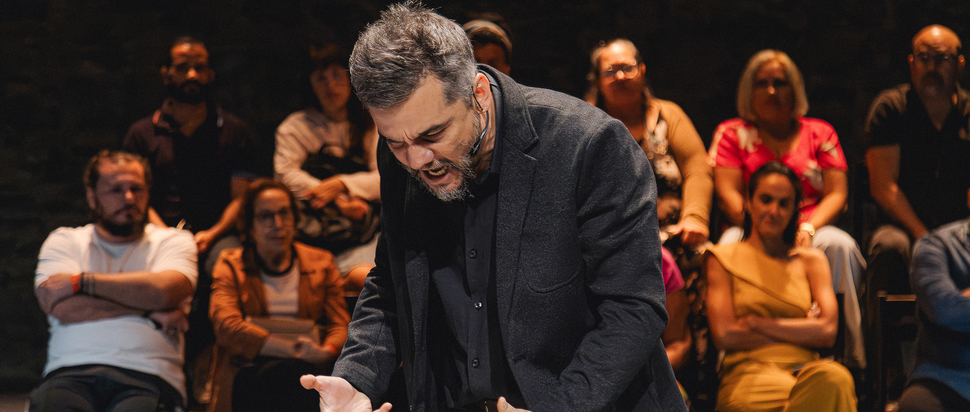
Wagner Moura in A Trial. Photo: Caio Lírio
To allow each performance to be its own kind, the play’s structure accommodates what Jatahy calls a “web of relationships” that occurs onstage and acts as a lifebuoy for actors: “They can grab [it] and create a circle that is strong to kep these emotions, this reality, this present moment... [products] not only in the mind of the actors, but [from] real connections that happen onstage,” she says.
The play’s mise en scene is emotional, Paraizo says, allowing people’s “impressions, fights and discussions” to manifest in real-time. While the fear exists that participants might insert their values into the play, Jatahy is not particularly worried about this. Both writers are optimistic about releasing control; Jatahy says she relinquishes her title as artist to “discover the piece through the eyes of the people inside of the play and the text.” This abdication is central to her work, her research, and what both writers call the “language” she has crafted for 25 years. The play's structure allows her, Jatahy explains, to “provoke accidents and surprises… lose control and find balance.”
Creating a solid text and a tight structure is, along with Ibsen’s play, the base of the production. This, Paraizo observes, allows the same writing to resonsate across changing audience and countries. But changing audiences and countries are not the only constant of the play: Paraizo notices that Jatahy herself “always has something to think about and improve". For Jatahy, the meeting between a random jury and such deliberate writing produces something in her akin to floating, as she motions her hands in such a way during our conversation.
There is an evident respect between the writers. Their portfolios span decades and connect intimately at points. The harmony is palpable, and Jatahy emphasises the dialogue between them as “more about listening [than speaking]”. If there is conflict, it is not to advocate for their respective ideas, but to advance their interest in a shared idea. Such respect between the writers translates into the play’s prioritisation of intimacy between unprepared audience members and actors. “We can write about big social political things,” Jatahy says, “but we never lose the human things, the families, the relationships – the most intimate relationships.” Paraizo echoes this, acknowledging that “the politics are a subtext, a very important subtext, but the relationships are the first layer of the stories.” To access the political, one must penetrate that first layer, which is, he adds, “the human being; that is our start, our beginning, our materia prima.”
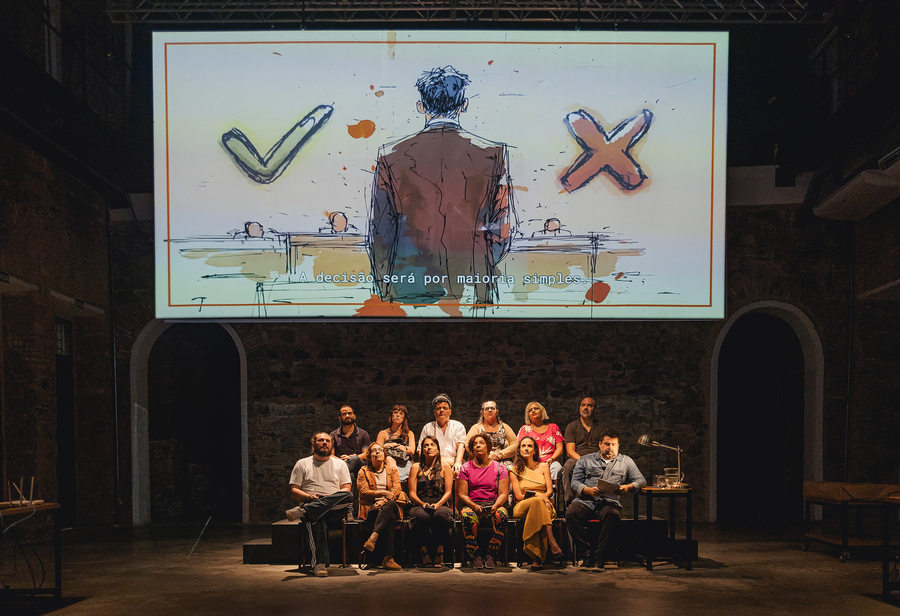
The audience jury in A Trial. Photo: Caio Lírio
Seeing as pollution and combustion – literal and political – surround the world’s core, A Trial seems to suggest that it is the unpredictability of human nature we must embrace to expand our ideas of what we are capable of. This play does not appear on stage to provide any utopian answers. On the contrary, Paraizo figures that the idea of utopia inspires questions. As both Jatahy and Paraizo believe, utopia is unknowable, but it is, as Jatahy puts it, “the place that we can invent [and] imagine to stay together in.” Utopia moves through Jatahy’s work, and while it is something Paraizo is hestitant to admit knowing, he says the idea “makes [him] wake up every day and look for it: a goal, a sense of provocation – and maybe without the answer, we can make questions.”
The political is subtextual, and the play is fully human. A Trial promises not only to be interactive, but provocative – and anyone in Edinburgh could be one of those provocateurs at The Lyceum this August.
A Trial – after An Enemy of the People, Royal Lyceum Theatre, 7-10 Aug, 7.30pm (2pm on 8th)